dailynewsnblog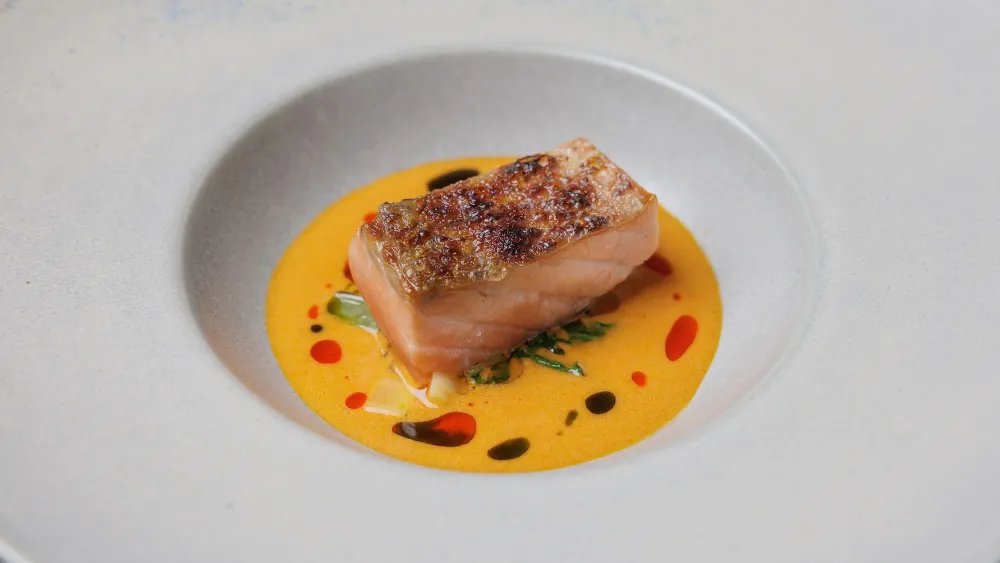
Chef Jungsik Yim, whose TriBeCa restaurant Jungsik remains the only three-Michelin starred Korean restaurant in America, is broadening his purview. Yim has debuted Muje, a new restaurant that follows Jungsik’s playbook with a culinary palette that ventures beyond the “New Korean” fine-dining cuisine he helped establish in New York over a decade ago.
”Jungsik is more expensive; it’s hard to get a table there. So I wanted to create a restaurant that’s more approachable,” says Yim. “So people can enjoy something as high quality as Jungsik, but with a more affordable cost.”

Inside the Muje dining room.
Alexander Stein
Muje is located at 151 W 30th Street, just south of Herald Square and located between Chelsea and Koreatown. The restaurant takes the place of Sea, a casual Southeast Asian a la carte restaurant that Yim opened in 2024 and which closed its doors earlier this spring to make way for the new concept.
“We realized, ‘Look, why don’t we lean into what we’re actually good at?’” says Yim. “I’m Korean, but our head chef here is Chinese, and we have a lot of other Asian chefs on the crew. So we figured, ‘Let’s broaden our scope and go with Asian cuisine.’”
Muje in Korean means “untitled” or “undefined,” a nod to the restaurant’s central philosophy of drawing inspiration from different Asian cuisines across the continent. The menu is defined as Asian food without boundaries, and brings Yim back to the earliest days of Jungsik. The pioneering chef, who graduated from the Culinary Institute of America and went on to cook for renowned restaurants across New York, Spain and France, opened the first location in Seoul in 2009, before expanding to New York in 2011.
“Around that time, I fell in love with Asian cuisines outside of Korea. So I used to make those dishes a lot as staff meals,” says Yim, adding that experience inspired him to open Sea over a decade later.
While Jungsik focuses on Korean cuisine with contemporary influences, Muje’s approach will be rooted in the more expansive perimeter of Asian cuisine.
“Even in Korea, we have Korean Chinese food, just like how you have American Chinese food here. We have Korean Japanese food,” says Yim. “Fusion Asian, traditional Japanese or traditional Chinese — all of those broader ranges is something that we’re gonna bring into Muje. In that sense, it is open-ended.”
Like Jungsik, Muje’s menu is structured as a tasting one, at a more approachable price point (starting at $150) with fewer courses (eight) than its sister restaurant downtown.

Kongguksu, a classic Korean soybean noodle dish, with perilla oil.
Alexander Stein
Courses include Kong-guksu, a popular cold soybean noodle soup dish, served warm with pollock roe and cured egg yolk — an example of a Korean dish that Yim has tweaked to match his own taste palette; short rib served in four wraps that each represents a different Asian culinary tradition, and salmon grilled over binchotan charcoal with razor clams and red curry. Dessert courses include pineapple sorbet with lime granita and an interpretation of Merlion, a coconut Singaporean dish. The kitchen will be led by executive chef Daeik Kim, who comes over from Jungsik.
Inspiration for the food menu stays within Asia, but the beverage program takes a global approach, with wines from prominent European regions. Cocktails will bring the focus back to Asian ingredients and flavors, with options like Midnight in Samui, a pea-infused rum cocktail.

Midnight in Samui cocktail.
Alexander Stein
The Muje dining room features 48 seats, with an additional six at the bar and 12 lounge seats, which will serve the tasting menu and à la carte options. The room design, led by Two Point Zero, is anchored in an earthy, neutral color palette with red oak and walnut millwork and raffia paper pendant lighting to create a warm, calm atmosphere.
”When I’m thinking about the space and the design of the interior, I always think it’s best to go minimal and simple,” says Yim of the space’s organic aesthetic. “That’s how you actually focus on and enjoy the food more.”
Although Muje is an opportunity for culinary exploration in the kitchen, guest enjoyment is where Yim casts his attention.
“Whether it’s Jungsik or Muje, when it comes to the philosophy of food, it’s just about making it delicious,” he adds.