dailynewsnblog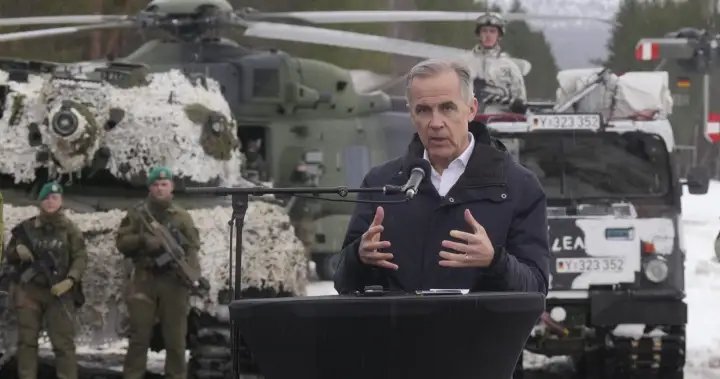
Prime Minister Mark Carney is scheduled to leave for Ankara on Monday to attend the annual NATO summit — the first visit by a Canadian prime minister to Turkey since 2015.

Turkey’s capital will make up the first leg of Carney’s week-long sojourn to the Middle East, which will conclude with a short stay in Saudi Arabia aimed at deepening trade and investment ties.
The July 7 and 8 NATO summit has been reduced in scale from the typical annual alliance gathering. What used to be two full days of meetings is now down to a dinner and one session where representatives of all member states will huddle.
Kerry Buck, Canada’s former ambassador to NATO, said this year’s gathering has been described as a “short, sweet summit to try avoid any drama,” given U.S. President Donald Trump’s propensity for disruption and insulting allies.
“This year’s meeting is, once again, primarily about managing the U.S. and keeping President Trump committed to the alliance,” she said.
“Because he likes, almost, autocrats better than allies, the fact that it’s being hosted by Turkey is not a bad thing. He’s got less of an incentive to explode the thing.”
President of the European Commission Ursula von der Leyen, front left to right, Prime Minister Mark Carney, Secretary General of NATO Mark Rutte and President of Ukraine Volodymyr Zelenskyy talk prior to a meeting on the situation in Ukraine during the 8th European Political Community Summit in Yerevan, Armenia, on Monday, May 4, 2026.
Sean Kilpatrick/The Canadian Press
This NATO summit is taking place shortly after the recent G7 summit in France, which went smoothly. Allies will hope for the same this week as they discuss their ambitions for higher military spending.
NATO Secretary-General Mark Rutte has said member states must present “credible” plans to meet the new alliance commitment of spending five per cent of national GDP on defence by 2035.
Canadian government officials told reporters in a background briefing on Friday that Carney will take part in a discussion on financing the defence sector and talk up Canada’s progress on boosting defence spending at the summit.
Carney’s schedule of bilateral meetings had yet to be finalized, the officials said.

Get breaking National news
Get breaking Canada news delivered to your inbox as it happens so you won’t miss a trending story.
The first part of Carney’s trip will also shine a spotlight on Canada’s ties with the host country, a NATO ally.
Hakan Fidan, Turkey’s Minister of Foreign Affairs, speaks during a joint press conference with Anita Anand, Minister of Foreign Affairs at Global Affairs Canada in Ottawa, on Friday, June 26, 2026. THE CANADIAN PRESS/Chris Tanouye.
Chris Tanouye/The Canadian Press
Turkish Foreign Minister Hakan Fidan has echoed the Canadian government’s argument that Europe should complement the military alliance without duplicating the work of NATO.
Chris Kilford, a former senior Canadian military attaché in Turkey, said Ottawa can work on securing trade benefits from Turkey but progress could stall over geopolitical issues.
“There are many things that can test this relationship. But for now, we seem to be on a very positive track, and I think it’s to the benefit of both countries,” he said.
Kilford, who leads the Victoria branch of the Canadian International Council, said Canada and Turkey are both trying to diversify their trading partnerships to prevent supply chain shocks.
Turkey, for example, recently expressed interest in Canadian nuclear technology to reduce its dependence on nuclear projects involving Russia.
The Carney government has set out four pillars of its relationship with Turkey: energy exports, economic opportunities and trade, defence and security, and people-to-people ties.
Global Affairs Canada views Turkey as an emerging market of broad interest to Canada, with opportunities for Canadian companies in agriculture, life sciences, mining and infrastructure.
Turkey has helped Ottawa evacuate Canadians from various Middle East crises and bring home activists detained by Israel for joining flotillas that sought to bring aid to Palestinians in Gaza.
Canada and Turkey have had a tricky relationship in recent years, particularly over matters concerning Canada’s large Armenian diaspora.
Canada has long held that Turkey committed a genocide against Armenians a century ago, a claim that Ankara has repeatedly denied.
Ottawa also suspended arms sales to Turkey seven years ago over reports Turkey was diverting Canadian military components to Azerbaijan for use against Armenia and ethnic Armenians. Canada tightened those rules two years later, before dropping them.
Kilford said that resulted in Turkey’s “very lucrative” arms industry being cut off from Ontario-made surveillance and targeting sensors that had been installed in Turkish-made Bayraktar drones.
Instead, countries like Ukraine started buying the Canadian sensors and installing them in the Turkish drones.
Turkey has criticized Canada for granting asylum to many Turkish political dissidents — an uncommon move for countries that are military allies.
“As far as Turkey is concerned, though, we’re granting political asylum to terrorists. They don’t like it,” Kilford said, calling the country a flawed democracy.
Turkey has cancelled multiple LGBTQ+ events and the Committee to Protect Journalists says Turkey is among the top jailers of journalists.
Kilford said the vast majority of Turkish media outlets are “either directly or indirectly owned by the government or government supporters.”
Ahead of the summit, Turkey has erected “miles and miles of barricades” across Ankara, Kilford said, which allows motorcades to cross the city with ease and makes street protests more difficult.
FILE – Turkey’s President Recep Tayyip Erdogan listens as Somalia’s President Hassan Sheikh Mohamud speaks during a joint news conference in Istanbul, Turkey, on Dec. 30, 2025.
Khalil Harma/AP Photo
The country is currently gripped by high inflation, he said. Turkish President Recep Tayyip Erdogan has intervened in the country’s central bank, while many of his opponents have been jailed.
Kilford describes Turkey as an increasingly important state since it has maintained relative stability in a region experiencing great upheaval — from Russia’s invasion of Ukraine, the collapse of Syria’s dictatorship and the war Washington launched against Iran.
The country is touched by many major conflicts and by migration from Afghanistan and Syria.
Turkish Airlines, which Canada recently allowed to operate more flights, flies to hotspots most carriers won’t or can’t service, such as Kabul, Caracas and Mogadishu.
But Kilford said the Turkish government has long felt pushed to the periphery of geopolitical alliances like NATO and the European Union — which it has been trying to join for years.