dailynewsnblog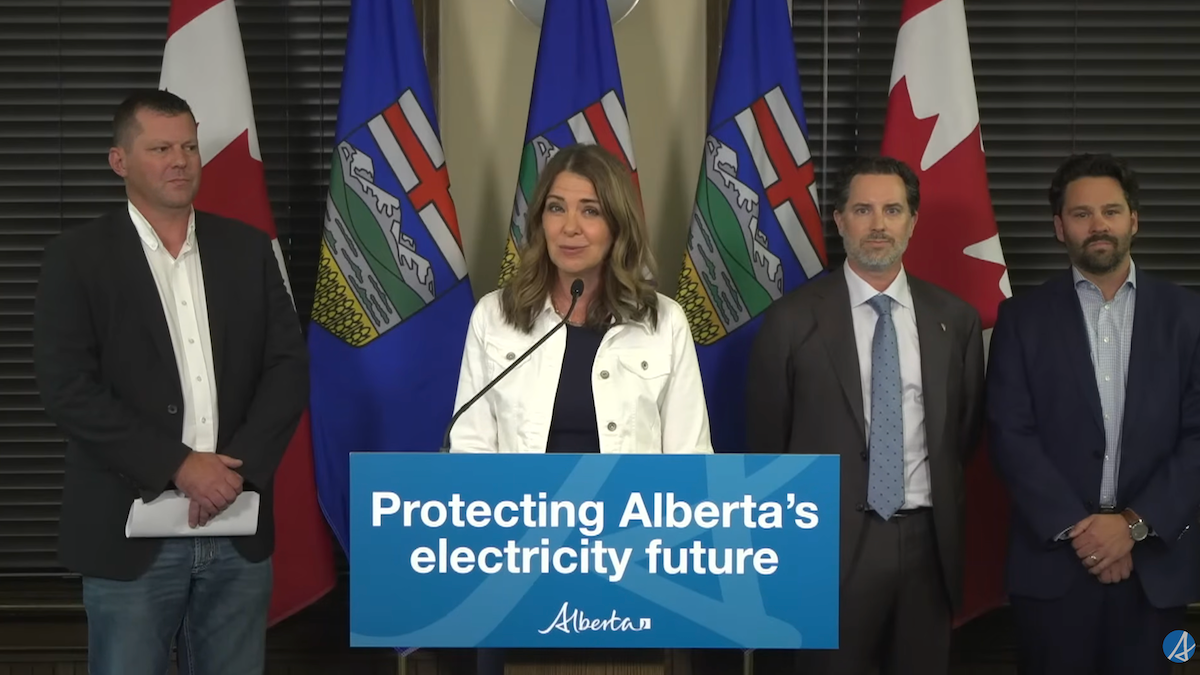
Alberta’s premier claims it’ll probably reduce electricity costs; don’t count on that, though, says the Pembina Institute
But what about that other Alberta Government announcement on Thursday?

Thursday afternoon at 3:30, Alberta Premier Danielle Smith and Utilities Minister RJ Sigurdson climbed up on a stage in Calgary with a couple of corporate bosses to announce something called “the Greenlight Electricity Centre” in Sturgeon County.
Say what? Ah, it’s just a wee 932-megawatt natural-gas-powered electricity plant up there just northeast of Edmonton in what really is called the region’s “industrial heartland,” the speakers explained.
It’ll be used to power one of those AI data centres, but don’t worry about that, all the residential houses are more than a kilometre away, Ms. Smith breezily told a reporter.
And, eventually, the three corporate partners in this project – Pembina Pipeline Corp., Kineticor Asset Management LP, and Morgan Stanley Infrastructure Partners Inc. – might expand the power plant to 1,800 megawatts …
At the risk of being a party pooper – or not, depending on how you view these things, dear readers – I will note that according to Google’s now ubiquitous AI research helper, which itself must run on considerable amounts of power from somewhere, 1,000 megawatts “is massive; running continuously, it is generally enough to supply electricity to between 700,000 and 1,000,000 typical homes depending on regional climate and energy use.”

Now, before we go on, we should note that it’s not clear why the news conference was held at all six and a half hours after Ms. Smith and Prime Minister Mark Carney had expected to be on stage together announcing their plan to build another diluted bitumen pipeline mostly along the route of the Trans Mountain Pipeline from the town of Bruderheim near Edmonton to the Roberts Bank Superport on the Salish Sea.
As we all know, the PM’s arrival was delayed by hours. Perhaps the Greenlight announcement was supposed to be the second news conference that day. Or maybe someone decided the delay was an opportunity to hold a quick newser on what is in fact a very significant development at a time reporters’ minds were focused on the bigger announcement to come, which had been rescheduled from 9 a.m. to 6 p.m. that night.
Like the premier and Mr. Sigurdson, Pembina Pipeline President Scott Burrows and Kineticor CEO Andrew Plaunt were on standby for the prime minister’s arrival that evening anyway.
The government’s 250-word news release showed signs of having been hastily cobbled together. No canned quotes composed for any of these guys. Pembina Pipeline’s release had more detail of the sort written with potential investors in mind. It even had some nice quotes, including one for Premier Smith.
“Investments like this will lead to thousands of jobs, significant economic growth, and hundreds of millions in provincial revenue that can be reinvested to support the services that matter most to Albertans,” she said in Pembina Pipeline’s release.

The cost of the project, it was revealed Thursday, will be a whopping $4.6 billion. This will produce about 30 “long-term skilled positions.” So that’s about $153 million per permanent job, I reckon, which if nothing else may tell us something about how efficient the petroleum industry has become at eliminating human work. Regardless, though, the government news release promised there will be about 1,000 construction jobs, so that’s something.
Water use? Nothing at all was said about water use in either news release or the news conference, although we know that water use like electricity demand is a major concern about AI data centres in other jurisdictions. Just because it’s been raining a lot in Alberta for the past month doesn’t mean it always will be.
The premier did boast that her government’s “Bring Your Own Power” model for AI data centres “is designed to protect the reliability and affordability of electricity that Albertans depend on.”
“By having data centres bring their own generation and pay for related power infrastructure, this framework ensures that projects like this one will actually reduce transmission costs on Alberta’s utility bills,” she insisted. This may be true, but living five minutes or so away from Sturgeon County myself, I’d feel better if I could see that claim crunched by an impartial expert.

Speaking of experts, a statement written by Pembina Institute Electricity Director David Pickup Thursday predicted that higher electricity prices are exactly what is likely to happen because of this and other natural-gas projects. The Pembina Institute, no relation to Pembina Pipeline, is an energy and environmental policy think tank based in Calgary.
“Adding a new power plant of this size – generating enough electricity to power a city two-thirds the size of Calgary – will massively increase demand for gas in the province,” Mr. Pickup wrote in his response to the announcement.
“This, combined with Prime Minister Carney’s announcement today that Canada intends to ‘triple’ LNG exports over the next decade, will expose Albertans to much more intense market competition for the gas they rely on heavily to heat their homes and power their grid,” he continued. “This likely means household electricity costs for Albertans will keep rising in the years ahead.”
Mr. Pickup argued such projects should instead have in part relied on cheaper renewable alternatives, such as wind, solar and battery storage – all of which, unfortunately, are illogically anathema to Ms. Smith and the UCP Government.
“We know from examples around the world that when countries begin to export more gas abroad, they see prices spike for consumers at home,” Mr. Pickup said. “Albertans, will be very exposed.”
He concluded: “Alberta urgently needs to return to a true free electricity market — where renewables are not suppressed, and demand for gas is not artificially enhanced. Until this happens, Albertans will continue to pay the price in their energy bills.”
Experience shows that data centres wherever they crop up tend to be rolled out in the same manner, said Saskatchewan-based researcher Simon Enoch of the Canadian Centre for Policy Alternatives at a recent presentation on data centres.
This often includes an implication by political leaders there is no alternative to AI data centres and financing details for the facilities that are cloaked in corporate confidentiality, sometimes enforced with non-disclosure agreements on local governments, Mr. Enoch said. Often such projects are fast tracked by local and regional governments that frequently cut corners to overcome opposition, he added.
Typical concerns raised by residents wherever AI data centres have been proposed include their impact on local electricity rates, water use, relentless noise at every hour of the day and night, hidden government subsidies, lack of environmental assessments, their impact on taxes, and the impact on the local economies.
The day after Mr. Enoch’s presentation in Regina, Manitoba Premier Wab Kinew announced that his province was pulling the plug on a large natural-gas-powered data centre proposed by a pair of companies from the U.S. and British Columbia on 141 hectares of farmland south of Winnipeg.
“We’ve taken a look at this project. We’ve taken a look at AI more broadly,” Mr. Kinew told the CBC on June 4. “These hyperscale data centres don’t appear to be in the best interests of Manitobans. So we’re going to say no to this data centre.”
“I reject the idea that we have to be slaves to surveillance capitalism in order to participate in the modern economy,” he said.