dailynewsnblog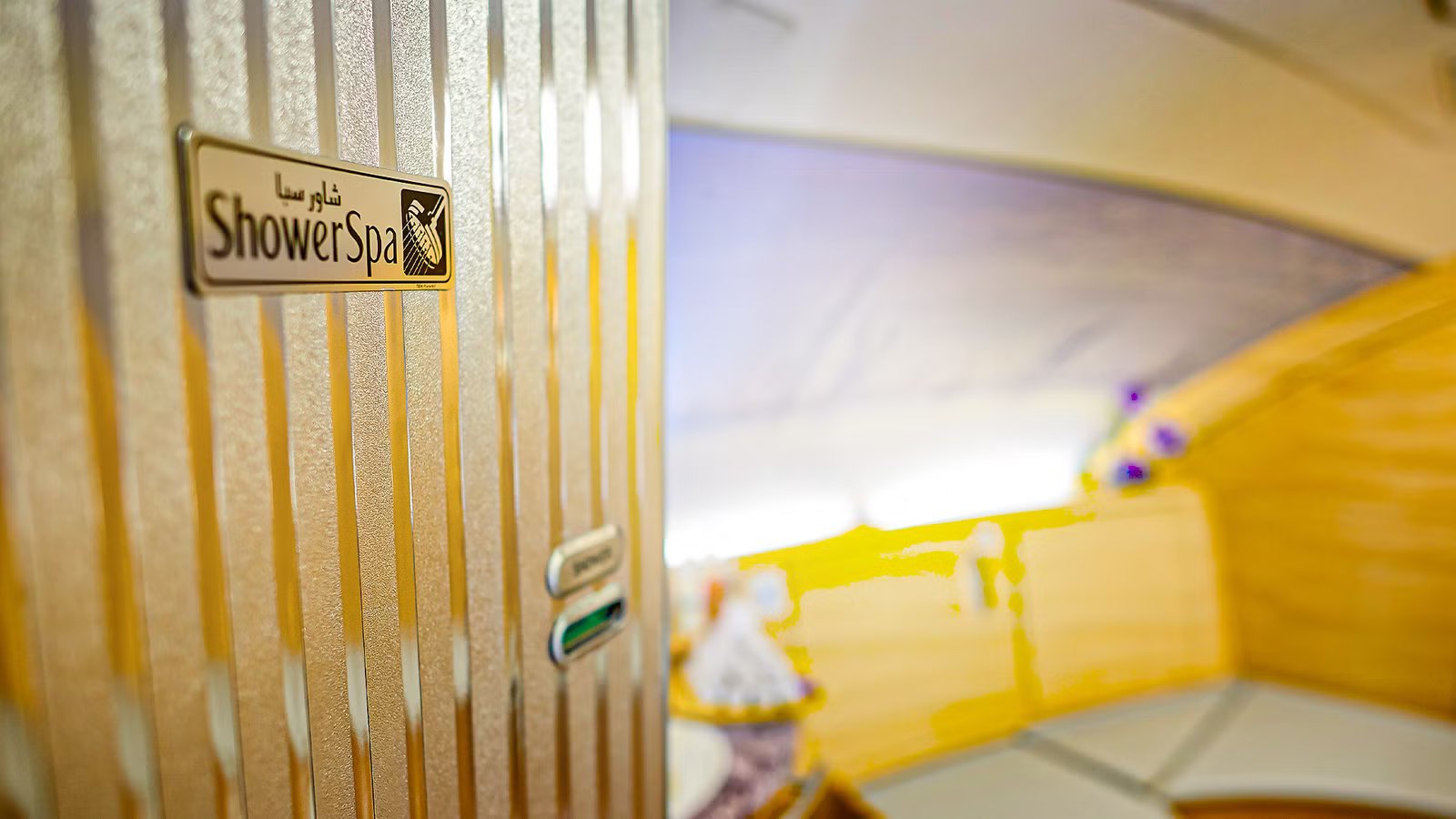
The Emirates Airbus A380 shower has become one of aviation’s most recognizable luxury features. It is routinely portrayed as the ultimate expression of excess: a fully functioning shower spa with heated floors, premium amenities, vanity mirrors, and enough room for passengers to freshen up while flying at 500 knots and cruising above 40,000 feet.
Among commercial airlines, few other products have become such a powerful symbol of airborne luxury because no other airline has been willing to build one at scale. For many travelers, the shower is not simply another first-class perk: it is the thing they remember about  Emirates. However, the visual spectacle hides a more interesting economic story. Airlines obsess over weight because every pound or kilogram on an aircraft eventually translates into fuel burn and operating costs.
Airlines remove magazines, lighten seats, and redesign food carts to shave every bit of excess weight they can. However, Emirates deliberately installed additional water tanks, plumbing systems, pumps, drainage equipment, and shower facilities aboard the heaviest passenger aircraft ever built. The economic reality is nuanced, as the weight of the water matters, but the higher costs come from what that luxury feature displaces and the broader economics of the A380 itself.
Why Emirates Built The A380 Shower When No Other Airline Would

Emirates remains one of the very few airlines to install commercial shower facilities on board passenger aircraft. The only major exception is the  Etihad AirwaysA380 The Residence, which includes a private shower available exclusively to passengers occupying the airline’s ultra-luxury three-room suite. Outside these rare examples, commercial airlines have generally avoided showers because of the operational penalties and complexities involved.
They choose instead to compete through better seating, greater privacy, upgraded dining experiences, and premium lounge concepts rather than introducing entirely new onboard infrastructure. The Emirates A380 first-class cabin contains 14 enclosed suites along with two dedicated shower spas positioned at the front of the upper deck. Each suite includes sliding privacy doors, personal minibars, large entertainment displays, adjustable lighting systems, and extensive personal storage space.
The shower spas themselves incorporate changing areas, sinks, mirrors, vanity spaces, and enough room for passengers to move around comfortably during use, effectively functioning as compact hotel-style bathrooms in the sky. This approach reflects Emirates’ broader strategy of investing heavily in products designed to create lasting impressions.
Features such as the onboard lounge bar, expansive premium cabin layouts, and shower spas generate marketing value far beyond their direct operational economics. Millions of passengers who have never purchased a first-class ticket still immediately associate Emirates with its shower experience because the product functions as a highly visible global branding tool as much as a passenger amenity.
The Water Weight Sounds Massive Until You Compare It To The Aircraft

Water can become quite heavy surprisingly quickly: one quart of water weighs almost exactly 2.09 pounds (0.95 kg), meaning a few hundred liters can quickly translate into hundreds or even over a thousand pounds of additional mass, which can make carrying large tanks of water through the sky surprisingly expensive on long flights that can exceed 14 or 15 hours.
Airbus A380, assuming shower-related requirements add approximately 1,100–2,200 pounds (500–1,000 kg) of water plus associated system weight, that additional mass represents only about 0.09%–0.17% of the aircraft’s 1,268,000-pound (575,000 kg) maximum takeoff weight. This value is mathematically correct but only an illustrative estimate because the real percentage varies with operational conditions.
In practice, aircraft weight effects are not fixed, as total takeoff mass varies with passenger load, cargo, fuel uplift, and dispatch conditions. The ‘shower system’ itself is also not a single constant figure, as plumbing design, tank size, redundancy requirements, and cabin configuration can all shift the installed weight.
Emirates Axes Airbus A380 Flights On This Major Route [Map]
Starting in July, the airline will resume its regular double-daily 777 services, as it did before the start of the Middle East conflict.
Calculating The Actual Fuel Penalty

For the A380, estimates from Jettly place fuel consumption at approximately 24,250–28,660 pounds (11,000–13,000 kg) per flight hour, depending on route length, weather conditions, payload, and operating procedures. However, this is not a fixed rate because fuel burn varies across phases of flight (higher during takeoff and climb, lower during cruise, and gradually decreasing as the aircraft becomes lighter). As such, total fuel use scales with mission duration.
For example, long-haul sectors, typically around 13 to 15 hours, can therefore result in total fuel consumption on the order of 315,000–430,000 pounds (143,000–195,000 kg) per flight, with actual values varying slightly based on winds, routing, payload, and airline operating strategy.
Aircraft fuel consumption does rise with additional weight, although the relationship is not perfectly linear because of aerodynamic and performance factors. Using a simplified proportional estimate, adding approximately 1,100 pounds (500 kg) could increase hourly fuel consumption by around 20–24 pounds (9–11 kg). Doubling the added weight to roughly 2,200 pounds (1,000 kg) raises the estimate to approximately 40–51 pounds (18–23 kg) per hour.
Catch what other flight trackers miss
Emergency squawks, holds, NOTAMs — live signals, no signup.
Open tracker
Catch what other flight trackers miss
Emergency squawks, holds, NOTAMs — live signals, no signup.
Open tracker
Across a 14-hour long-haul mission, the additional fuel consumed is likely to fall somewhere between roughly 275–705 pounds (125–320 kg). Since jet fuel weighs around 6.7 lb per gallon (0.8 kg per liter), this translates into approximately 41–105 gallons (155–400 liters) of fuel. Assuming fuel prices around $0.70–$1.00 per liter, the direct cost likely lands somewhere around $100–$400 per flight. The dramatic image of a fuel-guzzling flying bathroom turns out to be much smaller than many people might assume.
The Bigger Cost Is Lost Cabin Real Estate

However, the more significant economic issue is not fuel but space. Aircraft cabins are among the most valuable pieces of real estate in transportation because every square foot can potentially generate revenue. Airlines constantly redesign layouts because even small changes in seating density can produce major financial effects across thousands of flights.
The shower spas occupy a substantial amount of space at the front of the upper deck, which is among the most profitable areas of the aircraft. Premium cabin seats generate dramatically more revenue per passenger than economy seats, and airlines analyze layouts based on yield per square foot rather than seat count alone.
Suppose the same area could accommodate four additional premium seats. A long-haul premium fare can range from several thousand dollars to well above $10,000, depending on market and route conditions. Across years of operation and thousands of flights, the cumulative revenue opportunity can potentially reach tens of millions of dollars, far exceeding the fuel cost associated with carrying water.

Boeing 747 vs Airbus A380: Which Costs More?
Comparing the quadjets.
Plumbing, Maintenance & Complexity Add Up

For the A380, a shower system would involve more than just carrying water tanks. Indeed, it would also require integration with existing aircraft plumbing infrastructure, including pumps, water heaters, pipes, valves, sensors, and control systems to regulate pressure, temperature, and flow. Furthermore, dedicated potable water storage and greywater waste tanks sized for the additional demand are also necessary.
While many of these components already exist in some form for standard lavatories and galley services, expanding capability increases system complexity. It can also require additional installation space, weight allowance, and system integration within the aircraft’s certified design limits. In commercial aviation, all onboard systems are already subject to strict inspection, redundancy design, and scheduled maintenance to ensure safety and reliability.
However, adding specialized features still increases the number of inspection points, potential failure modes, and spare-part requirements over the aircraft’s service life. This matters because at cruise altitude, the aircraft is pressurized. As such, access to systems is limited, and even relatively minor issues such as a plumbing leak can carry greater operational significance due to the difficulty of in-flight repair and the high cost and logistical complexity of diversion.
There are also recurring operational costs that continue long after the hardware has been installed. Flight attendants prepare the shower area, replenish towels and amenities, clean surfaces, and reset the suite between passengers throughout the flight. Passengers receive approximately five minutes of running water, tracked using a traffic-light timer system designed to regulate consumption and prevent excessive water use.
The Shower Exists In The Shadow Of The A380’s Bigger Economic Problem

The fundamental challenge facing the A380 was never shower water. The aircraft entered service just before the broader industry shifted toward highly efficient twin-engine aircraft capable of operating long routes at lower cost. Modern aircraft such as the Boeing 787 and Airbus A350 transformed airline economics by reducing fuel consumption and improving flexibility.
Rather than filling 500-plus seats between giant hub airports, airlines increasingly preferred smaller aircraft capable of connecting more city pairs directly while maintaining lower operating costs. Against those larger industry trends, the Emirates shower becomes less of an economic burden and more of a symbolic decision.
Emirates is probably not spending thousands of dollars on fuel simply to carry water around the world. Instead, the airline accepts a relatively modest direct operating penalty while using the feature to reinforce its position as one of the most recognizable premium brands in aviation. The true story is not that Emirates flies a bathtub at 40,000 feet: it is that the airline decided the experience itself creates enough value to justify the cost.