dailynewsnblog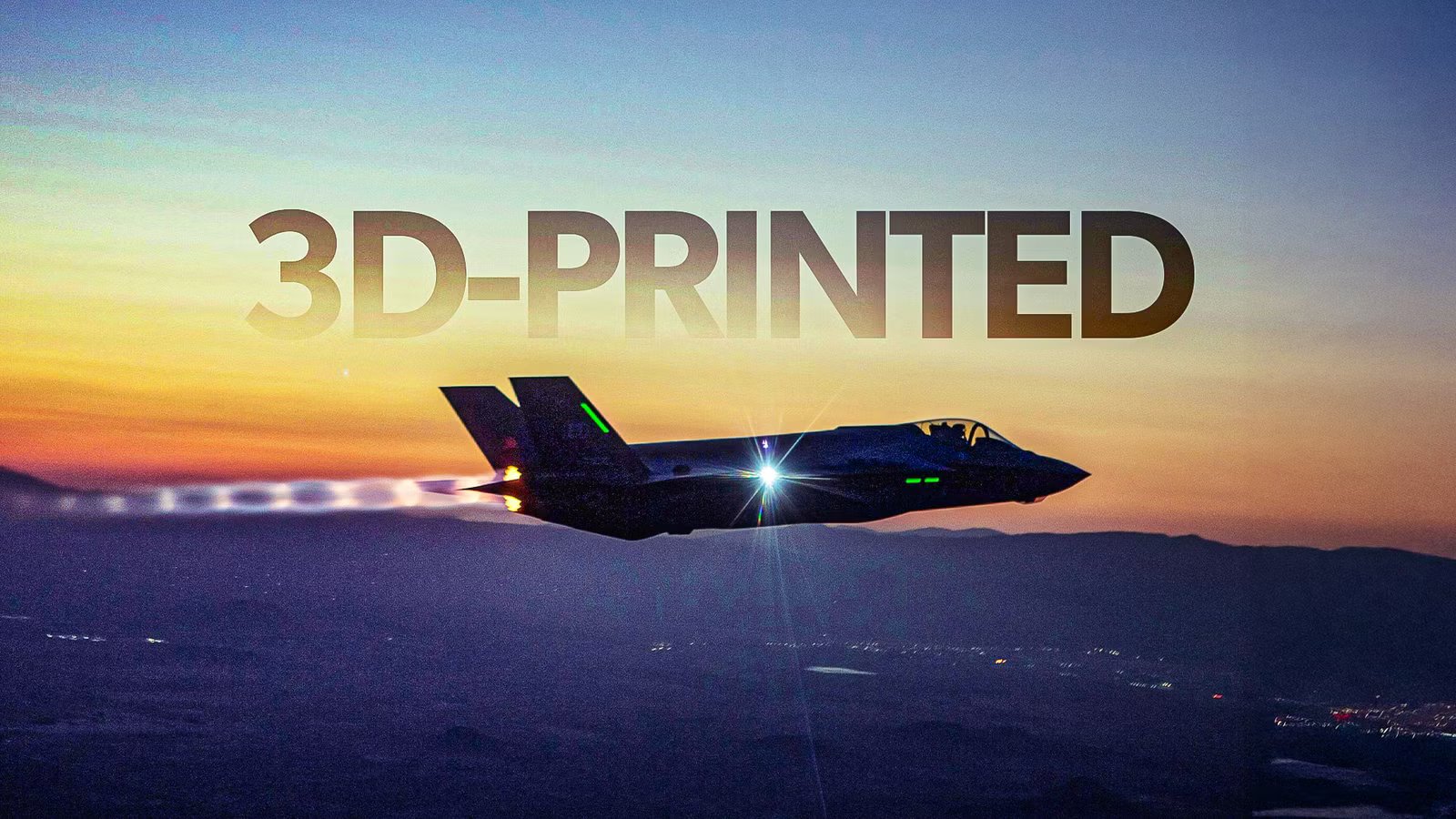
When the US selected the F-35 in the early 2000s, it took a total systems approach that allowed Lockheed Martin to have the rights to total control of the program, including relevant intellectual property and spare parts. This meant the military gave up the right to use its workforce for the sustainment of the program or to contract third-party vendors to support the program. Until that time, this was standard practice for fighter jet programs.
But the scale, complexity, and concurrency of the program have caused shortages in spare parts, reduced availability, and reduced margins with software upgrades. The US military feels like the contract ties its hands and is hamstringing its ability to push through modernization programs, leading to cost overruns and delays. As one small part of the saga, the Air Force is now looking to 3D printing to cut Lockheed Martin out of the loop in supplying select components used for training. The Air Force recently reported on the development in a news release widely seen as slighting Lockheed while never directly mentioning Lockheed.
The F-35 “Vendor Lock”

The contract was awarded to Lockheed Martin in 2001. One of the biggest regrets the Department of Defense (Department of War) has in the F-35 program is not explicitly detailing who has the intellectual property (IP) rights for the F-35. At the time, this was standard practice as older aircraft (e.g., F-16s, legacy F-15s) were simpler and didn’t require the constant software updates that the 5th-generation F-35 does. Their components were also generally less cutting-edge.
The F-35 contains tens of millions of lines of code, highly integrated avionics, and many specialized parts. Lockheed has a “vendor’s lock” over much of the IP and technical data, meaning it has a spare parts monopoly and the technology is proprietary. For many critical components, Lockheed only permits itself or approved subcontractors to repair and modify the aircraft.
Other fighter jets are also locked in, but the F-35 is at least somewhat exceptional. The F-16, Eurofighter Typhoon, and Rafale can be considered moderately locked in, while the Saab Gripen is comparatively low. The F-22 is very high, while the F-35 is extremely high. As part of lessons learned, new USAF contracts, like the CCA program and F-47, heavily emphasize open architecture designs that allow the Air Force to do more work in-house or allow it to grant contracts to third-party contractors.

The World’s Largest Air Forces By Number Of F-35s
A closer look at some of the leading F-35 armadas around the world.
Flagged By The GAO Audits

The United States’ Government Accountability Office (GAO) audits are incredibly detailed and provide a generous amount of transparency into US defense programs like the F-35, which is hard to find in other countries (particularly Russia and China). The GAO reports have repeatedly flagged the vendor lock on the F-35 as a cause of increased costs, delays in maintenance, and lower availability rates. It notes, “program personnel must use contractor-owned systems to access the most up-to-date technical data to support sustainment and maintenance activities.”
In its 2025 report, the GAO says that it recommended in its 2023 report that the DoD should “reconsider the F-35 sustainment strategy, including, among other things, assessing the level of necessary technical data.” It says the F-35’s weapon systems’ sustainment has consistently found that programs face “myriad challenges” when it comes to IP and data impacting aircraft readiness.
The GAO report quotes program officials and maintainers to say that the F-35 faces significant corrosion issues that maintainers cannot repair without contractor support due to a lack of technical data. There are also not enough contractors to respond to the corrosion issues, which slows the process down. It adds, “The program is attempting to develop organic sustainment capabilities by incrementally obtaining technical data to enable maintainers to do more repairs and improve timelines.”
JPO Turns To Reverse Engineering

In what is widely understood in the industry as sticking it to Lockheed Martin, the Air Force reported in June 2026 that it had successfully reverse-engineered and 3D-printed (additively manufactured) F-35 canopy frames for testing. This was done by the Air Force’s 809th Maintenance Support Squadron’s RAPID Lab at Hill Air Force Base, Utah. The official F-35 Lightning II Joint Program Office posted an image of the printed canopy with the caption “No parts? No problem!”
The post adds that 3D printing helps by “closing a critical training gap and bypassing supplier delays.” In the news release on the US Air Force website, it states that the process is enabling maintainers to train on installing the aircraft’s flexible linear share “without waiting on delayed supplier deliveries.” It explains that its RAPID Lab developed the solution after delayed supplier deliveries left maintainers “without the hands-on training mediums required to practice a mandatory safety-critical task.”
The lab conducted multiple design iterations to ensure the printed canopy frame met the functional requirements for the training mission. After tinkering with the design, the team at the lab validated the canopy frame’s performance and provided the team with confidence that engineered plastics can meet certain training requirements. It has now moved onto reverse-engineering a second variant and other parts for F-35 training so that they can “get the right parts to the right instructors much faster, directly improving readiness.”
“Just Getting Started” With 3D Printing Reverse Engineering

Not stopping there, the Air Force’s news release goes on to say that the reverse-engineering initiative is generating substantial cost and work-hour savings. This is achieved not only through 3D printing but also through “reduced procurement.” It says its RAPID Lab is expanding its portfolio of printed tooling, fixtures, and training aids.
The Air Force explains it is “identifying small, high‑impact aircraft components that can be safely printed for ground use or, when approved by the cognizant engineer, installed on aircraft.” The Air Force’s Rulon Stitzer is working as the RAPID Labs Flight Chief and said that it gives the “maintainers the tools they need without waiting on external vendors.” The Air Force is planning to ramp this up and scale production capacity so that more organizations across the installation can bring projects in-house.
Lockheed Martin F-35 Lightning II (per F-35.com) | |
|---|---|
United States Air Force | 1,763 (F-35A) |
United States Marine Corps | 420 (F-35B, F-35C) |
United States Navy | 273 (F-35C) |
Stitzer said, “We’re just getting started,” and that the lab will identify more small, high-impact parts where printing gives the Air Force a readiness advantage. What is notable in the Air Force news piece is that no vendors (including Lockheed Martin) are named. The article doesn’t explain why the Air Force had to reverse engineer its own aircraft in active production. The unwritten factor is that Lockheed is refusing to release its blueprints to the Air Force, and the Air Force is saying in so many words, “We can do it without you.”
Air Force Acquiring Some IP Rights

However, reverse engineering 3D printed components for training is not the same as having access to the source code or other systems. Part of the reason why the US’ Joint Program Office (JPO) for the F-35 created (Operational Data Integrated Network) ODIN was to give the government greater control. One change is with newer contracts requiring software commits to be stored in government-managed repositories rather than only with Lockheed Martin.
In April 2024, Inside Defense reported that the Air Force had begun to acquire the intellectual property of some F-35 systems needed to upgrade and maintain the system. The IP problem has seen lawsuits between the government and Lockheed. In 2024, the F-35 Joint Program Office and Lockheed Martin settled a five-year legal dispute over IP rights for critical testing software.
Under the new agreement, the government has the authority to integrate software called “F-35 in a box” into a service-operated experimental facility to rapidly conduct operational testing, advanced tactics development, and other training. Other lawsuits have been settled behind closed doors, with the details not released. Separately, one of the attractions of the Swedish Saab Gripen is its relatively low vendor lock. For example, around 30% of the IP is British-owned, with a comparable percentage also American-owned.
The Pentagon Declared The F-35’s Most Critical Upgrade ‘Predominantly Unusable’
The problem with the Joint Strike Fighter.
Tail Wagging The Dog & Jailbreaking The Jet

Former Secretary Frank Kendall said in 2024 that the F-35 IP rights are one of the “lessons we’ve learned very painfully over our history in acquisition.” Rep. Matt Gaetz (R-FL) went so far as to say “the tail here is wagging the dog” and that “government isn’t running this program, Lockheed Martin is running this program.” Lockheed’s monopoly over the F-35 is also seen as contributing to slowing down the fighter jet’s upgrades, including the Technology Refresh 3 upgrade that Simple Flying previously covered.
Gaetz also said in 2024 that the current F-35 deal “makes it very hard to upgrade and makes it very hard to make changes and cost-effectively do them and to take advantage of competition.” Still, it should be kept in mind that the F-35 is regarded as the most advanced and capable fighter jet in the world. As Professor Justin Bronk has pointed out, every potential customer with a requirement for an F-35-like aircraft that has been permitted to ‘peer behind the curtain’ and see its classified capabilities has opted to purchase it.
Since Bronks said that in 2024, Spain and Portugal have announced they are not interested in the jet, although this was due to geopolitical reasons following Trump’s reelection. France and Spain aren’t interested in the jet as they focus on their domestic Rafale and Gripen fighters. In 2025, unfounded rumors spread that the US had a “kill switch” for the jet, and in 2026, the Netherlands said they were able to ‘jailbreak’ the F-35 to accept new software upgrades should the US ever cut off support.