dailynewsnblog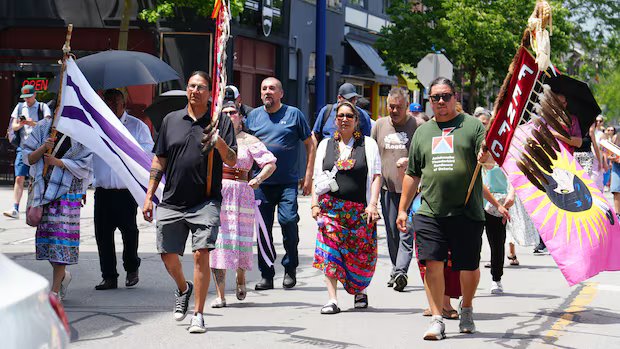
Evacuees from Kashechewan First Nation who have been living in Niagara Falls, Ont., for the last six months marched in sweltering heat through the city’s downtown Friday to demand an apology over recent comments made by the city’s former chief administrative officer and by the local mayor.
Upwards of 100 people were in attendance at the rally, including many supporters of the evacuees.
Their actions brought Mayor Jim Diodati out on Friday, where he greeted dozens of people on the front steps of city hall and issued an apology over how Indigenous people evacuated from that community had been portrayed.
About 1,100 Kashechwan residents have been living in hotel rooms in the city since a state of emergency was declared in the northern community in January when its aging water infrastructure failed and its nursing station was flooded with sewage.
Comments about homelessness were a flashpoint
The new controversy erupted after former CAO Ken Todd, who was appointed last fall to spearhead a new unhoused strategy for the city, told Niagara Falls city council on June 23 that some residents may have the mistaken impression that evacuees from Kashechewan staying at hotels in the tourism district are people experiencing homelessness.
“We want to be the jewel of tourism in Ontario,” in Niagara Falls, Todd said. “And unfortunately, a lot of the residents and people will see Indigenous people on the streets, walking around, thinking they’re homeless people in this community, and they’re not.”
Todd, who said the influx of evacuees was straining police, hospital emergency department, social services and paramedic service resources, said it was unfair to essentially warehouse them in hotel rooms and suggested a “purpose-built” facility in the province where the Kashechewan population could have a sense of community would be a better model.

In an interview with CBC before the rally, Todd apologized for his comments.
The Niagara Falls Review had also quoted Diodati, in a follow-up interview after the council meeting, where he accused senior levels of government of taking a shortcut to “dump [evacuees] in one city,” whereas “purpose-built” options such as military bases or former schools to house them might be preferable.
Organizers of Friday’s event demanded that Diodati issue a formal apology to the Kashechewan First Nation at the next city council meeting and that other steps be taken such as a public acknowledgement of harm caused by the remarks; a formal motion of city council distancing the municipality from the comments made during the June 23 meeting; and cultural and anti-racism training for staff and council.
Sean Vanderklis, co-host of the One Dish One Mic podcast in Niagara, set the scene for what would be an at times uncomfortable gathering for Diodati.
“To the mayor of Niagara Falls, I present to you the homeless Indigenous people,” he said.
Mayor apologizes, says he’s ‘humbled’
On the steps of city hall, Diodati said he regretted the comments and the impact they had.
“I am sorry that my comments caused hurt within your community and the broader Indigenous community,” he said. “I apologize. I take responsibility for that. No disrespect was ever intended.
“Sometimes you say things and you wish you didn’t. The problem is, you can’t get toothpaste back in the tube. So here I am, at your mercy, exposed, humbled, grateful that you’re here.”
Diodati said “our intentions to gain support for families and for the community were good, but comments can be misinterpreted.”
After his comments, Diodati waded through the crowd to exchange hugs with Kashechewan residents.
Kashechewan Chief Hosea Wesley, who met with Diodati after the June council meeting, told CBC that Diodati apologized multiple times to him.
“I don’t know how many times he apologized,” he said at the start of Friday’s event. Wesley said he accepted Diodati’s apology.
Not everyone was so forgiving. Shelby Young of St. Catharines, Ont., one of the event organizers, demanded that Diodati resign as mayor over the issue.
“The comments that were made were racist,” she told the crowd as Diodati watched. “You cannot tell the people who were affected by those words that it’s not racist.”
“We’re sick of the fake apologies after the fact. You should resign.”

Wesley told CBC that he was thrilled to see the large gathering of people on such a blistering day.
“I wasn’t expecting this to happen,” he said, as the rally participants gathered at a Tim Hortons parking lot. “It’s overwhelming to see the support in the community.”
But he called on the federal government to step up to relocate Kashechewan residents to a place not prone to flooding, and demanded adequate water and sewer infrastructure.
“Evacuations are not long-term solutions,” he said.”Our people did not choose to leave their homes. My people can’t keep living like this for the rest of their lives. We need a permanent solution.”
Comments reinforce ‘dangerous stereotype’
Lyndsay Joo, a member of the Kashechewan First Nation and an organizer of Friday’s event, told CBC News that she agrees the province and federal government need to work on some kind of designated housing for evacuees.
She said references to Indigenous people being mistaken for those experiencing homelessness “presents a dangerous stereotype about Indigenous people.”
In a statement after the controversy erupted, Grand Chief Alvin Fiddler of Nishnawbe Aski Nation, of which Kashechewan is part, appealed for compassion for evacuees from Kashechewan who he said may no longer feel welcome in Niagara Falls.
“It is repugnant that the city’s main concern is public image, not the care and [well-being] of these displaced people who have been forced to seek refuge far from home,” he said.
The Niagara Regional Native Centre also issued a statement condemning the “ignorant, racist, and biased” comments.
Diodati told CBC before Friday’s rally that the city is unfairly being “targeted as the bad guys” when they’ve been “the most welcoming community.” A community, that he said, is still “dealing with the effects of having 5000 asylum seekers in our community.”

“We’re happy to do our part and play Team Canada, but we think it’s unreasonable to expect us to do significantly more than the rest of the country,” Diodati said.
“We feel that upper levels of government should do a better job than putting people into hotel rooms without supports.”
On July 2, the Chiefs of Ontario lamented what it called “insulting” comments about Kashechewan evacuees and said long-term solutions and federal investments in clean water, safe housing and reliable services for Kashechewan and First Nations communities across the country are needed.
CBC News reached out to the office of Premier Doug Ford and Indigenous Services Canada (ISC) for comment on the call for more investments by senior levels of government for First Nations communities and possible purpose-built housing or shelter.
The province responded by saying the Ministry of Emergency Preparedness and Response has been engaged with Indigenous Services Canada and other partners to ensure all evacuees receive wraparound services, including healthcare, education, and other social services.

“All decisions about the long-term displacement and housing fall under the purview of Indigenous Services Canada,” the ministry said in a statement. “We will continue to work together with ISC and host communities to ensure communities have the tools and coordinated support needed during emergency evacuations.”
ISC spokesperson Eric Head acknowledged being displaced for six months now has been “extremely challenging” for Kashechewan residents.
ISC officials met again with Chief Wesley on June 29 to hear his concerns and meetings remain ongoing with Kashechewan leadership to discuss community needs, he said in a statement.
“Wraparound supports for health, safety, and wellness are being provided at all locations. We are working in partnership to return evacuees to their home as soon as possible. We have no higher priority than the safety and security of community members.”