dailynewsnblog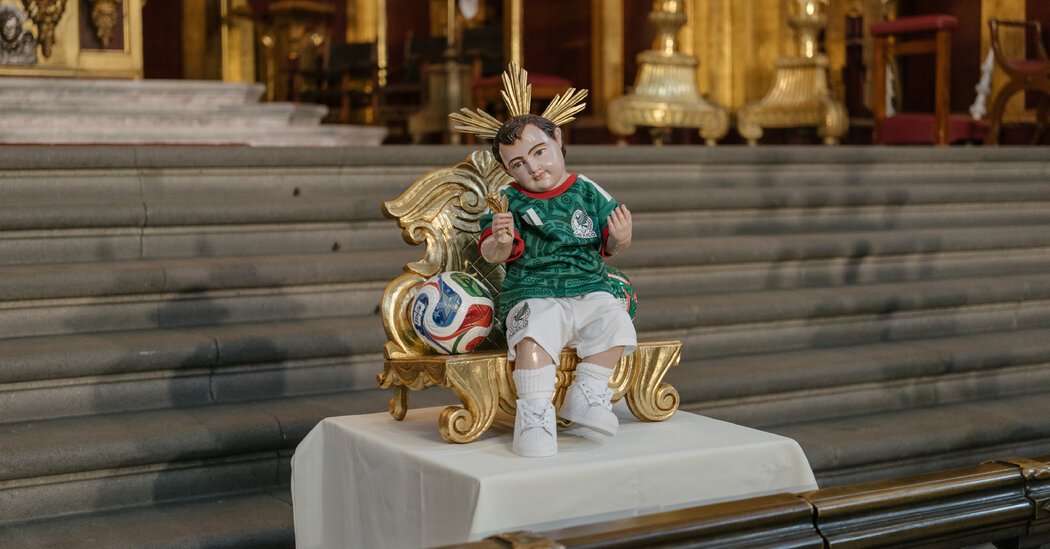
For Mexico, where soccer has an almost sacred status, this is already its most successful World Cup showing in generations. The massive celebrations, including for Tuesday’s knockout round victory over Ecuador, are proof.
So where have thousands of Mexicans gone to say thanks and pray for a little more divine intervention, especially as the team prepares to host England in Mexico City on Sunday in the round of 16?
To see a baby Jesus statue dressed in a national team jersey, sitting before an ornate gold altar at the 450-year-old Mexico City Metropolitan Cathedral.
“We only came to see him to ask to help us on Sunday,” said Marisela Tapia, 49, who was visiting the church with her cousin.
The tradition of dressing baby Jesus in the Mexico jersey during the World Cup dates to 1970, the first time the country hosted the tournament, said Canon Manuel Corral Martín, a priest who helps run the cathedral. That Jesus statue was kept at a different Mexico City church.
When a new parish priest took over that other church, he stopped the practice this year because he believed it was inappropriate, Father Corral Martín said, adding that people asked the cathedral to restore the tradition. The Metropolitan Cathedral did, dressing up its own two-foot statue of baby Jesus in a national team jersey, and placing him on a table in front of the Altar of the Kings, a Baroque masterpiece.
Before every Mexico game, baby Jesus is changed into the uniform — size 0, by the way — that the national team will use.
“It’s an expression of people’s religiosity,” said Father Corral Martín, 72, adding that the religion “has to evolve because sometimes we get stuck in the rituals.”
He pointed to examples of the Roman Catholic Church in Mexico incorporating local traditions, and in this case it was soccer. He applauded the World Cup and the national team for bringing people together.
In Latin America and specifically in Mexico, the country with the second highest population of Catholics in the world, faith and sports are often intertwined. Inside the Estadio Azteca, the Mexico City stadium that has now hosted three World Cups, Mexican players before games stop by an altar of the Virgin Mary of Guadalupe, an important religious and cultural figure.
Asked if prayers to the soccer baby Jesus had indeed worked during this World Cup, with Mexico winning its first knockout round game since 1986, Father Corral Martín laughed. He commended people’s faith and also wished for a Mexican title.
“It’s not that the child is going to perform the miracle,” he said, “but rather we create the miracle, the team itself does it by working as a team, and that’s what we have to do in all areas of life.”
Many cathedral visitors on Thursday were amused when they unwittingly stumbled across the soccer baby Jesus. They snapped photos of and with him. But some came specifically for him.
Ms. Tapia and her cousin Damaris González had come to Mexico City’s main square to watch the Spain-Austria game on a giant screen. They laughed when they heard on social media about the baby Jesus in a Mexico jersey. But as believers, they also wanted to make a special pilgrimage.
Ms. González, 61, said she wanted baby Jesus to help Mexico win its first-ever World Cup, but step by step. So she asked only for victory over England.
Both women said the national team’s success so far has allowed Mexicans to momentarily forget about the “ugly” realities of life. And if other countries are also praying to baby Jesus, Ms. González said “he loves Mexico more” and Ms. Tapia added that “he knows we need this happiness.”
Ivonne García Campos, 46, a teacher, and her husband, Ignacio De Jesús Reyes, 53, an electrician, were on vacation with their family from northern Mexico when they noticed the baby Jesus in the Mexico soccer kit. They also requested a World Cup title.
“It’s not disrespectful,” she said. “In other states in the country, for example, baby Jesus is dressed up as a doctor, a teacher, various professions. More than anything, it’s to give thanks and to be on our side.”