Canada, Alberta announce new west coast oil pipeline to boost exports


By Amanda Stephenson

CALGARY, July 2 (Reuters) – Canada announced plans to build a new oil pipeline from Alberta to the Pacific coast, which would give the world’s fourth-largest oil producer greater capacity to export to Asia and ease its reliance on the United States.

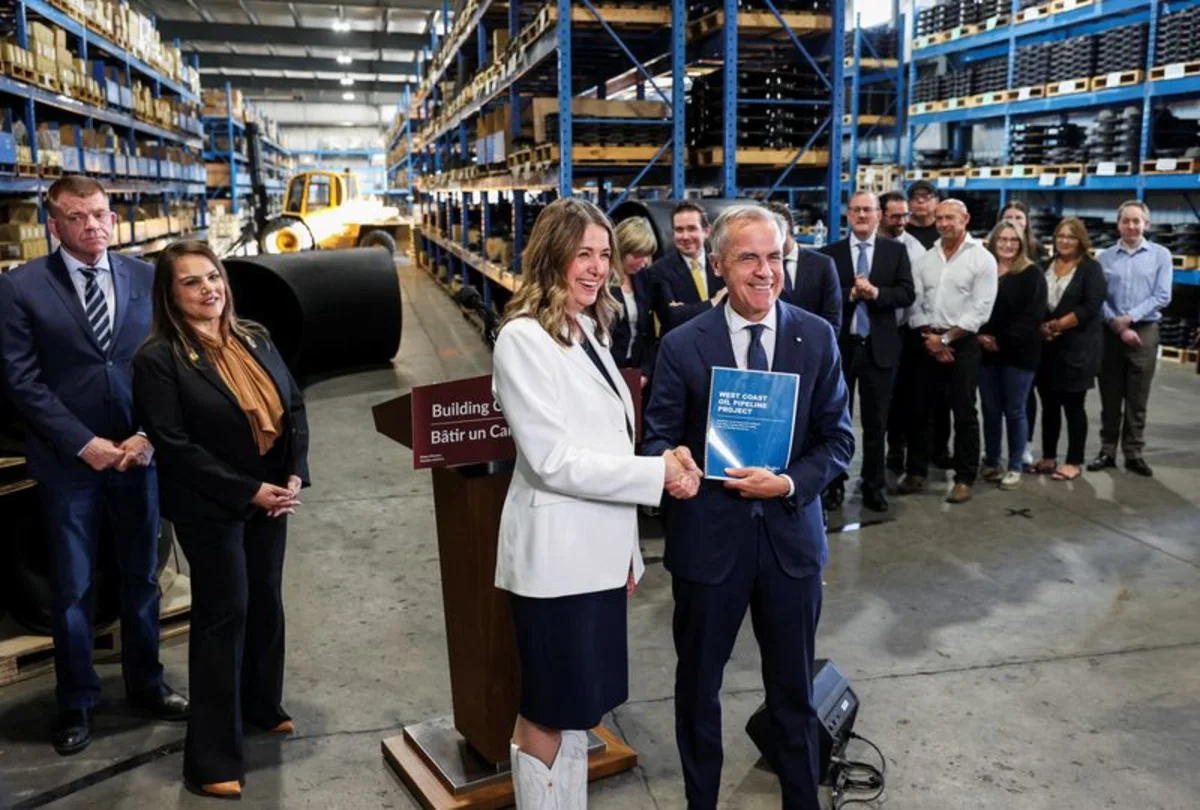
Prime Minister Mark ‌Carney made the announcement in Calgary alongside Alberta Premier Danielle Smith, whose government said construction of the 1-million-barrel-per-day pipeline would begin as early ‌as September 2027.

The plan marks the culmination of months of political wrangling and compromise on all sides. It represents the Carney government’s attempt to balance Canada’s environmental ideals with the economic reality posed ​by U.S. President Donald Trump’s tariffs policy.

“We’ve agreed the time for action is now,” said Carney.

The pipeline could make Canada a major global energy supplier, as Asia’s top importers seek oil from outside the Middle East in the wake of the Iran conflict.

No cost estimates have been released for the pipeline, which will be built by government-owned Trans Mountain Corp in coordination with Pembina Pipeline Corp to transport crude from Alberta’s oil sands to British Columbia’s southwest.

The federal government through Trans Mountain and the government of ‌Alberta through its Alberta Petroleum Marketing Corporation would be ⁠majority owners of the pipeline. Pembina would have a 10% stake through construction, with the opportunity for up to an additional 10% once the project enters operation.

Smith said funding details of the project are still being negotiated.

The plan has been formally submitted by the provincial ⁠government to Canada’s major projects office for potential regulatory fast-tracking.

PIPELINE HURDLES

Canada’s oil output, which in 2026 is expected to exceed last year’s record of 5.3 million bpd, currently has only one way to access Asian markets, the Trans Mountain pipeline, which runs along a similar route to the proposed new pipeline.

An expansion of the Trans Mountain pipeline was completed ​in ​2024, seven years after Kinder Morgan threatened to cancel it due to heavy environmental and ​Indigenous opposition.

Ottawa bought the Trans Mountain system for C$4.5 billion ($3.15 billion) ‌in 2018 to finish the expansion. Construction delays and budget overruns pushed its price tag to C$34 billion over four years.

Industry representatives have said regulatory uncertainties remain a major risk to crude oil pipeline construction in Canada, and no private company has expressed interest in taking a majority stake in Alberta’s proposal.


Canada’s environmental policies, especially under Liberal former Prime Minister Justin Trudeau, had stoked anger in oil-rich Alberta and fueled a nascent separatist movement. Carney has been seeking to improve relations with Alberta and last October signed an agreement to drop certain climate regulations and help the province grow its energy sector.

In a separate deal signed with British ‌Columbia on Thursday, Carney committed to retaining an existing federal ban on oil tankers along ​the northwest coast. He also committed to help fund infrastructure upgrades aimed at expanding the capacity ​at the Roberts Bank Terminal, part of the port of Vancouver, while ​also pledging to accelerate the building of new liquefied natural gas projects in B.C.

British Columbia Premier David Eby had strongly opposed the ‌idea of a northwest oil pipeline route due to concerns about ​the risk of an oil spill in ​the ecologically fragile area. On Thursday he appeared to open the door to a pipeline going through his province, as long as the tanker ban remains in place.

Carney has said any new crude pipeline must be developed in partnership with Indigenous communities, and is also dependent on the oil ​industry building a large-scale carbon capture and storage project.

On ‌Thursday, Alberta’s government said it is close to finalizing a tripartite agreement with Ottawa and the Oil Sands Alliance industry group that will ​pave the way for the carbon capture project to move ahead. Details of this agreement are expected to be released in the coming ​days.

(Reporting by Ismail Shakil and Amanda Stephenson; Editing by Paul Simao and Sonali Paul)


Source link

  • Related Posts

    Carlos Pavón: “El próximo rival tiene que pensarlo mucho”

    IE 11 no es compatible. Para una experiencia óptima, visite nuestro sitio en otro navegador. SIGUIENTE Murat Yakin se va contento con el trabajo de Suiza sobre Argelia 02:19 Riyad…

    Vietnam Growth Tops Estimates Despite Trade Risks, Oil Shock

    Economic activity is accelerating on multiple fronts, particularly manufacturing as it “benefits from AI-driven hardware demand and an influx of FDI,” according to Brian Lee, analyst at Maybank Securities in…

    Leave a Reply

    Your email address will not be published. Required fields are marked *

    You Missed

    Carlos Pavón: “El próximo rival tiene que pensarlo mucho”

    Carlos Pavón: “El próximo rival tiene que pensarlo mucho”

    Rolls-Royce Says Airlines Could Save Nearly $10 Million A Year From Its Latest Airbus A350 Engine Upgrade

    Rolls-Royce Says Airlines Could Save Nearly $10 Million A Year From Its Latest Airbus A350 Engine Upgrade

    6 Easy But Elegant Dress Trends Zara Is Backing In Summer 2026

    6 Easy But Elegant Dress Trends Zara Is Backing In Summer 2026

    The internet is agog at Captain America’s hog

    The internet is agog at Captain America’s hog

    Jacinta Allan admits criminals infiltrated Big Build but rejects calls for royal commission | Victoria

    Jacinta Allan admits criminals infiltrated Big Build but rejects calls for royal commission | Victoria

    Trump got the Senate candidates he wanted. How much will he spend to help them?

    Trump got the Senate candidates he wanted. How much will he spend to help them?