dailynewsnblog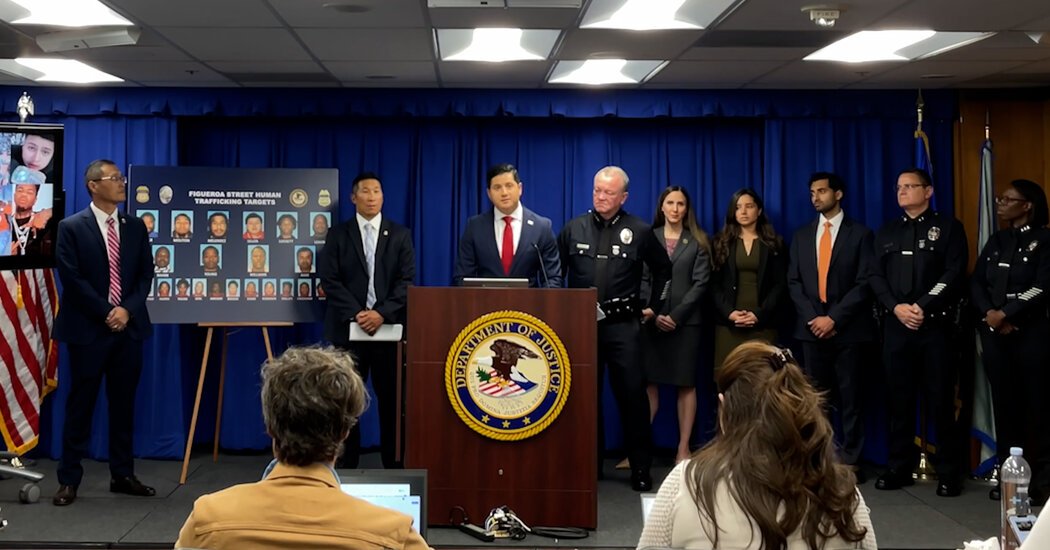
Federal agents on Wednesday raided a section of Los Angeles that has become one of the country’s most notorious child sex-trafficking corridors, arresting nine people on charges related to selling girls as young as 14 for sex.
The operation took place near a 3.5-mile stretch of Figueroa Street known as “the Blade,” where girls go from car to car in stilettos, soliciting customers for sex to reach their traffickers’ nightly quotas. The girls can be seen wearing hair bows and dangling condoms from Hello Kitty lingerie, their faces tattooed with their traffickers’ monikers.
A federal indictment unsealed on Wednesday listed more than 50 victims, and officials identified an additional five during the sweep.
“We really don’t know how many victims are out there,” Bill Essayli, the top federal prosecutor in Los Angeles, said in an interview on Wednesday. “The more of these arrests we do, we get more information, we get more evidence, we get into their phones, we discover more and more victims.”
Six of the defendants were identified by officials as members of the Hoover Criminal Gang, which formed in the late 1960s and claimed its territory in a swath of south Los Angeles that includes the Figueroa corridor. For years, the gang has controlled much of the sex trafficking there, and many of its motels. Among those arrested was the manager of a local motel, the Stadium Inn & Spas, where prosecutors said victims were held and exploited. An additional arrest on Monday was linked to the case.
The operation on Wednesday came nine months after The New York Times published an examination into the city’s sex trafficking crisis, drawing widespread outrage and national attention to the abuse many of the girls face on Figueroa Street. Court documents described how the traffickers worked together to recruit and control their victims, including by branding the girls’ faces, necks and buttocks with tattoos of their street names and logos.
The authorities said Cameron Lockett, 23, beat one of his victims on her back and ribs, bit off a chunk of her cheek and then pressured her to lie when she was taken to the hospital for stitches. Officials said Caleed Mouton, 26, ordered one of the girls to get an abortion. Hours after the procedure, he required her to continue having sex with customers, according to the indictment. Prosecutors also accused Jorge Melendez, 23, of punching a 14-year-old victim in the face at least five times and dragging her by her hair because she did not meet her quota.
“The whole thing, from top down, is just absolutely disgusting and horrific,” Mr. Essayli said. “When it comes to victims, these are among the most vulnerable victims that we see in the work that we do.”
The names of the lawyers representing Mr. Lockett, Mr. Mouton and Mr. Melendez were not available.
Many of the girls on the Figueroa corridor have been recruited out of the Los Angeles County foster care system; others have run away from home and were in need of financial and emotional security when they were befriended by traffickers on social media. Several of the defendants arrested on Wednesday had promised girls luxurious lifestyles before turning violent, according to the indictment, hooking them on amphetamines and oxycodone to create addictions they could exploit.
Wednesday’s operation, which was part of a joint federal and local investigation known as Operation Broken Blade, involved Homeland Security Investigations, I.R.S. Criminal Investigation and the Los Angeles Police Department. Prosecutors are using a federal racketeering statute that was originally aimed at fighting organized crime, the Racketeer Influenced and Corrupt Organizations Act, or RICO.
In January, city and county officials announced renewed efforts to combat sex trafficking in the area, saying they would push for state lawmakers to pursue stricter penalties for both traffickers and buyers.
“Let me affirm our clear commitment to everyone: The L.A.P.D. will protect the victims, will hold the traffickers accountable, and will restore dignity and safety along this corridor,” Jim McDonnell, the police chief, told reporters as he stood on Figueroa Street.
If convicted, some of the defendants who were arrested on Wednesday face a mandatory minimum sentence of 15 years in federal prison, and a statutory maximum sentence of life in prison.