dailynewsnblog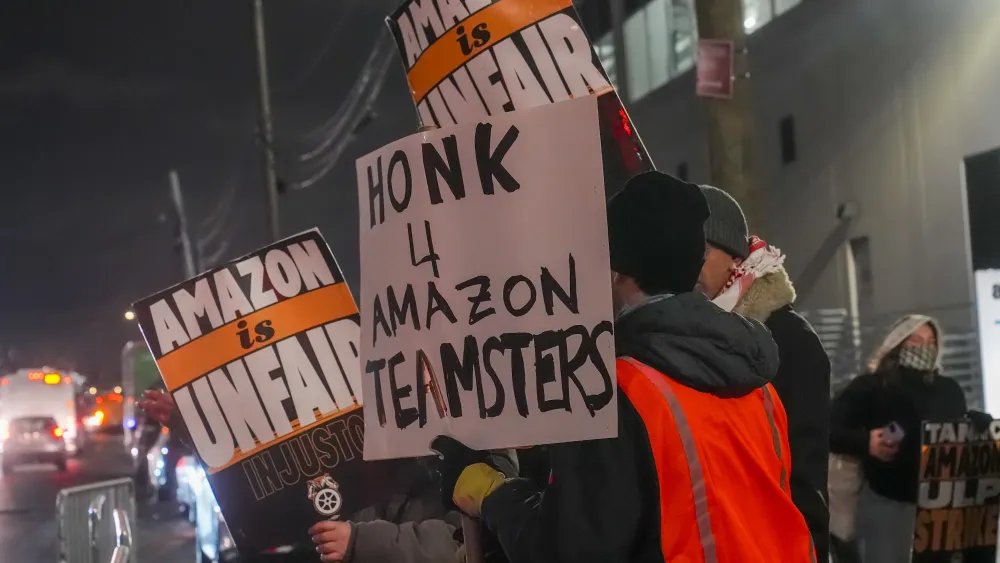
A National Labor Relations Board (NLRB) judge has ruled Amazon must collectively bargain with dozens of Teamsters-represented workers at a San Francisco warehouse, saying the company failed to recognize the union or call for an election as required by a Biden-era board ruling.
In the decision issued in a Washington, D.C. court on June 22, Administrative Law Judge Michael Silverstein said Amazon must negotiate with about 120 “sortation associates” at the delivery station known as “DCK6” after the union informed the company nearly two years ago that two-thirds of the workers had signed off on joining the union.
Judge Silverstein cited the board’s August 2023 ruling, Cemex Construction Materials Pacific, LLC, 372 NLRB No. 130, which established a framework where an employer must either recognize and bargain with a union or promptly file a petition seeking a secret ballot election as long as a majority of employees in the bargaining unit have designated the union as their representative.
In October 2024, 80 out of 121 “Tier 1” associates at the facility had submitted authorization cards declaring they wished to affiliate with the Teamsters.
“Under this new paradigm, unions that obtain signed authorization cards from a majority of employees in an appropriate unit can present the employer with a demand for recognition,” said Silverstein, who determined that Amazon violated the the National Labor Relations Act since it didn’t recognize the union or file an election petition.
Despite the decision, Amazon is likely to have the upper hand in the legal battle due to multiple factors.
For one, President Donald Trump’s two appointees to the NLRB would lead to a three-two Republican majority that is widely expected to overturn the Cemex ruling. Prior to the Cemex precedent, if an employer refused to recognize a union, it was up to the labor group to file a petition with the NLRB to force a secret ballot election.
Another case challenged Cemex’s validity. In March, the U.S. Court of Appeals for the Sixth Circuit ruled the NLRB had overstepped its authority in issuing its Cemex decision and rules that went along with it.
However, the NLRB does not treat appeals court rulings as binding precedent in other cases, allowing it to continue applying its own nationwide standard unless the U.S. Supreme Court steps in.
Amazon disagreed with the decision and will appeal, with a spokesperson saying “we’re confident that a court will overrule it. Following in the footsteps of the Sixth Circuit court, the company argued the Cemex decision was unlawful namely in that it created substantive new policy without going through the proper rulemaking process.
The NLRB’s order came hours ahead of the tech titan’s annual Amazon Prime Day promotion, which reportedly drove shoppers to spend roughly $26.4 billion across all e-commerce platforms over the four-day stretch, according to data from Adobe.
In a statement, the Teamsters lauded the ruling while citing an NLRB decision from April instructing Amazon to begin negotiating with members of the labor group at a Staten Island, N.Y. warehouse, also known as “JFK8.”
“The Teamsters applaud this decision and will do everything in our power to ensure that Amazon complies with it,” said Randy Korgan, director of the Teamsters Amazon division, who called the company the “most abusive and corrupt employer in the world.”
That location is the only U.S.-based Amazon facility where the employees successfully voted to unionize, with the Amazon Labor Union (ALU) that led the unionization push since aligning with the Teamsters.
The e-commerce giant has not recognized the Staten Island unionization since the election took place in April 2022.
“Amazon has repeatedly demonstrated it has no interest in recognizing its workforce or respecting workers enough to meet them at the table,” Korgan said. “But as this ruling proves, Amazon cannot forever dodge its legal obligations. The time for Amazon to start bargaining is now.”
In recent years, the Teamsters have had an ongoing back-and-forth with Amazon over various labor arguments, such as allegations of unlawful contract terminations for workers at its delivery partners and whether the Seattle-based online marketplace is a joint employer along with those partners.
At the end of March, Amazon settled with the Teamsters in which the company restored previously deducted unpaid time off to employees who engaged in walkouts.