dailynewsnblog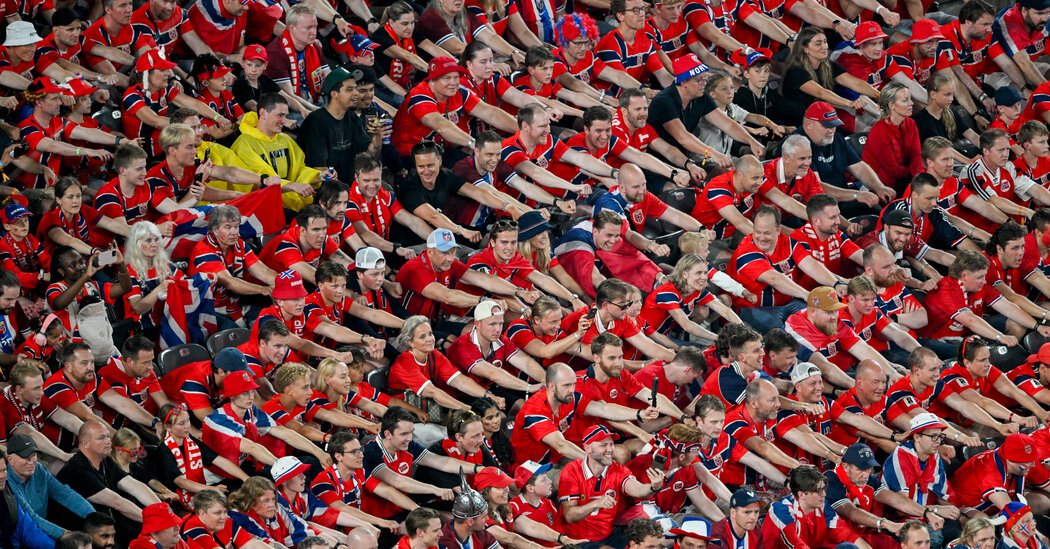
With imaginary oars drawn and voices strong in unison, Norway’s soccer fans have rowed through this World Cup like Viking conquerors piloting a longboat a thousand years ago.
The fans’ signature cheer, known as the “Viking row” — heaving backward and forward in synchronicity while chanting, “Ro!” — has become a phenomenon alongside Norway’s most successful run at the World Cup in nearly three decades.
They have rowed in stadiums in Boston and East Rutherford, N.J. They have rowed in Times Square. Back home, Norwegians have rowed in schools and nursing homes, and even in Parliament, where the prime minister joined in.
“We’re a small country, and everyone can take part,” said Trond Sveva, who has been rowing in front of his TV at home while watching Norway’s matches.
“It doesn’t matter if you’re rich or poor, sitting in the V.I.P. section or in the cheapest seats — you can still row.”
A kindergarten class in Drammen, about 30 miles outside Oslo, arranged themselves shoulder to shoulder and rowed. The school posted the video to Instagram, where it was shared by Norway’s star player, Erling Haaland.
At a nursing home outside Trondheim, 300 miles north of the capital, residents set their alarms for 2 a.m. last Wednesday to catch the team playing Senegal. They donned Viking hats and rowed before the match began.
For Gerd Lie, 90, watching the team’s progress has been riveting. “They’re getting there now,” she said. “At last.”
After Norway’s victory against Senegal last week, the players themselves did the row, sitting on the field with the team captain, Martin Odegaard, beating a drum. After a thrashing from France on Friday, the fans rowed through the defeat.
The men’s national team members have leaned into Viking iconography. In 2023, they adopted runic script on their jerseys. For the World Cup, the players went all in, posing for an official team photo wearing leather and furs and brandishing shields and bows, looking like Nordic warriors about to set off into a fjord.
Not everyone is a fan.
Aleksander Schau, a soccer journalist, said he was happy that Norwegians “finally have a good team” at the World Cup but called the row “an introvert’s nightmare.”
“It’s like you’re not allowed to say no,” he said.
A fan who refused to join in amid a sea of rowing red shirts during the game against Senegal was pilloried on Norwegian social media. The man, Emil Anners Lappen, stood his ground when Norway’s national broadcaster, NRK, interviewed him, saying, “Norway cannot steal from Iceland.”
He was referring to the “Viking thunderclap,” a cheer that Iceland’s fans do. Though it does not look much like the row — fans hold their hands aloft and clap in unison — the chanting and Viking imagery feel too similar to some.
For others, the row stakes a claim on a Viking heritage that goes beyond Norway’s borders. In neighboring Sweden, also a proud Viking nation and Norway’s centuries-long rival, all the rowing has annoyed some players and fans.
“We just sigh,” Gustaf Lagerbielke, a player on Sweden’s World Cup team, said at a news conference last week when asked about the row. “It is very similar” to the Icelandic cheer, he added. “But whatever floats your boat.”
The row is “more Swedish than Norwegian,” the commentator Anders Q. Björkman wrote in a column in the Swedish newspaper Svenska Dagbladet. He argued that Vikings from present-day Sweden, who made their conquests through Eastern Europe by river, used oars more than those from what is now Norway, who sailed across the open ocean to the British Isles and North America.
But historical accuracy aside, he allowed: “I suspect we’re actually a little jealous of the powerful chant and spectacle.”
The cheer began after Norway beat Italy in a match in June last year, a key step on its way to securing a place in the World Cup for the first time since 1998 — and only the third time in nearly 90 years, according to FIFA records. Jonas Thomassen, a producer and musician, recorded the beginning of the chant featuring the refrain, “Ro!” (it means row in Norwegian).
The Viking connection was very intentional.
“Since the World Cup is in America, we had to do something with the idea of Vikings returning to reclaim the continent they discovered long before Columbus,” Mr. Thomassen said.
He happened to live next door to Ole Froystad, a member of the Norwegian soccer team’s official fan club. Mr. Froystad has been the driving force behind popularizing the rowing maneuver among fans. They teamed up, and the effect was viral.
“People criticized us for leaning into the whole Viking thing, saying it was overused and worn out,” Mr. Thomassen said. “Well, I actually think that’s what the rest of the world finds pretty cool.”