dailynewsnblog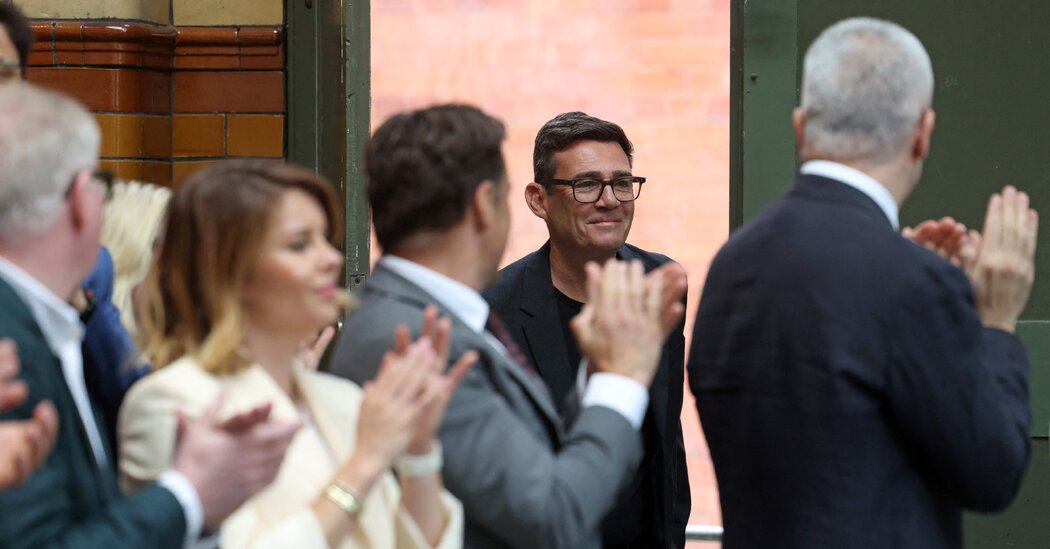
Britain’s outgoing prime minister, Keir Starmer, was repeatedly criticized for lacking a clear political narrative.
Andy Burnham, the popular former mayor of Greater Manchester and the lead contender to succeed Mr. Starmer, appears determined not to make the same mistake.
On Monday morning in Manchester, Mr. Burnham gave his first policy speech outlining his plan for government and underscored his promise to “do things differently” if he becomes prime minister.
Speaking in the People’s History Museum, which is dedicated to democracy and workers’ rights, Mr. Burnham pledged to raise living standards, shift power from London to other cities and even create a branch of the prime minister’s official office in Manchester.
The national government “hasn’t been working for people, and it hasn’t been working for a very long time,” Mr. Burnham said. “In fact, it is broken.”
But in an upbeat speech peppered with jokes and broad smiles, he was careful not to linger on the negatives. “I am going to give Britain the circuit breaker it needs,” he said, by focusing more on collaboration with local leaders.
He described Britain as “one of the most over-centralized countries in the world” and promised the “biggest rebalancing of power our country has ever seen” — a bold claim given that, less than three decades ago, Britain transferred some significant responsibilities from London to politicians in Scotland and Wales.
Mr. Burnham spent nine years as mayor before being elected to Parliament this month. So far, no other candidate has declared for the race to succeed Mr. Starmer and, with the prospect that Mr. Burnham could enter Downing Street in three weeks, his words are being watched closely.
On Monday he called for a 10-year mission to raise living standards through re-industrialization, a big program of new housing projects, changes to the welfare system and greater state control over some main utilities.
Decision-making should be put in the hands of regions and local communities, Mr. Burnham said, promising “good growth” in every postal code of the country and “hope in every heart,” and concluding: “Imagine no more. Let’s make it happen.”
Reaching back into history, Mr. Burnham referenced the Peterloo massacre — a bloody confrontation in 19th-century Manchester, when protesters demanding democratic rights were brutally suppressed by the authorities — as well as his own experience as a civic leader in the northwest of England.
The political direction he was outlining was “not up for negotiation,” Mr. Burnham said — perhaps a backhanded reference to numerous policy flip-flops Mr. Starmer was forced into — although he added that he wanted to cooperate across party lines.
Mr. Burnham, who won the nickname “King of the North” when he was mayor, said that what had worked in that job would be at the core of his agenda for national government.
That, he added, would include “public intervention where necessary to set higher ambitions” and a rejection of the “trickle-down” theory of economics, which holds that the flourishing of private firms and individuals, often thanks to tax cuts and deregulation, will eventually benefit everyone.
To a burst of applause from his audience, Mr. Burnham promised that he would move part of Downing Street, the prime minister’s traditional office, to Manchester, creating a unit — “No. 10 North” — that would become the “nerve center of a rewired Britain.”
At the heart of his vision is a proposal to give more power to mayors, handing them greater control over budgets for housing projects, welfare and education. Britain’s government and economy is more centralized than many other nations in Europe, with wealth and power concentrated in London and southeast England.
Mr. Burnham is not the first politician to promise a rebalancing of the British economy or to shift officials to the north. Boris Johnson, a former Conservative prime minister, promised to spread prosperity beyond the south of England with a policy he called “leveling up.” As chancellor of the Exchequer, Rishi Sunak, another Conservative, set up a new “Treasury North” campus in Darlington, in the northeast.
Many specifics of Mr. Burnham’s economic agenda are not yet clear. He caused concern in financial markets last year when he said that he did not wish to be “in hock to the bond markets,” words he subsequently claimed were misinterpreted.
On Monday Mr. Burnham sought to reassure those critics, explicitly promising to respect the “discipline of our fiscal rules,” which dictate that the day-to-day costs of government must be met by its revenues by 2030, at which point borrowing would be used only to invest for the longer term.
On Monday, political opponents singled out his approach to economic policy for criticism.
“If you look under the hood of Andy Burnham’s proposals, you will find at their core a mistaken belief: the belief that it is government that creates growth,” Kemi Badenoch, leader of the main opposition Conservative Party, said in a speech. “It is not. It is business that creates growth.”