dailynewsnblog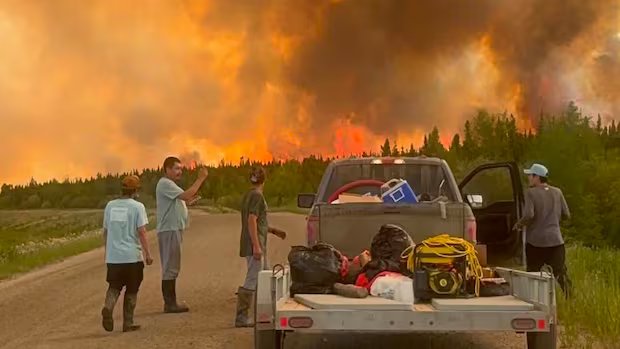

Listen to this article
Estimated 4 minutes
The audio version of this article is generated by AI-based technology. Mispronunciations can occur. We are working with our partners to continually review and improve the results.
Hundreds of people have been forced out of their homes as wildfires continue to threaten communities in northern Manitoba.
The last evacuation flight left Lynn Lake earlier on Sunday as efforts to protect the town of about 600 residents from a nearby wildfire continued a day after it issued a mandatory evacuation order.
The fire detected Thursday was 5,173 hectares as of Saturday, according to the provincial fire map. That’s more than three times larger than reported only a day earlier.
Lynn Lake officials warned in a social media post firefighters faced “challenging” conditions amid warmer temperatures, low humidity and changing winds late Sunday morning.
The fire was projected to reach the community on Sunday. But Mayor Brandon Dulewich said in the afternoon he was “a lot more confident” about the situation than he was 24 hours ago even if they’re not “out of the woods yet.”
“The influx of people coming to community to defend it has been quite overwhelming,” he said, with Manitoba Wildfire Service crews battling the flames and companies like Alamos Gold providing equipment so they can set up protections around town.
“We have been able to keep the fire at bay,” Dulewich said. “The next few days [we’re] hoping to get it to a manageable situation where we can feel a lot more comfortable.”
Lynn Lake said emergency personnel were also assisting evacuation efforts at nearby Marcel Colomb First Nation, also known as Black Sturgeon Falls.
Belinda Merasty with the community’s emergency management team said in a Facebook live video Saturday afternoon the First Nation had declared a state of emergency.
About 100 members of the First Nation about 20 kilometres east of Lynn Lake live on reserve, according to the federal government.
“I’m really sorry to our communities of Lynn Lake and to Marcel Colomb First Nation that we’re experiencing this again,” Merasty said in the Saturday video. Residents of both communities were forced to leave their homes during last year’s wildfire season.
“It’s definitely not going to be like last year where so many people stayed behind … which was really unsafe,” she said.
Marcel Colomb Chief Delhia Hart-Francois said in a statement all but four residents remained in the community as of Sunday afternoon.
Hart-Francois said road closures meant members had lost access to essential goods and services.
“We function virtually as one community,” Lynn Lake’s Dulewich said. “The grocery stores and fuel facilities and everything [is in] Lynn Lake. So with our population gone, it poses a lot of difficulties for them to stay and function as a community.”
The province said more than a dozen firefighting personnel have been deployed in Lynn Lake, with more firefighters from The Pas set to arrive Sunday. Additional supports from other areas including Lac Brochet and Grand Rapids could arrive at Lynn Lake as well, it said.
O-Pipon-Na-Piwin evacuating vulnerable members
About 100 kilometres east of Marcel Colomb, O-Pipon-Na-Piwin Cree Nation was also evacuating some residents after declaring a state of emergency.
An out-of-control blaze southwest of the community was 2,900 hectares in size as of Saturday, with several smaller fires also active in the area. A stretch of Highway 493 connecting the First Nation to the rest of Manitoba remained closed as of Sunday.
O-Pipon-Na-Piwin Chief Shirley Ducharme said about 130 high-priority residents — including people with breathing issues and other medical conditions — will be flown to Winnipeg Sunday, with evacuations continuing Monday.

“There’s a possibility of getting a lot of smoke in the community,” Ducharme said. “If the smoke intensifies then the planes cannot land. So that’s why we’re [getting] the Priority 1s out.”
Water bombers were fighting the large fire southwest of the First Nation Sunday, Ducharme said.
More than 1,100 O-Pipon-Na-Piwin Cree Nation members live on reserve. Ducharme said she hopes the situation doesn’t get to the point they have to order a full evacuation.
The First Nation only had to evacuate half of its residents last year despite a lengthy outage after power lines burned down.
There were few resources available to immediately attack that fire “with so many fires all over the north” last year, Ducharme said.
“I’m hoping it’s a different … scenario this year.”