dailynewsnblog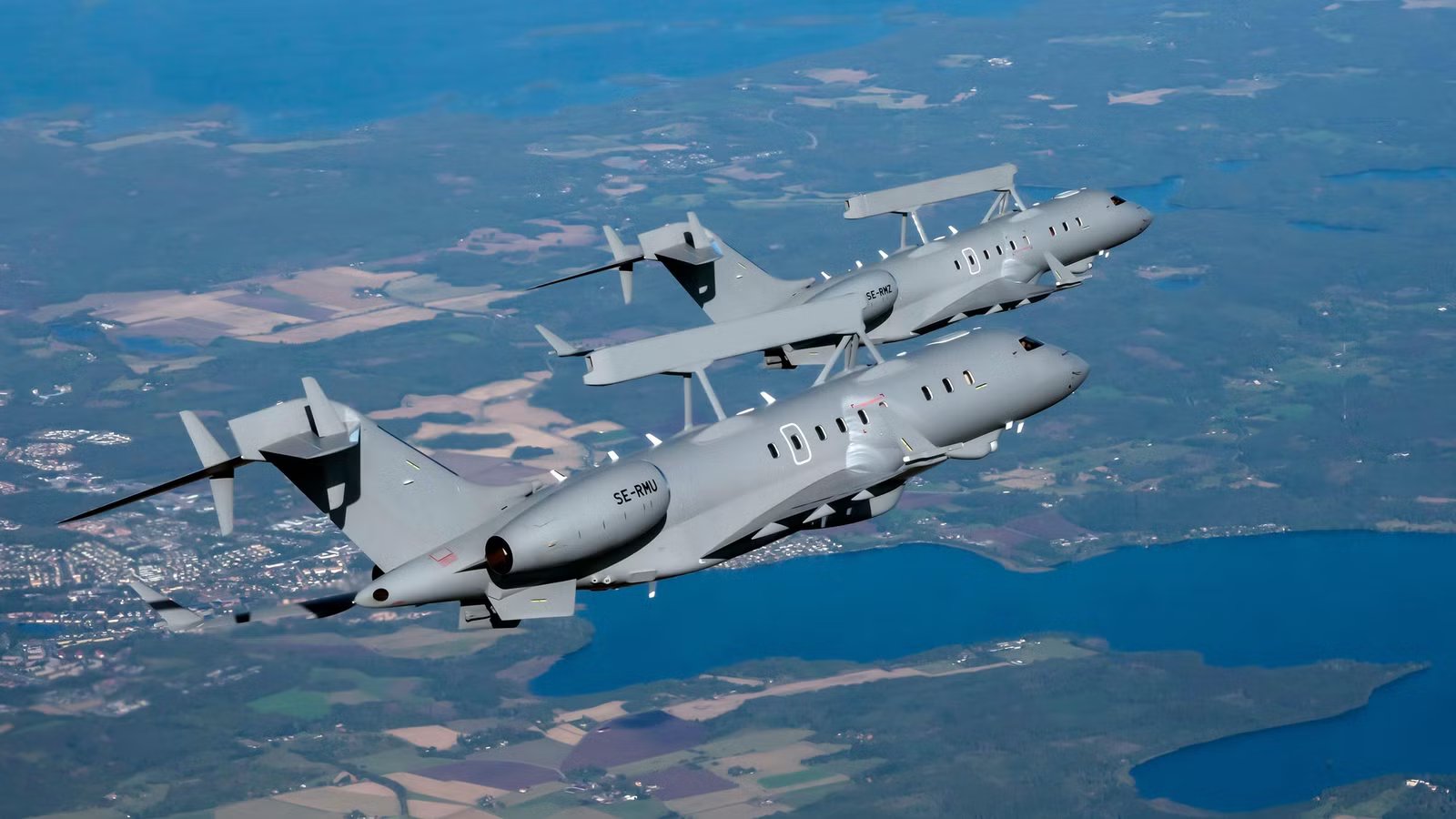
Canada has stated that it will be purchasing the Saab GlobalEye AEW&C aircraft based on the Bombardier business jet. Discussion of this announcement is inseparable from its ongoing acquisition of Lockheed Martin F-35 Lightning IIs, and the prospect of Canada purchasing Saab JAS 39 Gripen E. Canada is exploring operating a mixed fleet of fighter jets.
As discussed in this article, it is unclear how useful GlobalEyes will be for networking with Canada’s future fleet of F-35s, as the aircraft will almost certainly not have access to MADL. Instead, the announcement appears to reinforce the suggestion that Canada is moving to purchase large numbers of Gripen fighter jets. Here is what to know about how GlobalEye fits into Canada’s ongoing efforts to balance NORAD commitments, needed capabilities, sovereignty, and a desire for “made in Canada.”
What Decides Fighter Jet Purchases

While a fighter jet’s capabilities and initial purchase price are certainly important to a country’s selection of a fighter jet type, they are far from the only issues. Arguably, these are not even the most important issues. Fighter jet purchases are extremely high-profile and political. Often, the first filter is geopolitical, not capability per se or initial purchase cost.
For example, it is practically inconceivable for a NATO-member country to purchase Russian or Chinese fighter jets. Here, geopolitics is essentially a hard “no” even before considering capabilities or costs. It is also geopolitically inconceivable for Japan, India, or Vietnam to purchase Chinese fighter jets. This automatically narrows the potential field, and for Canada’s Future Fighter Capability Project (FFCP), that meant only the Eurofighter, Rafale, Gripen, F/A-18 Super Hornet, F-35, F-16, and F-15 could be considered. The F-16 and F-15 did not bid for the contract, while the Super Hornet was eliminated in 2021.
The F-16, F-15, and F/A-18 Super Hornet were not considered suitable for Canadian requirements. This left the Eurofighter, Rafale, Gripen, and F-35. Other considerations for selecting fighter jets include affordability, capability, sovereignty, dependence on foreign nations, contribution to local industry, financing, etc. For a wealthy country like Canada, financing is not a major concern (like it is for Peru). While Canada is a country that would like the fighter jet to contribute to the domestic industry, the integration and capabilities of the F-35 were such that it was selected with a comparatively small added workshare.
Just Two Canadian Options

By 2018, there were five contenders for Canada’s FFCP: the Gripen, Rafale, Super Hornet, Eurofighter, and F-35. In 2018 and 2019, the Eurofighter and Rafale withdrew from the competition. Airbus said two factors led to its decision. One was the NORAD security requirements, which were prohibitive for a fighter jet outside the United States-Canada 2-EYES community. The second reason was a revision of Industrial Technological Benefits (ITB) obligations.
Dassault’s statement also referenced the NORAD security requirements. This left Canada with three options: two American (Super Hornet and F-35) and one Swedish (Gripen). The Super Hornet was eliminated for not meeting capabilities. Simple Flying previously reported that the biggest issue for Canada’s potential decision to purchase Saab Gripen fighter jets is not only that they are significantly less capable than F-35s but also the issue of NORAD integration.
Canada’s fighter jet acquisition (per CBC News, etc.) | |
|---|---|
FFCP winner | F-35 with 95% score (Gripen at 33%) |
Current plan | 88 F-35As |
Reported revised plan | 72 F-35As & Approx. 60 Gripens |
Number of GlobalEyes | Not disclosed (requirement for six) |
% of F-35 made in the US | Approx. 85% |
% of Gripen E made in the US | Approx. 30+% |
A leaked report by Radio Canada shows that in Canadian FFCP evaluations, the F-35 received a “near perfect score” of 95% versus the Saab Gripen E + GlobalEye’s score of just 33%. Canada was left with a decision to purchase the plug-and-play, high-end F-35 or a lower-end, but more sovereign-capable option that offered increased worksharing. However, that latter option would require Washington’s cooperation to integrate into NORAD.
Here’s Why Canada Is Replacing Its CF-18 Hornets With The F-35A
A closer look at the reasons behind an unexpected move.
Canada’s Announcement To Purchase GlobalEye

As stated, geopolitics is often the biggest filter in selecting fighter jets. After Trump returned to the White House, relations between the US and Canada soured, and the purchase of the F-35 became politically contentious. Canada has already contracted to purchase the initial 16 F-35As out of a planned purchase of 88. The first of these is being built. It is considered too late for Canada to outright cancel the F-35, and so it is considering operating a mixed fleet of F-35s and Saab Gripens.
This is where the Saab GlobalEye (with the Saab Erieye radar system) enters the picture. The GlobalEye is interoperable with any Gripens Canada may choose to purchase. The cherry on top is that it is built on modified Canadian Bombardier Global 6000/6500 business jets, allowing the Canadian government to present it as at least partially “made in Canada.”
Canada selected it over the competing Boeing E-7 Wedgetail and the U.S.-Israeli L3-Harris-Elta Systems Aeris X. While the Canadian Prime Minister announced Canada intends to purchase the GlobalEye, he also stressed no contract has yet been signed. He didn’t elaborate on the quantity, delivery timetable, or purchase price, although Canada has previously said it needs six AEW&Cs aircraft.
GlobalEyes Will Come Without MADL

However, the GlobalEye faces the same NORAD integration issues as the Gripen. Without access to MADL or a suitable gateway solution, the GlobalEye and Gripen may be unable to fully exploit the networking capabilities of the F-35 within NORAD operations. MADL is a high-tech, low-probability-of-intercept (stealthy) data link used primarily by F-35 Lightning II fighters as well as some other US platforms.
The US has never exported or licensed MADL technology. CBC News writes, “Data exchange is at the heart of the Royal Canadian Air Force’s concerns about interoperability with allies, particularly when it comes to working alongside the United States in NORAD.” CBC News also quoted retired Canadian Air Force colonel Billie Flynn as saying, “There is no chance that at this point in time that the United States is going to allow anyone who is not an F-35 partner nation to get into the MADL network.”
Without MADL, the GlobalEye and Gripen would need to rely on the older Link 16 system or some kind of “bridge capability”, which makes aircraft far more detectable through electronic emissions. This means that the GlobalEye’s ability to communicate with the F-35s will be hobbled. If a workaround with Washington can’t be reached, then Canada could end up operating almost two separate fleets. The F-35s would be NORAD-integrated, while the Gripens and GlobalEye would not.
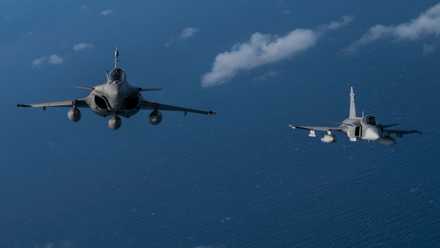
Canada & Portugal Rethink Plans To Buy F-35s Due To Trump
Two key NATO allies are reconsidering plans to buy F-35s as a result of Trump Administration communications.
A Mixed Canadian F-35 & Gripen Fleet

The F-35’s sensor fusion, stealth, and networking capabilities place it in a class above fourth-generation fighters such as the Gripen E. It is better thought of less as a conventional fighter jet, and more as a stealthy flying supercomputer with missiles and networking. Some talking points for the Gripen are questionable, at least in the Canadian context.
Proponents argue the Gripen is designed for Arctic conditions; that is true, but so is the F-35. It has been selected by Finland and Norway over the Gripen and regularly operates from US bases in Alaska. It is said that the Gripen is designed to operate from dispersed bases. This is broadly true but also nuanced plus the F-35 can do the same, and Finland has a similar doctrine for its F-35As. In the Canadian context, dispersion is not nearly as important as range.
In June 2026, Radio-Canada reported a leak that Canada was considering a mixed fleet of F-35s and Gripens. As stated, Canada has already paid for the first 16 F-35s and is reportedly discreetly making the payments for an additional 14 F-35As. Reports suggest that Canada is considering purchasing 72 F-35As (down from 88) and around 60 Gripens. It is likely Canada is calculating that 72 is enough to placate Washington with its NORAD commitments, while 60 is enough to warrant a Gripen production line in Canada, secure worksharing, and present the public with a “made in Canada” non-American fighter jet.
Washington’s Decision & The Irony Of The Gripen

Saab says, “What is interoperability? In the Canadian context, it has two separate but important components: conformance with international military standards (ex. NATO), and the security of data in compliance with inter-governmental agreements (ex. NORAD).” Saab argues that interoperability extends beyond access to specific systems, such as MADL, and believes technical solutions could be developed to meet NORAD requirements.
However, this is simply not Saab’s decision to make. At the end of the day, Washington has control and decides which aircraft to integrate. Canada and Saab can lobby, offer solutions, suggest workarounds, etc. Ultimately, access to key US-controlled communications and encryption technologies depends on Washington’s approval.
Depending on the methodology, the US contributes around 30+% of the components and systems of the Gripen, and this has only increased with the Gripen E’s new engine. Additionally, around 30+% of it is produced by the United Kingdom. The Gripen can be thought of as an Anglo-American-Swedish fighter jet with Saab maintaining overall control. The only modern Western fighter jets that are mostly free from US export restrictions are the Eurofighter and especially the Rafale. Conversely, the F-35 is roughly 80-85% American, with much of the remainder being British. Canada is a small but not insignificant contributor, accounting for around $2.3 million for each aircraft (per F-35.com).