dailynewsnblog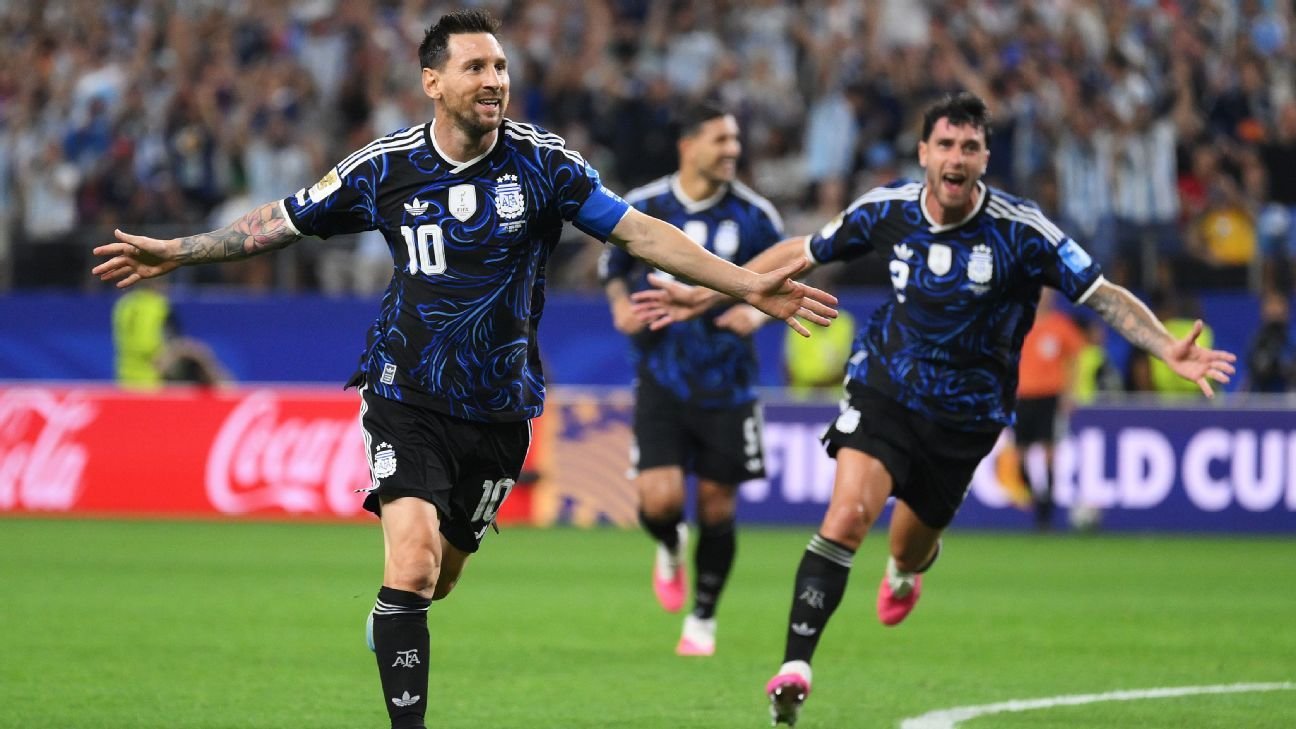
DALLAS — As Argentina captain Lionel Messi found his way to an unusual position for the start of the final Group J match against Jordan on Saturday night, the substitute’s bench, fans inside Dallas Stadium chanted his name.
Argentina manager Lionel Scaloni had said ahead of the game that, with the team already qualified in top spot, certain players needed rest and it would give him a chance to gauge the depth of his roster.
So, with Messi sitting out, Scaloni opted for a mixture of experience and youth against Jordan; Giovani Lo Celso, Giuliano Simeone, Nico Paz and Marcos Senesi made their World Cup debuts, while defenders Nicolás Otamendi (38) and Nicolás Tagliafico (33) balanced out the line up’s average age.
“Today was a match to avoid risking players and to be able to see players who can fill different positions,” Scaloni said after the match. And it worked, as La Albiceleste ran out easy 3-1 winners.
By the 10th minute, Argentina had enjoyed 83% of possession and consistently pegged Jordan back into their own half; nine minutes later, midfielder Lo Celso broke the deadlock with a free kick from just outside the box.
Messi would usually have been the one to set up from that distance, but Lo Celso was tasked with the responsibility and struck a sweet shot to become only the second Argentina player to score in this World Cup … behind Messi.
Striker Lautaro Martínez then doubled the score before halftime with a penalty — again, taking over from where Messi would have stood — and celebrated his first World Cup goal with a cleansing motion to signal a fresh start.
“The boys played a good match; we were able to give minutes to everyone and that makes us happy,” Scaloni said after the match. “Lo Celso couldn’t be in the previous World Cup [due to injury]; Lautaro hadn’t been able to score. We’re happy for them. Now the good part is coming.”
Of course, no Argentina game at this World Cup could be complete without a Messi goal. After Mousa Al-Tamari had surprisingly pulled a goal back for Jordan, the 39-year-old came on for Martinez in the 60th minute and was able to add to his incredible tournament tally with signature free kick, sending the crowd into a frenzy.
Messi is now the only player to have scored in seven consecutive World Cup games, the longest streak in World Cup history — having been one of only three players to score in six consecutive games alongside France striker Just Fontaine and Brazil great Jairzinho — and also extended his personal goal-scoring record at the tournament to 19.
“I am very happy for him [Messi], for the moment he is having,” Lo Celso said after the game. “The truth is that seeing him every day excites, excites and infects a lot. So obviously seeing him like that for us is very important.”
In a dominant performance, Argentina ended the match with 12 shots, 73% possession and an expected goals tally of 2.13. But more importantly, they showed that they can still play well without their captain.
They face World Cup debutants Cape Verde next in Miami in the round of 32, but their undefeated opponents have shown during the group stage — in holding Spain, Uruguay and Saudi Arabia to draws and earning second place in Group H — that their defensive nature may pose a threat for the reigning champions.
However, Scaloni can rest assured that if Cape Verde or any future opponents somehow crack the code on how to stop Messi, La Albiceleste will continue to shine as they have plenty of players who can step up in his absence.
“We always focus on ourselves, any opponent is tough,” he said. “We have to try to do maximum damage to the opponent with our best weapons.”