dailynewsnblog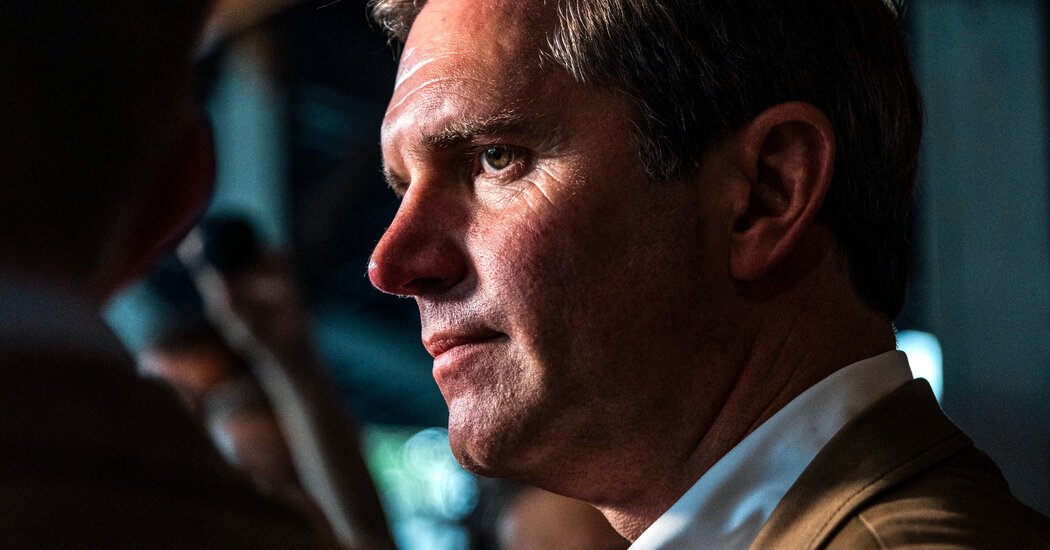
Gov. Andy Beshear of Kentucky made a pilgrimage in April to the Rev. Al Sharpton’s National Action Network conference in New York City. On a sweltering night in May, he was at Representative James E. Clyburn’s “World Famous Fish Fry” in South Carolina. This month, he has rallied Democrats in Colorado, Nevada, Minnesota and Iowa.
“I am living, breathing proof the Democrats can win anywhere, and we should be fighting everywhere!” Mr. Beshear shouted at a rally in Des Moines for Rob Sand, who had just won the party’s nomination for Iowa governor.
Mr. Beshear, who seems to be everywhere on the 2026 midterms circuit, is in demand as a surrogate for Democrats in frontline races, all while positioning himself for an expected presidential run in 2028. Democrats, who urgently need to be competitive in more states if they are to win back Congress and eventually the White House, see hope in Mr. Beshear, a twice-elected Democratic governor of a deep-red state that President Trump won by 30 points in 2024. But some wonder whether his success is replicable outside of Kentucky, where he benefited from the popularity of his father, a two-term governor from 2007 to 2015.
Mr. Beshear, who is pushing moderation as democratic socialists are ascendant in New York City and other recent contests, is now making his case to key constituencies, particularly Black voters.
“I am the grandson and great-grandson of lay Baptist ministers from Western Kentucky,” Mr. Beshear, a deacon at Beargrass Christian Church in Louisville, told Mr. Sharpton’s civil rights group.
“I will never be able to feel the pain of racism,” he said a short time later, but “I can listen and I can try to hear.”
Mr. Beshear’s message is that as a Southern pro-business, pro-union “pragmatic” Democrat who knows his way around the Bible, he can appeal to voters beyond the party’s liberal base. In speeches he touts the growth in jobs, economic investment and health care access that has occurred under his leadership in Kentucky, one of the poorest states in the country. He argues that America is ready for someone who can heal.
“I don’t think ultimately that people are going to want a Democratic version of Trump,” Mr. Beshear said in a recent interview at the Old Governor’s Mansion in Frankfort, Kentucky’s sleepy state capital. It was a clear reference to Gov. Gavin Newsom of California, an early front-runner.
In an already-congested field of potential Democratic candidates, Mr. Beshear would face a formidable challenge. He has none of Mr. Newsom’s flash and taste for combat, none of the name recognition of former Vice President Kamala Harris, nothing like the money of Gov. JB Pritzker of Illinois and none of the recent buzz surrounding Senator Jon Ossoff of Georgia. Representative Ro Khanna, a Democrat from California who represents Silicon Valley, is matching Mr. Beshear’s aggressive travel schedule, including turning up at Mr. Clyburn’s fish fry.
Mr. Beshear is the Boy Scout in this group — disciplined, earnest, eager to please, a little stiff. No one has ever accused him of being exciting. But he projects more energy and passion on the stump than he did even two years ago, and his manners and soft Lexington drawl hide a certain intensity. When he can’t sleep at night, he said, he gets up and runs on a treadmill, then heads to work.
“That’s probably once a week,” he said. “I’ll go to sleep at 10, I’ll wake up at 4.”
He grew up in the horse country of Lexington, Ky., where his father expected top grades and hard work and his mother, an equestrian, put him in the saddle on the family’s 35-acre Hourglass Farm almost before he could walk. His first job was at a nearby farm mucking stalls, including shoveling manure.
“The joke I’m able to make, because it’s real, is it prepares you for politics,” Mr. Beshear said. “Horses are great animals, but you can’t ever get too comfortable. The only horse that ever kicked me was one of the calmest ones.”
His early reviews this year have been good. Mr. Sharpton went so far as to compare Mr. Beshear to former President Bill Clinton, a Democratic governor from a southern state who few people saw coming ahead of the primaries in 1992.
“You can’t count Beshear out because he could be a sleeper that arrives without any forecast,” Mr. Sharpton said in an interview.
Mr. Clyburn, South Carolina’s Democratic power broker who for years was the highest-ranking Black member of the House, was complimentary too. “I think the American people are waiting on someone to enunciate a vision that they can become emotionally attached to, and Beshear’s been doing that,” he said at the state Democratic Party’s annual Blue Palmetto Dinner, where Mr. Beshear was the keynote speaker.
In Kentucky, Mr. Beshear remains popular despite his support for abortion rights and his veto in 2023 of a bill that placed sweeping restrictions on transgender youth. A statewide poll in February showed that 52 percent of Kentucky voters approved of the job he was doing as governor, including 81 percent of Democrats, 50 percent of independents and 30 percent of Republicans.
The transgender bill was “the nastiest piece of anti-L.G.B.T.Q.+ legislation the state had ever seen,” Mr. Beshear said in a speech at the New Hampshire Democratic Party’s annual convention in May in Dover, N.H. “I believe that all children are children of God. And I didn’t want people picking on those kids.”
The veto was overridden by the powerful Republican state Legislature, led by the Senate president, Robert Stivers, who has fought bitterly with Mr. Beshear over budgets and executive power. He takes a dim view of Mr. Beshear’s future.
“In hell a snowball would have a better chance,” Mr. Stivers told The Lexington Herald Leader when asked about Mr. Beshear’s potential 2028 presidential run.
Others in the state give Mr. Beshear somewhat better odds. “Many Kentuckians were naturally skeptical because they remember him from when he was a very green candidate and as attorney general,” said Al Cross, a veteran Kentucky political writer. “It took him a while to find his feet.”
But every time Mr. Cross has seen Mr. Beshear recently, he said, “he gets a little bit better. He continues that incremental progress. The question is, what is his ceiling?”
A Father and Son
What is striking about Mr. Beshear, 48, is how closely his career has followed that of his father, Steven L. Beshear, 81. Before becoming governor, both Beshears worked at the White & Case law firm in Washington and the Stites & Harbison firm in Louisville, and both were attorney general of Kentucky. (Steve Beshear was also lieutenant governor.)
The younger Mr. Beshear shrugged off any sense of competition. “I love the man, and if you compare him to me, I take that as a huge compliment,” he said. “Now, I do let him know that when you look at governors who brought in the most private sector investment, he is second.” Mr. Beshear smiled at that, then took a more serious tone.
“Oh, I haven’t felt in Dad’s shadow for a long time,” he said.
Mr. Beshear’s father was dismissive of any familial motive behind his son’s potential presidential run. “You mean he wants to outdo me?” he said with a laugh.
Steve Beshear spoke at a Starbucks near the family farm, which he said had grown to 55 acres. The property has been referred to in the local news media as a “small horse farm,” which the younger Mr. Beshear maintained was an accurate description, if only in comparison to the legendary thoroughbred farms of sometimes thousands of acres around Lexington. He had a quarter horse, a “really mean pony,” and competed in some shows as a youth.
But he has not been on a horse in 20 years. “I did it to be with my family,” he said. “It just wasn’t my passion.”
In 2019 Mr. Beshear won his first gubernatorial race with the help of his last name, and even then he beat an unpopular Republican incumbent, Matt Bevin, by less than half a percentage point. He won a solid victory four years later against Daniel Cameron, a former Kentucky attorney general.
Mr. Beshear’s first term as governor was dominated by a tornado in western Kentucky that killed 80 people, flooding in the east that killed 45 and Covid-19, which killed more than 18,000. For many in the state, the former governor’s son turned out to be a strong leader in a crisis.
In the early months of the coronavirus pandemic, Mr. Beshear updated Kentuckians daily on camera, including with the stories of those who had died. He occasionally choked up and frequently invoked his faith. Although he drew anger over mask mandates and school closures, his supporters cite his empathy as one reason for his popularity in the state.
‘I Believed It in the Moment’
Mr. Beshear spoke at two Black churches on his May swing through South Carolina, including the Zion Benevolent Baptist Church outside of Columbia. “I lead with my faith,” he told the pastor and parishioners.
In an interview afterward, he criticized Pete Hegseth, the defense secretary, who has asked Americans to pray “every day, on bended knee” for a military victory in the Middle East “in the name of Jesus Christ.” Invoking Christ’s name in war, Mr. Beshear said, “is manipulation.”
In March, Mr. Beshear excoriated Vice President JD Vance, another likely 2028 presidential candidate, as the “most arrogant politician I have ever seen” and said that “Hillbilly Elegy,” Mr. Vance’s memoir about his difficult youth in Kentucky and Ohio, “trafficked in this tired stereotype” about the region. The book amounted to “poverty tourism,” Mr. Beshear said.
At this point, Mr. Beshear plans to spend more time on the political circuit before a tour in September for what will serve as his campaign book, “Go and Do Likewise,” about his faith and his time as governor. He said he would decide later this year whether to run for president.
After he won re-election as governor, he said, “I walked off the stage in 2023, took a long breath, looked at my wife and said, ‘We’ll never have to run for anything ever again.’”
Things changed in November 2024. Ms. Harris’s presidential election loss meant the Democratic field would be wide open in 2028, and what Mr. Beshear has called the “chaos, incompetence and cruelty” of Mr. Trump’s second term gave him something to run against.
“I will not leave a broken country to my kids or to anyone else’s kids,” he said recently in Nevada.
As for what he said in 2023? “I truly believed it in the moment,” he said.
Kitty Bennett contributed research.