dailynewsnblog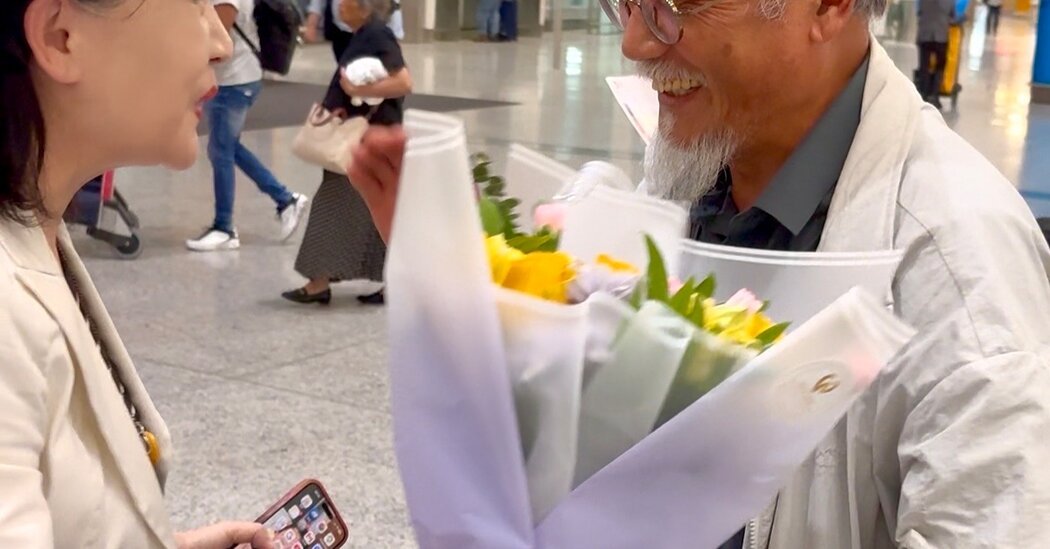
About a month ago, the Chinese dissident Dong Guangping spent 36 hours at sea in an inflatable rubber boat with a sputtering engine, a peeling face and a dying phone before getting detained in South Korea.
But on Saturday, Mr. Dong, 68, told The New York Times that he had flown to Toronto, ending a treacherous and decade-long search for freedom. He also recounted details of his voyage across the Yellow Sea from China to South Korea for the first time.
Mr. Dong, a critic of China’s ruling Communist Party, had been trying for more than 10 years to escape his country, where he was imprisoned several times and faced police surveillance and an exit ban. He was thrown out of Thailand and Vietnam, and picked up by mainland Chinese fishermen as he attempted to swim to Taiwan.
Mr. Dong’s friends hoped that his recent escape across the Yellow Sea to South Korea would end differently — and they were right.
His journey started before sunrise on May 24, when he set off from the coastal Chinese city of Weihai in a gray inflatable boat.
Three years earlier, another Chinese dissident had fled to South Korea by jet ski and was eventually permitted to leave after facing months of detention and legal limbo.
That journey was an inspiration for Mr. Dong, though he said he aimed his boat for Japan because he was more familiar with it. His plan was to eventually fly to Canada, where his wife and daughter live.
He said he brought 42 gallons of gasoline, enough for a journey that he estimated would stretch nearly 440 miles, and a supply of cooked beef and crackers.
Mr. Dong, who had never operated a boat before, said he feared the engine would fail. To protect it, he kept his speed low, crawling along at just three miles per hour.
He used his smartphone to chart a course around the Korean Peninsula toward Japan, relying on the sun during the clear, scorching day to keep his bearings without draining his battery.
In the evening, he recalled, he experienced a brief moment of peace at sunset, with the moon in the sky. “The scenery was truly, truly beautiful,” he said.
But the next day was unforgiving.
The weather shifted, turning the sky into a featureless grayish white. With the sun obscured by clouds, he lost his bearings.
“The sea and sky are just a vast expanse of white, and you can’t tell which way is which,” he said.
Then his phone died, and his power bank was no help. He said the prospect of having no communications terrified him.
The boat’s engine also began to betray him as seaweed and debris clogged its intake. It kept stalling whenever he tried to slow down. After 36 hours of grueling effort, he said, he had traveled only 124 miles.
That’s when he picked up his speed and switched to his backup plan of heading toward South Korea. At certain points, he said, the only thing on his mind was survival.
“You’re facing a life-or-death juncture,” he said. “If your decision-making is poor, then you’re dead. Everything else — thinking about family, friends, work, money, food and water — none of that was useful.”
By the evening, he began seeing lights in the distance. He said he was relieved and steered toward them.
He said he then encountered a construction vessel. He cried for help, but he couldn’t be heard over noise from the ship’s propellers.
Moments later, he saw a fishing boat and called for help again as he watched a fisherman pull in his net.
“I thought I was going to die” from exhaustion, Mr. Dong said. “I was already in a terrible state.”
A fisherman agreed to take him onto the boat and called the coast guard. South Korean coast guard officials then detained him and brought him back to land to face questioning.
The exact legal process that led to Mr. Dong’s release was not immediately clear on Saturday.
Kim Joo-kwang, the lawyer who represented him in South Korea, said on Saturday that he could not comment. A spokesman for the court that handled Mr. Dong’s case could not immediately be reached.
The Chinese authorities also did not respond to a request for comment on Saturday. A Chinese foreign ministry official said at the time of Mr. Dong’s arrival in South Korea that officials in China were not aware of his situation.
Mr. Dong said that the true turning point in his journey didn’t happen at sea, but in the clinical confines of a South Korean coast guard station where officials granted him access to a lawyer.
“I knew then they would send me to Canada, because they were proceeding according to legal procedures,” he said, contrasting his experience there with his past captures in China, Thailand and Vietnam. “As long as it is a democratic country run by the rule of law, they would not send me back to China.”
Days later, Coast Guard officials requested an arrest warrant for him. But a judge denied it, Mr. Dong said, and the authorities eventually allowed him to leave the country.
Mr. Dong said he was housed in a refugee center in Incheon, a city near Seoul, with asylum seekers from Myanmar, Uzbekistan, Kazakhstan and other countries. He passed his evenings watching pickup soccer at the facility and later World Cup matches on television.
One day, he said, his lawyer secured a temporary exit permit that allowed him to visit a monument to the Korean War in Seoul. He said that he had been curious about the history of the conflict and wanted to compare South Korea’s portrayal of events with the propaganda he had been raised on in China.
Then the day finally arrived: He was flying to Toronto.
“It felt like I was dreaming,” he said.
When he boarded the plane and settled into his aisle seat, he said, his mind was flooded with so many thoughts that his head ached. To stop thinking, he watched the science fiction movies “Avatar” and “Interstellar.”
Zang Xihong, a fellow Chinese activist who goes by the pen name Sheng Xue and helped to coordinate his escape, was among those who greeted him at Toronto Pearson International Airport on Friday evening.
“I’m very happy,” Mr. Dong said in a video interview from her home a few hours later. “Sitting here now, it feels like I’ve come home.”
The Canadian authorities did not immediately respond to a request for comment.
Mr. Dong added that he hoped to keep working on a cause he began chasing in 1999, when he signed a letter about the 1989 Tiananmen Square massacre in Beijing — the initial act that angered the Chinese authorities.
“It is necessary to achieve constitutional democracy in China,” he said. “I treat this as what I need to do for the rest of my life.”