dailynewsnblog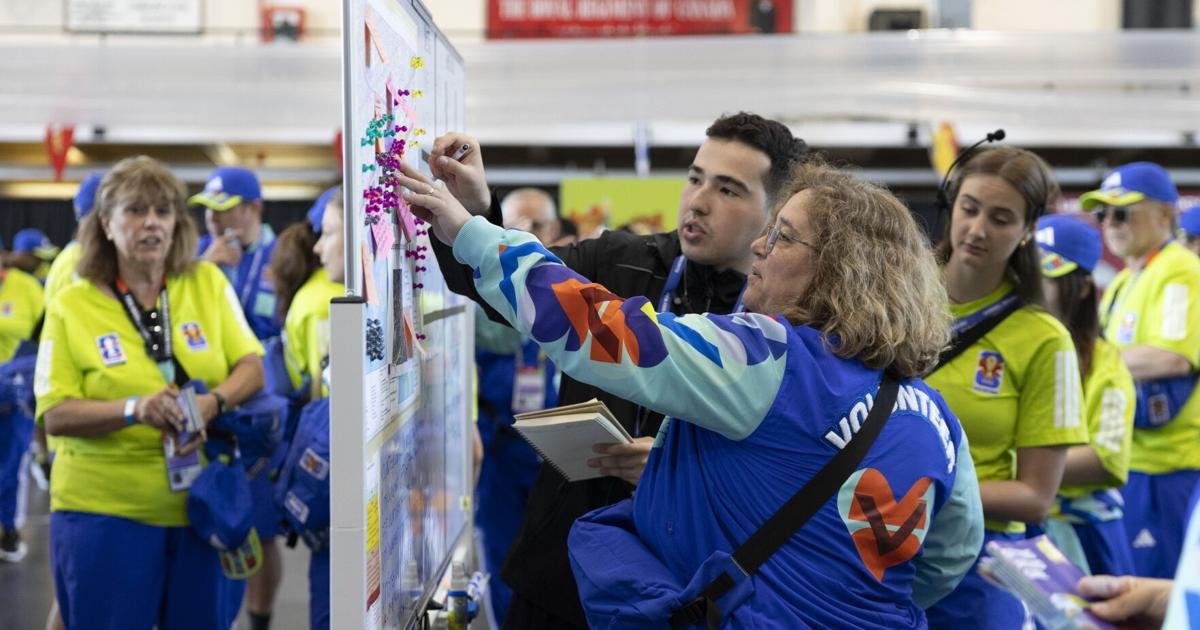
You may see them welcoming visiting soccer fans at Pearson airport, or guiding people around Toronto Stadium. You can spot them on the fringes of press conferences with global soccer stars, and on the field before each match unveiling massive flags, creating images beamed around the world.
FIFA volunteers and their eye-catching blue and teal outfits are all over Toronto this month, as the city co-hosts the World Cup. Although the famous players and big-name sponsors may get most of the attention, it’s this army of unpaid recruits that is helping make the tournament run.
Organizers in 16 host cities in Canada, the U.S. and Mexico expect to use some 65,000 volunteers to stage the games, making this edition of FIFA’s volunteer program the largest ever. More than 3,000 are in Toronto, which is hosting six matches.
The volunteers aren’t relegated to waving at fans or handing out merch. They assist with such essential tasks as accessibility services, media operations and event logistics. Specific roles range from language interpretation to anti-doping support — where volunteers notify athletes for testing and escort them to the doping control room — to brand protection duties, in which volunteers act as the “eyes and ears” of FIFA by reporting the sale of unauthorized products around stadiums.
FIFA — which, as soccer’s global governing body, takes in billions of dollars in annual revenue — says that while its volunteers aren’t paid, they get a chance to learn valuable skills and make lifelong memories.
But the use of unpaid positions to aid with important tournament functions has some advocates questioning whether FIFA is relying on unfair labour practices to bring the beautiful game to the global stage. It’s a criticism FIFA strongly denies.

Volunteers eat lunch and watch the match on TV at the Fort York Armoury on June 17.
Sophie Bouquillon/Toronto Star
Volunteer program complies with all laws, FIFA says
“These aren’t true volunteers like, say, parents chaperoning their kids on school trips,” said labour relations lawyer Ryan White, of Cavalluzzo LLP. He said roles being filled by FIFA volunteers such as ticketing services are jobs an organization would normally have to pay someone to do.
“If what people are providing is what would normally be service-sector employment or security-sector employment, there’s a strong presumption that it’s not volunteer work,” White said.
“This is actual labour that’s being disguised as volunteer work in order to get around labour protections.”
In a statement, FIFA said it “categorically rejects any suggestion that its volunteer program replaces paid employment, circumvents labour laws or is inconsistent with applicable employment protections.”
It said the program complies with the laws and regulations of each host country, and as is typical of international sporting events, it uses volunteers in “defined, non-specialist” roles to “complement tournament operations.”
“Any suggestion that the program is being used to avoid labour protections or engage in unfair labour practices is simply false,” it said.
FIFA didn’t directly respond to a question about why an organization with its extensive resources has decided to use volunteers rather than paying people for those roles.
The Swiss-based association expects to take in more than $13 billion (U.S.) in revenue over the 2023-26 World Cup cycle, through the sale of broadcast rights, licensing, tickets and other sources. A non-profit, FIFA says it reinvests that money to grow the game throughout the world.
The organization said it “places a strong emphasis on volunteer wellbeing” and has great respect “for their time and contribution.” Volunteers receive “resources to ensure they feel supported throughout their participation,” including rest breaks and meals.
FIFA also noted there has been a “massive show of enthusiasm” for volunteering at the 2026 World Cup.
More than 1.1 million people applied, about 387,000 from Canada; just over 5,000 from the country were offered roles.
The City of Toronto, which partnered with organizers on the volunteer recruitment drive, declined to answer questions, referring them to FIFA.
Detailed guidelines for volunteers
World Cup volunteers are expected to commit to a minimum of eight shifts, each about six hours. However, according to FIFA’s “Rules of Play” training guide, volunteers are encouraged to stay flexible to account for “rare instances” when a match goes late and they may be asked “at (their) discretion” to remain “beyond their scheduled time.”
The guide also directs volunteers to “show discretion” toward players and other VIPs, and to not take photos or ask for autographs. Volunteers must refer all media requests to organizers, and unauthorized communications may be grounds for “immediate removal” from the program.
The guide puts particular emphasis on the need to “protect” the brands of FIFA and its sponsors. Volunteers are directed to “proudly wear” their official Adidas uniform, with no modifications. If for some reason they aren’t able to wear their supplied Adidas shoes, the guide explicitly forbids them from wearing Nikes instead. If any part of the uniform isn’t wearable, “you must wear Adidas or unbranded items,” it states.

A volunteer briefing map.
Sophie Bouquillon/Toronto Star
‘You may feel exploited’
Rafiq Dhanji, a sustainability consultant from Scarborough, is volunteering at Toronto Stadium for the World Cup. He’s excited to be close to the action, and will be performing tasks such as prepping change rooms, grabbing towels and getting cold tubs ready.
“My understanding is that we are able to interact with the team, should they want to interact with us,” he said, with a smile.
FIFA gave the Star permission to interview Dhanji on the condition his team lead and a member of the organization’s media office sat in.
Dhanji has loved soccer since he was young, and saw volunteering as a chance to celebrate the game with people from different backgrounds. To have the tournament in Toronto is a “memorable, lifetime experience,” he said.
Not all volunteers agree that their role is a dream come true, however.
One volunteer, who is tasked with greeting people at Pearson airport, told the Star participants may not realize what they’re signing up for, which they said can include rowdy fans, limited perks and long hours. Being asked to stay late on an evening shift could mean staying past midnight, said the volunteer.
The source, who spoke on condition their name wouldn’t be published because they weren’t authorized to talk to media, said the training that volunteers receive emphasizes that they’re an extension of FIFA’s brand. “We need to be on our best behaviour and represent the organization in a good light,” they said. But the idea of volunteers’ importance to FIFA seemed at odds with the fact they’re not paid, they said.
“You just have to rationalize it in your head,” the volunteer said. “Otherwise, you may feel exploited.”
Despite reservations, the volunteer wanted to take part in the tournament because they’re a big soccer fan. FIFA is “taking advantage of the fact” that many people “just want to be involved any way that they can,” they said.
FIFA said volunteers are “not expected nor required to remain beyond their confirmed shift, including in cases of match delays or extra time.” The organization said all shifts are “self-scheduled.”

More than 3,000 FIFA volunteers are in Toronto, which is hosting six matches.
Sophie BouquillonToronto Star
Province should scrutinize volunteer roles, advocates say
Labour advocates say Ontario’s Ministry of Labour should proactively assess whether FIFA has misclassified volunteer roles that under provincial law should be paid employment. The classification is important because under Ontario’s Employment Standards Act (ESA), volunteers aren’t entitled to the same protections as employees such as overtime pay and minimum wage.
“Many of the volunteer roles listed (by FIFA) are skilled jobs,” said Deena Ladd, executive director of the Workers’ Action Centre, who said it was up to the government “to be holding FIFA accountable and for the vetting of jobs and job descriptions.”
White, the labour lawyer, pointed to FIFA’s expectations for volunteers — including requirements they wear uniforms, follow codes of conduct and may be asked to stay later than initially scheduled — as examples of the kind of oversight commonly associated with an employer-employee relationship.
He argued that FIFA’s economic and cultural influence, combined with the prestige associated with the World Cup, could encourage people to accept unpaid work they might otherwise expect to be compensated for.
Ministry spokesperson Spenser Maki said misclassification “is a very complex thing to proactively monitor,” but the ministry has reached out to “FIFA stakeholders” to make them aware of their obligations, with “a particular emphasis on the use of volunteers.”