dailynewsnblog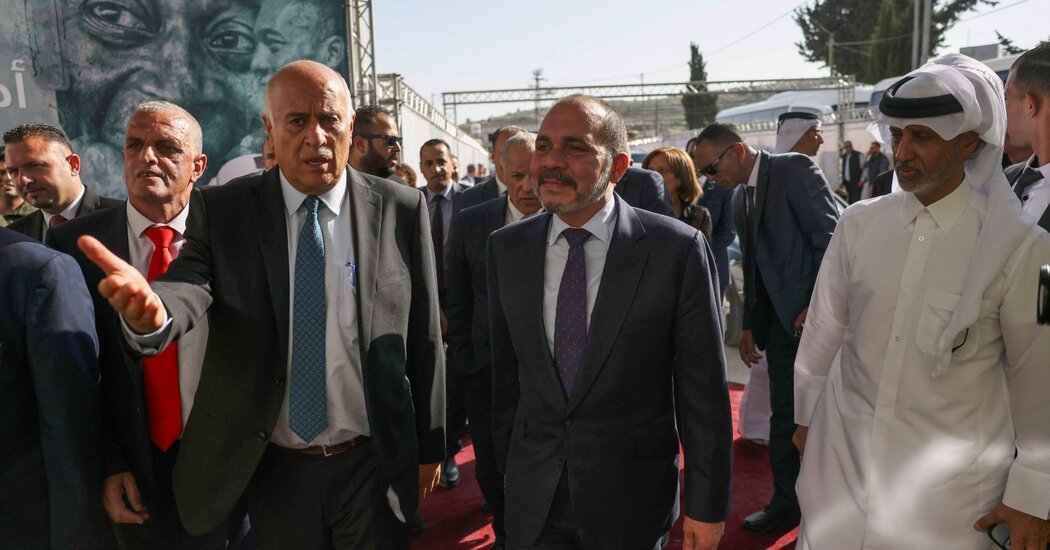
He was once better known as an outsider prince running to lead FIFA. Those chances were remote, but at the time perhaps more likely than the possibility of his nation, Jordan, qualifying for the World Cup.
Sitting at a hotel, in a navy team polo, officials scurrying around him as they prepared for an evening game against Algeria, Prince Ali bin Al Hussein, half brother of King Abdullah, could not be happier about how things turned out.
Jordan arrived at the 2026 World Cup as one of four first-time entrants. That achievement, Prince Ali said in an interview, is the culmination of two decades of work.
With the help of technical experts, he built a youth system and a network of centers to identify and develop local talent, drawing in players as young as 10 and waiting for the pipeline to mature. Unlike many smaller countries like Curaçao, the small Caribbean island that is another first-time competitor, Jordan has not relied on a diaspora developed in the academies of wealthier European nations. Nor has it imported and naturalized players, as some Middle Eastern neighbors have done.
“They’re my boys,” he said. Some are now the same age as his own children, and others feel like younger brothers. The prince, 50, travels with the team, and acts as a mediator when a member of the coaching staff needs help with a player. That hands-on approach extended to helping design the team’s jersey with help from his daughter.
Qualifying for soccer’s grandest and most watched tournament gave Jordan’s players a global platform, and with it, a responsibility. The jerseys the players wore needed to reflect the nation. Nothing expressed that more than the red and white checkered scarf known as the shemagh, a staple of the fans’ uniform at games. “So we thought, why not just put it on the jersey itself?” the prince said.
Heading Jordan’s soccer federation is only one part of Prince Ali’s portfolio, and by his own account the most fun. His more consequential role is coordinating Jordan’s response to crises. And in recent years, there have been many. Next door to Israel, Jordan has found itself at the forefront of war and geopolitics. It is home to millions of Palestinian refugees and recently has absorbed a barrage of Iranian missiles aimed at countries hosting American military installations. Qualification for the World Cup offered a release and a chance for the team to represent more than itself.
“The Middle East is not a homogeneous area, as people think,” he said. “In Jordan, we don’t have oil or resources that others have, but at the same time, we also represent the Levant as a whole, which is much more similar in culture. So, for example, Palestine, Lebanon, Syria, we also represent them because they associate with us.”
That much was clear at the game with Algeria, which Jordan led before losing, ending its chances of advancing from the group stage, with only one game remaining — against the world champion Argentina and its superstar Lionel Messi on Saturday night.
Fans wore the traditional Jordanian shemagh, but often paired it with a similar scarf with black and white checks representing the Palestinian people. That solidarity was also on display a day before the game, when some Palestinians who had been wounded in the Gaza war and brought to the United States for medical treatment stopped by for a visit.
“It’s important to show support for them, and then they’re supporting us,” said Prince Ali, whose mother was Palestinian. “But it is sad seeing somebody without their arms, without limbs, you know, it is very emotional.”
Jordan’s World Cup run has given its diaspora across the United States an opportunity to come together in ways it never had before. Outside the team’s hotel in San Jose, Calif., before its second game, Jordanians and Palestinians from Chicago, Michigan and California gathered to sing and chant as they waited for the players to leave for the stadium.
“Oh my God, this is the proudest moment of my life,” said Farouk Jarrah, 65, who moved to America when he was 17. “For a small nation like ours, a survivor in a difficult part of the world, you cannot believe how proud we are.”
He was among a crowd of people who stopped Prince Ali, wandering into the hotel, for a chat. The prince’s low-key, one-of-the-team energy briefly turned a Los Angeles woman viral.
Shannon Manson, part of the security detail at the team’s hotel, was tasked with moving members of the Jordanian delegation to the door to catch a bus to practice. The prince was dawdling, busy signing autographs. Ms. Mason put her arms around him and laughed uproariously. “So you really want to do this today, right?” she asked.
A video of the moment spread across the Jordanian community in the United States, Jordan and the Middle East, instantly transforming Ms. Manson into a World Cup celebrity. “She kicked me out,” Prince Ali said, grinning as he recalled the moment.
“I didn’t know he was a prince, but I feel real good,” Ms. Manson said in an interview in between the photo requests.
Outside the hotel, security guards and police officers accepted Jordanian scarves and placed them over their shoulders; similar scenes have played out in Portland, Ore., where the team is based. “This is hugely important, you know, just the appreciation they have and we have for them,” Prince Ali said. “I think that’s also important for others to realize so, regardless of what you see as politics.”
Next, and last, comes Messi, and a match against Prince Ali’s favorite team. “It’s a challenge, and if you’re going to go up at this level, go up against the best, and see how good we really are,” he said. “Maybe they will want our autographs after the game.”