dailynewsnblog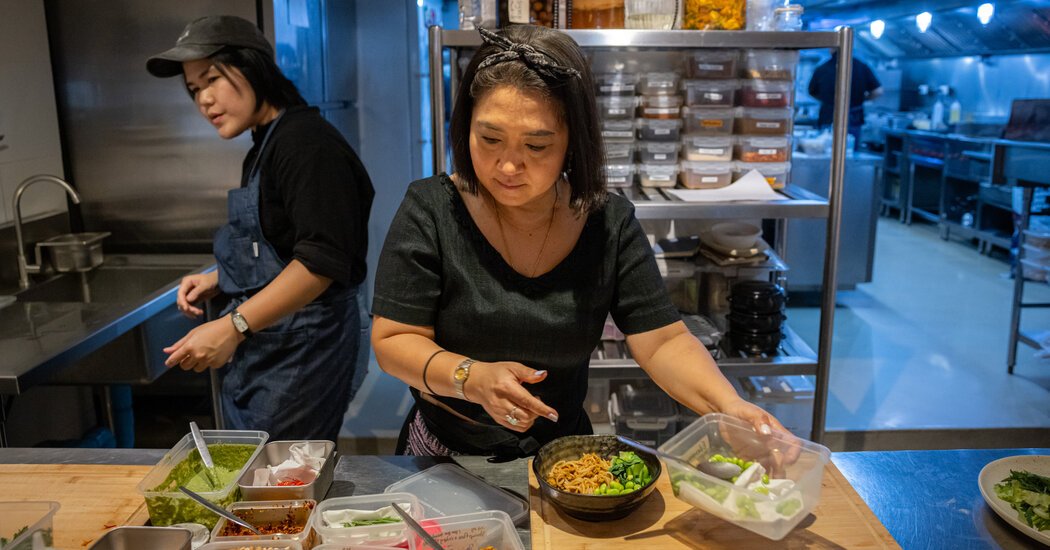
Phyu Cyn calls herself a nomad chef and never travels without laphet, fermented tea leaves, a signature snack from her native Myanmar.
On a recent Thursday, at a hip Thai restaurant in the popular Kreuzberg neighborhood of Berlin, she served laphet in a dip, plus grilled eggplant with sesame oil and fish sauce.
The cuisine was unfamiliar to many of the guests, most likely because of the isolation Myanmar has suffered through decades of authoritarian rule.
“I was going into it fully blind, and it was amazing,” said Emil Ringheim, a designer originally from Oslo.
Seated in front of vibrant modern art, guests were scrambling to find words to describe the food. One couple came in expecting some punchy Thai dishes, but were pleasantly surprised that well-rounded flavors, not chili heat, took center stage. Eventually, the conversation turned to Myanmar itself, the country formerly known as Burma that has been wracked by a coup and years of civil war.
“When their tummies are happy, we sometimes talk, and they ask about the situation in Myanmar,” Ms. Phyu Cyn, 42, said of her customers.
The former public relations consultant, who also goes by Goo Goo, is one of about four million people who have fled Myanmar since the military seized power from an elected government in 2021. She travels for most of the year, hosting pop-up dinners in trendy restaurants and wine bars in Asia and Europe. Like some other exiles, she is trying to bring more visibility to Burmese cuisine.
In Brooklyn’s Dumbo neighborhood, Aung Myo Htet, 28, cooks up mohinga, a comforting fish chowder served with noodles and lentil fritters. His eatery No Last Names, a nod to the fact that surnames are uncommon in Myanmar, shares space with a Vietnamese bistro.
He used to work in the film industry in Yangon, Myanmar’s biggest city. In New York, his mohinga is a remedy for homesickness for his compatriots — two of his customers broke down in tears, he said. For most others, it remains a novelty.
“Opening a Burmese eatery is still very risky,” Mr. Aung Myo Htet said. It requires, for example, explaining that the fish chowder is not that fishy after all and that many Burmese noodle dishes are cold on purpose.
For me, once the crunch of almost every Myanmar dish kicks in, a wave of longing wells up for a place that I called home for five years and that now is mostly off limits to journalists.
In neighboring Thailand, where I now live, Burmese cuisine has long been easy to find because of the large population of migrant workers from Myanmar.
Satisfying a craving for laphet thoke, or tea leaf salad, no longer requires scrambling to the back of a market. The dish, often garnished with tomatoes, cabbage or fried split peas, has been popping up on menus of hip coffee shops in Bangkok. One can even enjoy it with burrata and wash it down with orange wine.
Ms. Phyu Cyn, who’s based in Bangkok, is part of this scene. Luka, a restaurant usually packed with digital nomads, is currently serving three of her recipes. One noodle dish, a staple of the Shan ethnic group, is uncharacteristically garnished with edamame, “for the protein,” she said.
Many of the restaurant’s service staff — who are Burmese, as is often the case in Thailand — were excited to see food from their homeland pop up at a trendy spot.
“I am so proud,” said Nan Moe Moe Aung, an engineer who left Myanmar after the coup and is now a waitress at Luka.
Content creators on social media are also helping increase awareness of Burmese food, often with videos in English.
“Until a year or two ago, it was mainly Burmese chefs appealing to their own community with videos captioned in Burmese,” said MiMi Aye, the Burmese British author of the cookbook “Mandalay.”
Influencers have also been key for Ka Gyi, a restaurant in Melbourne, Australia, which was struggling until word spread on social media, said its owner, Aung Kyaw Kyaw, 26. He was so desperate that he had tried to entice customers by giving away mohinga in a nearby park.
The restaurant’s name is Burmese for the letter “A,” a reference to Mr. Aung Kyaw Kyaw’s ambition of becoming “number one.” His best seller is the tofu nway, a comforting noodle dish in silky, custard-like, warm chickpea tofu that he describes as “tofu béchamel.”
He believes most of the world has negative connotations about Myanmar. He is trying to change that with his cooking, adding, “I am proud to introduce people to our food.”
But the reality at home is never far away. Recently, Ms. Phyu Cyn lost contact with the farmer from whom she buys chilies. The fighting had been inching closer to the woman’s home in eastern Myanmar, but she had managed to flee and was safe. Both hope the farmer can again grow chilies, which Ms. Phyu Cyn can serve around the world.
“I use food as a tool to let people know that we still exist,” Ms. Phyu Cyn said.