dailynewsnblog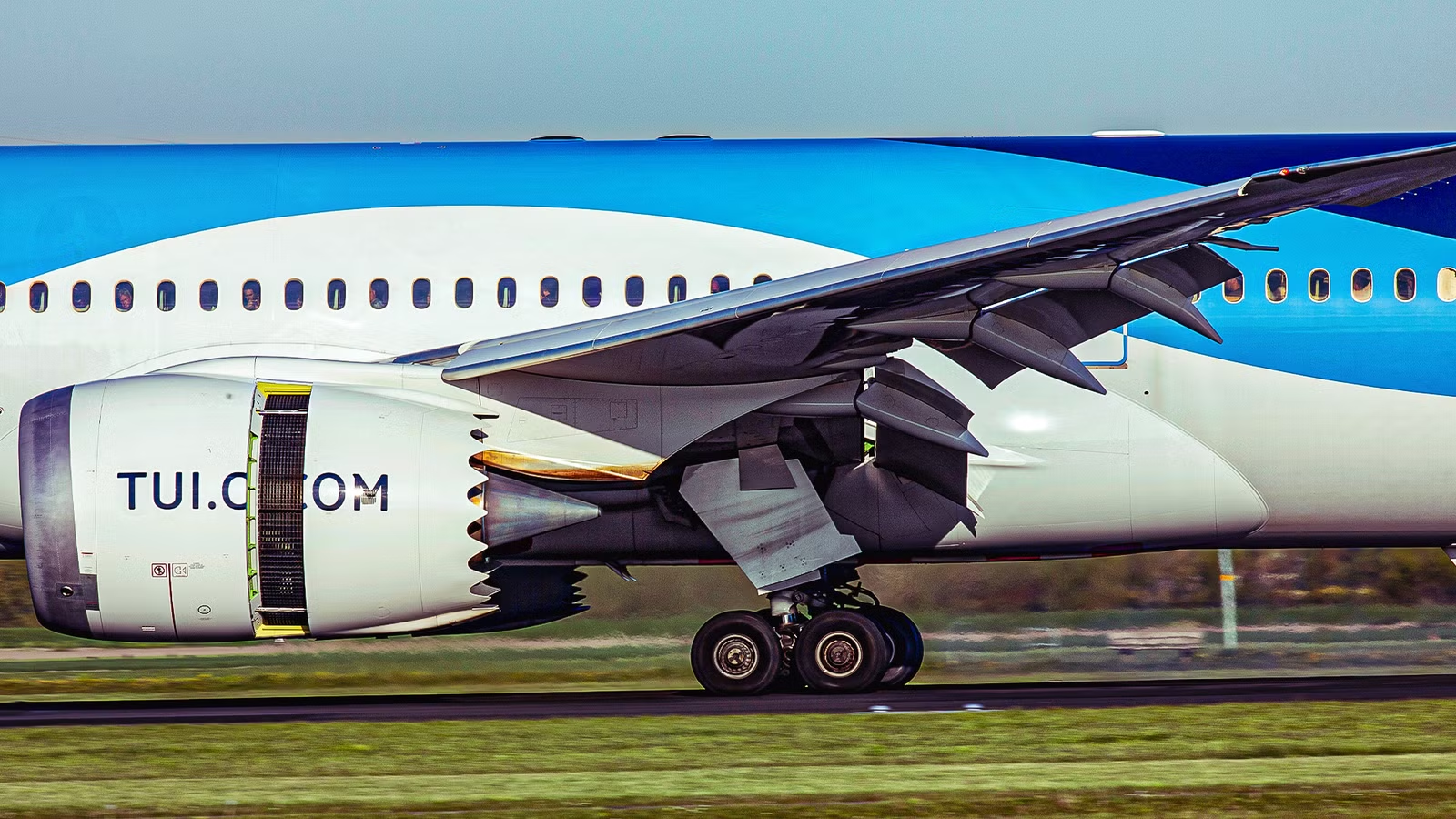
The Boeing 787 Dreamliner beat the Airbus A350-900 to the market, which has made it a much more popular widebody in the era of next-generation composite jetliners. Yet, the two planes share many technical features in common, with novel differences. In particular, comparing the 787-10, which is the closest in size to the A350-900, illustrates the different engineering philosophies of the two titans of aerospace.
While each of the iconic plane makers produced these two planes to capitalize on composite technology and advanced digital avionics, the minor differences in their target customers and niche missions created some design peculiarities that distinguish the two in unique ways. For starters, the A350-900 has a tall nose profile that keeps the cabin floor level, unlike the A340’s forward-tilted nose.
Each of these jets uses a significant amount of carbon fiber-reinforced plastic (CFRP) in the construction of the airframe. The A350 has a slight advantage, with the new material being 53% of its weight, but the Boeing plane is not far behind. Airbus also came to market years later, and while it has not matched the record-setting orders that have made the Dreamliner the best-selling widebody in history, the company has learned from further technological advances to refine its Xtra Wide Body jets.
787 SLG: What is Semi-Levered Gear?

Boeing faced unique engineering challenges when designing the 787-10 because it is a double-stretched version of the previous models, with an overall length of 224 feet. For that reason, the 787-10 features a distinct semi-levered landing gear system, in contrast to the A350-900, which employs a traditional center-pivoting main landing gear bogie. This difference arises from the unique dynamics of the two planes during takeoff rotation. The mechanism effectively ‘stretches’ the gear, allowing the main strut to lift the fuselage higher off the ground.
If Boeing had adopted a typical center-pivot landing gear for the elongated fuselage, the tail would risk striking the runway at a shallow takeoff angle, thus limiting the rotation speed during takeoff. The cabin extension makes the tail structure protrude well behind the main landing gear compared to the shorter 787-8 and 787-9 models. The SLG uses a hydraulic actuator during takeoff to restrict the tilt of the main wheel bogie, thereby pushing up the main strut and lifting the fuselage higher.
Airbus designed the A350-900 as a clean-sheet project, unlike the 787-10. Thus, engineers set the landing gear struts to an exact height from the outset to avoid the complexities of a secondary mechanical locking system, thereby facilitating smoother and safer takeoffs. The Airbus A350-900 does not require a semi-levered system due to its shorter overall fuselage length of approximately 219 feet, which allows for a steeper rotation angle before tail strikes become a risk.
Size Matters: Shock Struts & Ole-Air

The A350-900 is equipped with a nitrogen-oil shock absorber strut in its main landing gear, supporting a maximum landing weight of over 300 tons. The A350-900 is a substantial advance over the preceding A330, with a high-pressure strut capable of supporting higher landing weights. This oleo-pneumatic system effectively dissipates the heavy impact of the long-haul Airbus while also stabilizing the big widebody against crosswinds, though it adds to the overall gear weight.
While using the same ‘oleo-air’ systems, the Boeing 787-10 is designed differently as it has a slightly lower maximum landing weight in comparison to the A350. By declining to create a special, heavy strut for the expanded 787-10, Boeing leveraged its weight advantage. Rather, they repurposed a small, compact oleo-pneumatic cylinder that was initially shared by the smaller 787-8 and 787-9 models.
Boeing 787-10 | Airbus A350-900 | |
|---|---|---|
Overall Length | 224 feet (68.28 meters) | 219 feet, 2 inches (66.80 meters) |
Wingspan | 197 feet, 3 inches (60.12 meters) | 212 feet, 5 inches (64.75 meters) |
Max Takeoff Weight (MTOW) | 560,000 lb (254 tons) | 623,900 lb (283 tons) |
Maximum Range | 6,330 nautical miles (11,730 km) | 8,500 nautical miles (15,750 km) |
Typical 3-Class Seating | 300 to 330 passengers | 325 to 350 passengers |
While each of these aircraft is a modern, high-tech jet primarily made of carbon fiber, the 787-10 is a late entry in the Dreamliner family. Whereas the A350-900 was designed by Airbus as the first in its series to be a dedicated long-range, high-capacity platform. To withstand the severe vertical stresses of a maximum landing weight of 205 metric tons, they designed a huge, heavy-duty, wide-bore nitrogen-oil shock strut. This custom high-pressure cylinder protects the airframe during harsh landings and offers optimal cushioning for a comfortable passenger experience.
6 Notable Design Features Of Modern Landing Gear Systems
They ensure the safety of the aircraft and passengers on the ground and in the air.
Taxi & Runway Steering Systems

Airbus fully embraced the digital future with the A350-900, implementing pure FBW nose-wheel steering. When a pilot moves the cockpit controls, electronic sensors interpret the input and translate it into digital commands for the hydraulic steering actuators. Boeing chose a Liebherr Remote Electronic Unit that follows a similar engineering approach. Electronic signals from the cockpit tiller and rudder pedals are processed by the REU, which commands the hydraulic steering actuators digitally.
The Airbus A350-900 incorporates an advanced digital fly-by-wire nose-wheel steering system that provides the sidesticks with feedback for precise ground maneuvering. This system uses electronic sensors to convert pilot inputs into hydraulic signals, allowing the nose gear to rotate up to 72 degrees for tight turns. It also features automatic steering adjustments to counteract crosswinds, integrating nose-wheel steering with main rudder controls during takeoffs and landings.
The 787-10 also uses steering-by-wire for the yoke and rudder pedals. However, it reportedly provides more tactile feedback for pilots to feel the resistance of the nose tires. Although it features more electronic safety backups, the assembly still prioritizes maintenance and dependability, like legacy planes, giving it more refined ground handling characteristics and a smaller turning radius than its predecessor, the 767.
The A350-900’s entirely digital system replaces the A340’s outdated mechanical cable-and-pulley structure, turning physical exertion into smoother operations via sensors that sync nose-wheel angles with the rudder. The 787-10, on the other hand, strikes a more hybrid balance, retaining its analog feeling tiller while incorporating electrical backups to reduce oversteering and tire scrubbing, both of which are absent from the 767’s mechanical design.
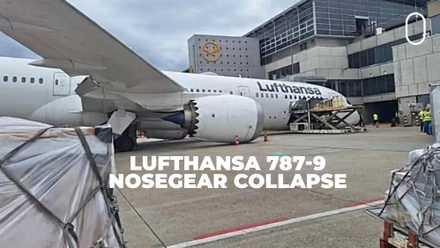
Staff Injured: Lufthansa Boeing 787 Nose Gear Collapses Before Los Angeles Flight
As first reported by aeroTELEGRAPH, it was on June 4th that a Lufthansa Boeing 787-9 suffered a nose gear collapse at Frankfurt Airport. The incident occurred while the jet was preparing to operate a transatlantic service to Los Angeles.
While the passengers who were set to fly on the service had not yet boarded at the time of the incident, the collapse did result in injuries to staff members.
Material Choices & Gear Mechanisms

Boeing and Airbus took two completely different paths to save weight on their massive landing gear. Because the Boeing 787-10 is lighter overall, the manufacturer forged its heavy inner shock cylinder from solid titanium rather than steel, an industry first. This is paired with a carbon-fiber drag brace, shaving hundreds of pounds off the jet. The A350 is a larger, heavier aircraft designed for high payload capacity. Since it requires greater structural stiffness, Airbus skipped the composite braces and stuck with ultra-high-strength steel, using titanium parts for particularly critical components.
The 787-10 features a forward-retracting nose gear secured by a mechanical over-center lock, utilizing heavy-duty springs and hydraulic actuators to maximize space efficiency within a compact nose bay. This architecture improves upon legacy platforms like the 767 by replacing heavy hydraulic retraction locks with a passive mechanical system, thereby reducing structural weight and eliminating uncommanded gear deployment during a total hydraulic failure.
Safran shaved hundreds of pounds off the 787’s assembly with its revolutionary carbon-fiber composite drag brace. These CFRP parts replaced heavy metal links that lock the gear into place. The A350 limits its carbon-fiber composite use to non-structural elements such as the gear bay doors and aerodynamic fairings. Because landing gear must withstand violent, unpredictable, multidirectional impacts, neither aircraft uses carbon-fiber composites for the primary load-bearing cylinders.
To accommodate the high loads on the gear, Airbus engineered a wide-set structural drag brace layout that distributes mechanical forces evenly across the airframe. The most critical spots, wheel axles and high-stress pivot joints, received titanium components. Airbus replaced the mechanical locking hooks on the A330 with a new retraction-and-locking linkage, extending component life and reducing scheduled maintenance intervals to cut down on day-to-day operating costs as well as the lifetime cost of the A350.
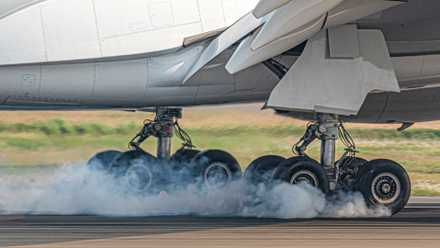
Why The Airbus A350-900’s Main Landing Gear Has Fewer Tires Than The A350-1000
The Airbus A350-1000’s 6-wheel main landing gear is a mechanical necessity driven by weight, physics, and airport infrastructure.
Brake Power & Cooling Systems

Airbus and  Boeing took different approaches to the brake cooling system, one of the areas of greatest contrast between the two next-gen wide bodies. Both aircraft have ultra-lightweight carbon heat sinks, or brake disks, to withstand temperatures over 1,832° (1,000°C). The divergent design lies in the 787’s purely electric actuation system. The A350 uses a traditional hydraulic actuation system.
Built by Safran Landing Systems, the 787 is famous for its ‘More Electric Aircraft’ design theme. Electric motors drive small gears that mechanically press the carbon brake pads together, and the system continuously monitors brake wear through automated programs. Getting rid of hydraulic lines, valves, and fluid on the gear reduces the risk of leaks, simplifies routine maintenance, and lowers the aircraft’s overall weight footprint.
The main technical reason why the two planes differ so much in this particular area is that the A350-900 is more than 20 tons heavier. This requires the A350’s system to more efficiently absorb kinetic energy and manage heat generated during landing and rejected takeoffs. This doesn’t mean that the more conventional design had greater cooling power thanks to the electric fans in its gear. These fans blow high-velocity air through the carbon brake disks right after touchdown, ensuring rapid cooling and facilitating shorter airport turnaround times.