dailynewsnblog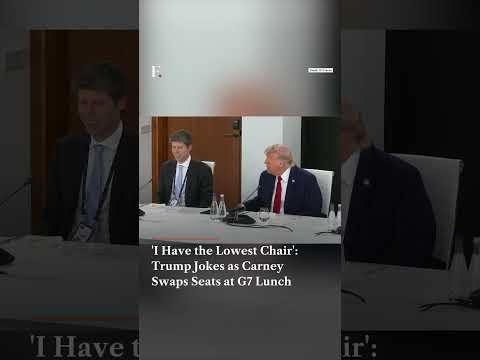
Depending upon who you read/listen to, Prime Minister Carney’s sycophantic behaviour toward Don Trump is either odious but necessary in the lead up to CUSMA talks, or something that does nothing to advance our national goals and everything to erode Canadian pride. SPOILER ALERT: I fall into the second camp.
However, those who justify Carney’s ostensibly craven deference toward Trump have some good arguments, but also admit there are limits to that approach. Matt Gurney writes:
We saw some examples recently of Carney’s efforts to say and do things publicly that will please the grandiose president. He lauded Trump’s U.S.-Iran deal, calling the Iran war and the deaths it caused on both sides “worth it.” That’s objectively bonkers:…
Carney also went out of his way to swap chairs with Trump at the G7 annual summit last week, as the president found his own chair uncomfortable. These little symbolic acts, in combination with grander offerings — such as the prime minister’s recent overtures to the U.S. during a speech in New York City — are clearly calculated to flatter Trump and please his administration.
And that’s fine. Good, even. None of the above is meant as criticism. Yes, the Iran stuff is unavoidably eye-rolling, but it’s still very clear what Carney is doing, and Canadians know why he’s doing it. We are stuck in a relationship with a very powerful, increasingly erratic neighbour, about whom perhaps the last thing you can predict is that he likes when people bend the knee for him in public. Carney, correctly and probably necessarily, has made peace with swallowing his pride and doing so on matters — from Iran to uncomfortable chairs — that will cost Canada and his dignity as little as possible. And honestly, I thank him for that.
Gurney warns that this kind of abasement can only take one so far, and bending on substantive issues such as CUSMA would alienate many.
Flattering Trump is perceived as a means to an end. If Ottawa starts making painful concessions, Carney runs the risk that his flattery will be seen not as a necessary evil but part of a broader pattern of subordination to the U.S. And that moment could well be the one that breaks the public’s faith in the prime minister.
On the other side of the issue stands Susan Delacourt, who is unsettled by Carney’s actions, despite the fact that it has been echoed by some European leaders,
King Charles hosting a state visit for Trump to France’s Emmanuel Macron treating him to a state dinner at the Palace of Versailles after the G7 meetings wrapped up in that country last week.
But the real expression of worrying deference was found in Carney’s remarks on the agreement to end the U.S.-Iran war, inked only on the eve of the G7 meeting and not even released in full when the Canadian prime minister gave an interview on CNN.
Carney told Kaitlan Collins he had seen the deal and it was a “game-changer.”
“I have to say it’s exceeded my expectations. We’re very pleased with the deal that’s been struck,” Carney told Collins.
That was pretty bold praise for a deal that really isn’t a deal — it’s a memorandum of understanding, which is proving divisive in the U.S. and attracting concern of what it achieved among Middle East experts.
It is not being well-received by foreign policy experts either.
[N]ational security expert Wesley Wark has noticed the pattern and posted some blistering criticism over the weekend, under the heading of “Mark Carney’s bad calls on Iran.” Wark outlines why Carney’s description of the deal, not to mention his views on the war itself, are out of line with serious intelligence analysis of the situation.
Like others, Wark is chalking this up to the new normal of overpraising Trump and urges that Canada reconsider falling into that trap. “If the instinct piece is based on some sense that flattering the U.S. president is a good strategy, surely we are well past that,” Wark writes.
It is difficult to see that any of this sycophancy is yielding any results. Trump is still talking about terminating CUSMA, still talking about destroying our car industry, and, to our increasing immediate discomfort, still stopping the opening of the Gordie Howe Bridge, which Canada paid for entirely. Will the next Carney manoeuver be to give the Americans half of it?
In his Davos speech, Carney said that nostalgia is not a strategy. One hopes that, before he does more damage to Canada’s pride and its prospects, he will come to realize that neither is appeasement.