dailynewsnblog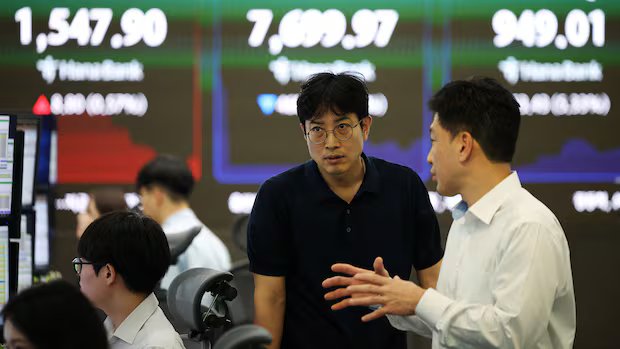

Listen to this article
Estimated 4 minutes
The audio version of this article is generated by AI-based technology. Mispronunciations can occur. We are working with our partners to continually review and improve the results.
Global stocks fell on Tuesday, led by broad-based declines in technology shares, including SpaceX, as growing expectations for the U.S. Federal Reserve to be more aggressive in tackling inflation drove investors into bonds and the dollar.
Futures on the Nasdaq were down more than 2.5 per cent, suggesting Monday’s 1.3 per cent slide might extend into a second day.
Shares in SpaceX struggled to push into positive territory in Tuesday’s premarket, after losing nearly 17 per cent on Monday, while the likes of Alphabet, Meta Platforms and Microsoft also tumbled.
S&P 500 e-mini futures were down 1.2 per cent. The STOXX 600 fell 0.8 per cent, under pressure from declines in European semiconductor and chip-equipment makers, which followed declines in tech stocks in Japan and South Korea, where the KOSPI index fell 10 per cent in its largest one-day selloff since March.
“Questions are once again being raised over AI infrastructure spending, particularly as some corporate giants plan to sell equity to help fund expansion,” said Trade Nation senior market analyst David Morrison.
“Time will tell if this is yet another ‘buy the dip’ opportunity, or a harbinger of worse things to come.”
Oil remains below $80 a barrel
Meanwhile, Brent crude futures remained below $80 US a barrel on Tuesday, as the number of vessels transiting through the Strait of Hormuz continued to build.
A drop in oil prices would ordinarily give stocks a boost, but investors are now focused on what the surge in energy prices will mean for central bank policy and, specifically, the Federal Reserve. New chair Kevin Warsh looks set to take a much tougher line on inflation.

CBC’s senior business correspondent Peter Armstrong breaks down why — even when the Strait of Hormuz is open again — getting markets back to pre-war levels is going to be a mammoth task.
As such, two-year Treasury yields, which are the most responsive to shifts in expectations for inflation and rates, have shot to their highest levels in 16 months, while longer-dated yields have also risen sharply. On Tuesday, two- and 10-year yields were both down around three basis points on the day, at 4.20 per cent and 4.49 per cent, respectively.
“The adjustment higher in U.S. yields is creating a more challenging backdrop for risk assets in the near term after strong gains in recent months,” MUFG currency strategist Lee Hardman said.
Money markets show investors are close to fully pricing in a rate rise by September. Against that backdrop, the dollar is at one-year highs against a basket of currencies.
Asian, European markets fall
France’s CAC 40 dipped one per cent in early trading, while the German DAX fell 1.6 per cent. Britain’s FTSE 100 declined 0.6 per cent.
Earlier in Asia, Japan’s benchmark Nikkei 225 lost 3.6 per cent.
“We’ve had eight days of strong markets,” said Neil Newman, head of strategy at Astris Advisory Japan. “Now, it has cooled off a bit.”
The Japanese yen was also flat on Tuesday at 161.58 versus the U.S. dollar, having neared 40-year lows the previous day.
Japanese Finance Minister Satsuki Katayama said on Tuesday she had held an online meeting with U.S. Treasury Secretary Scott Bessent a day earlier to discuss global financial markets, which analysts said suggested an increased risk of official intervention from Tokyo to prop up the yen.
Signs of greater regulatory scrutiny in South Korea’s semiconductor sector contributed to the 10 per cent drop in the KOSPI.
Hong Kong’s Hang Seng slipped 1.8 per cent, while the Shanghai Composite shed 1.4 per cent.