dailynewsnblog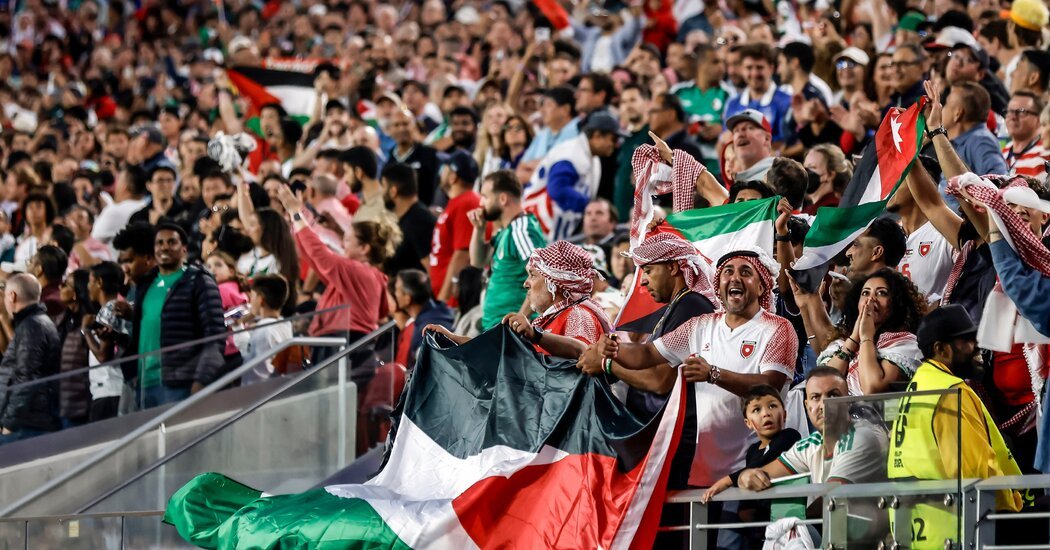
The scarves were everywhere, and with an unmistakable Palestinian accent.
Draped on the shoulders of fans, or wrapped around their heads, they were symbols of Palestinian solidarity at Levi’s Stadium in Santa Clara, Calif., as Jordan and Algeria played their World Cup game Monday night.
Jordan had never previously qualified for the World Cup, and now that they are here, the team is representing more than the kingdom. Many Jordanians can trace their roots to Palestinian families, and more than 2.3 million registered Palestinian refugees live in Jordan.
The feeling of fraternity toward the Palestinians was not limited to Jordan’s players. Algeria’s soccer team has become well known for integrating Palestinian emblems into its World Cup journey. The team even displayed the Palestinian flag on the field when it sealed its spot in the World Cup with victory over Somalia last October.
Soccer’s governing body, FIFA, typically does not allow political gestures at World Cup venues. But because the Palestinian soccer federation is one of FIFA’s 211 member associations, fans, officials and players alike are allowed to carry the symbols to venues across the United States, Mexico and Canada, the three nations hosting the tournament.
The Palestinian diaspora, estimated at more than six million people worldwide, includes significant populations in Lebanon, Syria and Egypt, and also in places like Dearborn, Mich., and Santiago, Chile, where a soccer team is named for the Palestinian people.
Monday’s game became a magnet for Palestinians as much as it was for Algerians and Jordanians.
Hania Taha, a postdoctoral student, made the last minute choice to buy tickets and flights from Virginia to California on the morning of the game. Ms. Taha, born in Jerusalem, proudly wore colors associated with both Jordanians and Palestinians: On her head was a kaffiyeh, a black-and-white checked cloth that has become a badge of Palestinian identity. Draped over her shoulders was a similar one, but in the unmistakable red and white of Jordan.
“I’m Palestinian and I’m here to support Jordan,” said Ms. Taha, as she joined a group of fans serenading the team outside its hotel in San Jose. “That’s why I’m wearing both: Most of the Jordanians are originally Palestinians.”
The connections extend to the Jordanian royal family. The country’s ruler, King Abdullah II, made a surprise trip to the game, taking a corner box in the stadium, which suddenly exploded into celebration when Nizar Al Rashdan smashed Jordan into a surprise lead. Abdullah’s wife, Queen Rania, was born in Kuwait to Palestinian parents.
His half brother, Prince Ali bin Al Hussein, whose late mother Alia was Palestinian, is the president of the country’s soccer federation. He was present on Sunday when Gazans who were injured in the war with Israel and were receiving medical treatment in the United States visited with Jordan’s players on Sunday.
The Israel-Gaza War was front of mind for some supporters, too.
Omar Khalid, 24, who was born in the West Bank city of Ramallah before moving to California wore a T-shirt featuring an image of Suleiman Al-Obeid, one of Palestinian soccer’s most revered players who died following an Israeli attack in southern Gaza in 2025. “He was a really good soccer player,” said Mr. Khalid, who came to the game with his father.
“We wanted to watch a game of two Arab teams going against each other, and we support both,” he added. “We are one.”
That spirit was clear as the teams lined up before the game, with fans of both teams cheering each others’ national anthems. At the Algerian team’s last game, where they lost to defending champion Argentina, fans of Algeria went viral on social media after chanting in support of the Palestinians.
“We love both countries, we want both of them to win,” said Sal Judieh, a 22-year-old from San Francisco, whose family came to the United States from Ramallah before he was born.
The split loyalties between Jordan and Algeria extended to the royal household, too. Prince Ali’s wife, Rym Ali, is the daughter of Lakhdar Brahimi, a former Algerian foreign minister and top United Nations official. Persuading his wife to support Jordan, Prince Ali said, was easier than with his father-in-law.
But this time, Algeria came out with the victory, coming from behind to win 2-1.