dailynewsnblog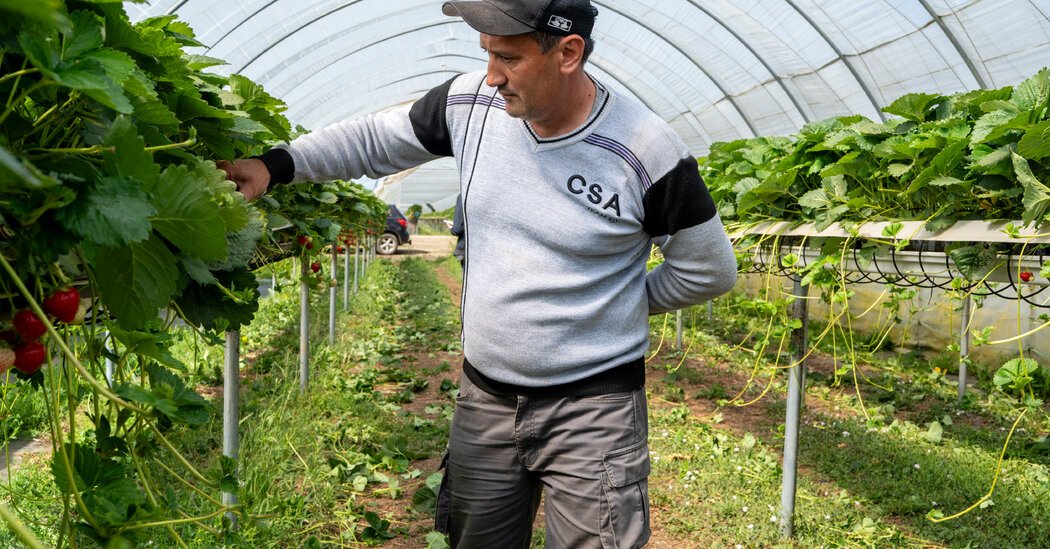
There were dozens of strawberry plants to prune, and Shukrat Djuraev was more than 3,000 miles from home, but he was not complaining as he worked his way down a giant greenhouse tunnel in Kent, in southern England.
“I like it here,” said Mr. Djuraev, 44, who is from Bukhara in Uzbekistan and is one of thousands of seasonal workers that British farmers rely on every year to get their produce into stores. “It’s good working here. It’s very steady and calm.”
Before Britain quit the European Union, many farm workers came from Eastern Europe. After Brexit, they lost the right to work in Britain — and many voters assumed, therefore, that fewer foreign workers would come.
Instead, 10 years after the Brexit referendum, British farmers have filled labor shortages by turning to a more distant region for seasonal workers, granted entry on six-month visas: Central Asia.
Immigration was an animating issue in the Brexit vote, with its promoters promising that leaving the European Union would allow Britain to “take back control” of the country’s borders. A decade later, it remains one of the biggest political pressure points, this time for the governing Labour Party.
One of the loudest voices behind Brexit, Nigel Farage, and his latest anti-immigration populist party, Reform U.K., have since become a dominant political force, leading in opinion polls and making significant gains in recent local elections. His party’s success has shaken Labour and contributed to the downfall of Prime Minister Keir Starmer, who announced his resignation on Monday.
Immigration is a complicated picture in Britain. In the years after Brexit, net migration soared, driven by the admission of people fleeing Ukraine and Hong Kong, as well as of students and their relatives, and professionals eligible under new rules. It has fallen significantly of late after changes to the regulations. Regardless of the numbers, Labour and the previous Conservative leadership vowed to rein in immigration, knowing the political pitfalls of doing otherwise.
There has also been a mismatch between perception of migration and the reality of the country’s needs. Farms across the country say they would be unable to operate without seasonal workers from abroad, and the mix shifted after Brexit.
In the early years after the vote, many Ukrainians and some workers from Russia and Belarus took on seasonal work in Britain. Then war broke out in Ukraine, and British recruiters, who supply big British farms, started looking farther afield, landing on the Central Asian countries, where wages were relatively low.
By 2023, when more than 32,000 six-month seasonal worker visas were issued by Britain, the top four countries for recruitment were Kyrgyzstan (24 percent), Tajikistan (17 percent), Kazakhstan (15 percent) and Uzbekistan (13 percent) — nations that once sent much of their work force to Russia. They do not gain the right to stay in Britain.
Mr. Djuraev appreciates the money he earns at Homefield Farm in Kent, which has helped him to buy an apartment back home. He is even upbeat about Britain’s unpredictable weather, though that’s partly because he once worked as an oil and gas driller in Russia.
“Well, it’s not Siberia,” he said in Russian with a laugh, recalling his time as a qualified engineer and technologist working in Nizhnevartovsk and Surgut. “There, it could be 50 degrees minus.”
Tim Chambers, chief executive of WB Chambers, the firm that runs Homefield and 25 other farms in the region, said that without his seasonal workers, “it would be impossible to run the business; I would be losing so much money, I would have to stop.”
“If you took away that source of labor I would close immediately — it wouldn’t even cross my mind — all I could do to survive would be to double or triple my costs of production,” he added.
Mr. Chambers can trace his ancestral roots in Kent back to 1640. The family firm he runs was founded in 1952, and it sends about 3,500 tons of both raspberries and strawberries to British supermarkets every year.
Even if some of the packaging on that fruit features the British flag, here in the Kent countryside, it is the Russian language — widely used in Central Asia — that is spoken by most of the pickers.
Mr. Chambers said that in the 1990s his company hired many Britons but that none were tempted by seasonal work now. Without a permanent, year-round job, they are unable to obtain credit or a mortgage, he said.
Those without other work would lose welfare payments while picking fruit and would then have to reapply for state support when the season ended, making it not worth the trouble. The system, he said, was so inflexible it was “ridiculous.”
Britain’s minimum wage is 12.71 pounds, about $16.80, an hour, and seasonal workers are guaranteed 32 hours of work a week; some can earn about £700 a week, about $927, or more. By contrast, the average salary in Kyrgyzstan in 2024 was a little more than £300, or $397, a month.
Mr. Djuraev is living with four people from Tajikistan in a mobile home designed for six, and he says he hopes to return to Britain for at least three more seasons.
Previously, many Central Asian workers left to work in Russia, said Christopher Gerry, a British academic who is rector of the University of Central Asia, based in Bishkek, the capital of Kyrgyzstan.
Given the economic volatility in Russia after the invasion of Ukraine, and reports of hostility toward Central Asians, Britain has become attractive.
“You’re looking at a very young population that’s more globally oriented, connected through Instagram, etc., looking at global labor markets and wanting to speak English,” Professor Gerry said, referring to the Kyrgyz work force.
Charities report that some seasonal workers in Britain have been exploited. Because visas last just six months, unscrupulous employers know that workers will soon have to leave and be unable to pursue any claim, said Daniyar Abdrakhmanov, who is from Kazakhstan and who worked on a farm in Northern Ireland.
“Can you imagine being a person coming to another country — where you don’t know the language — for the first time?” he said. “Maybe they borrowed money or took credit in their country and are coming here with debts.” And if a farmer treats workers badly, he added, “they have to be silent because they don’t want to lose their job.”
Dora-Olivia Vicol, chief executive officer of the Work Rights Center, a charity, said, “The exploitation of seasonal workers that our solicitors see is widespread. It is systemic, and it is enabled by a visa scheme that ties them to a single employer, leaving them with nowhere to turn when things go wrong.”
To workers who have a good experience, the program can open horizons.
Orozbek Saipidin, who is originally from the Batken region of southwestern Kyrgyzstan, said in an interview in Bishkek, where he now lives, that the prospect of working in Britain offered a real opportunity for him and his family. “In six months, I could change our lives for the better,” he said.
Mr. Saipidin, 34, said that he had never traveled abroad before and had initially found his first visit to Britain, five years ago, tough.
“Backs, arms and legs ached,” he said. “There were days when I would cry in the shower and curse myself, ‘Why did I come here?’ But after about three weeks I got used to it. We started earning decent money — 550 to 600 pounds a week.”
Mr. Saipidin was about to travel to England again in May to work at a farm in Cornwall, in southwestern England.
In Kent, David Catt, a partner in Ragstone Ridge, a vineyard, said his grapes were harvested with the help of a team of Central Asian workers.
“They are all from Kazakhstan, Uzbekistan, Kyrgyzstan,” Mr. Catt said, adding, “Communicating with them is tricky — you have to physically show them what to do — because my Russian is not too hot, to be honest.”
It was, Mr. Catt noted, just one of the consequences of Brexit.
“It’s just the way things are now,” he said. “When we were in Europe, it was so easy because labor could come and go as it suited.”