dailynewsnblog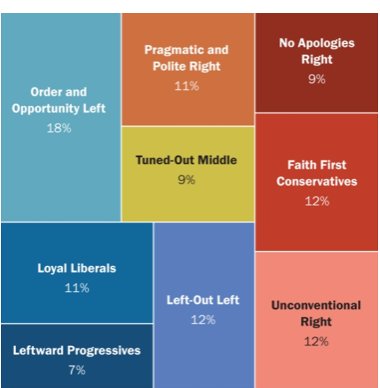

We tend to like things simple. Right or Wrong. Black or white. Mother Nature tends to disagree, however. She prefers complexity, and as a result things tend to come more in shades of grey than black and white.
This is true of politics. We tend to see politics as about us and them, friends and enemies, so we generalize with just two categories to keep things conveniently simple: left or right, progressive or conservative.
In the United States, the result has been two parties completely dominating politics: the Democratic Party (progressive) and the Republican Party (conservative). Anyone seriously entertaining a political career has to choose one of these two. In recent years this dichotomy has brought intense polarization.
The country divides into two shades: blue states (Democrats) and red states (Republican). Of course in reality Americans don’t all neatly fit into these two artificial categories of progressive and conservative. In order to get a more meaningful representation of Americans’ political beliefs and values, the Pew Research Centre did extensive polling and created a more nuanced picture. Its report is appropriately entitled Beyond Red vs. Blue: The Political Typology.
Pew used the data to sort the American public into nine distinct groups, ignoring party affiliation. The result is a political picture much more colourful than blue/red (see the graphic at the upper right).
According to the report, “A few groups are very ideological, partisan and politically active. But they are a minority: Most Americans fall into groups within a large, politically messy centre—even as many of them clearly favour one party over the other.” Pew states that to achieve success, the two parties have to reach out to people who don’t fully support either of their agendas.
It suggested that 21 percent of the public was solid right and 17 percent solid left. Twenty-three percent leaned right and 30 percent left, with a tuned-out middle of nine percent not much interested either way.
It hardly seems surprising that forcing such a variety of voters into only two blocks is a recipe for polarization. Perhaps if Americans could choose a party closer to their politics, or at least less distant, i.e. less bad, they would find the system more fulfilling. A choice that closely satisfied their values and beliefs might lead to a more satisfied citizen.
There are voting systems that do just that—proportional representation (PR) systems. There are a variety, one can be tailored to the particular characteristics of a state or country.
This possibility for improvement applies to our political system as well. We, like the Americans, labour under the first-past-the-post (FPTP) voting system. Five parties sit in the House of Commons but two consistently dominate. The last election brought a flood of electors voting Liberal, many not because they particularly liked the party, but because it was the only one with a hope of defeating the Conservatives.
Perhaps we, too, should be considering a PR system so we could choose a party closer to our beliefs, tailored of course for the particular idiosyncrasies of the Canadian political reality.
Whether or not you agree you might enjoy considering the Pew typology. The centre has provided a quiz that allows readers to determine which of the nine groups best describes their own political type. It’s designed for Americans but works reasonably well enough for a Canuck.
I took the test and it suggested my best fit was the group labelled “Loyal Liberals.” Loyal Liberals are “Highly educated and relatively economically secure, they have broadly progressive political values across most issues and a deep allegiance to the Democratic Party. They strongly support the U.S.’s traditional diplomatic alliances and social safety net programs.”
That actually sounded about right except for the deep allegiance to the Democratic Party, although if I was an American that’s who I would vote for. If it’s good enough for Bernie Sanders and Elizabeth Warren, it would be good enough for me. And, like voting Liberal in 2025, the alternative is beyond serious consideration.