dailynewsnblog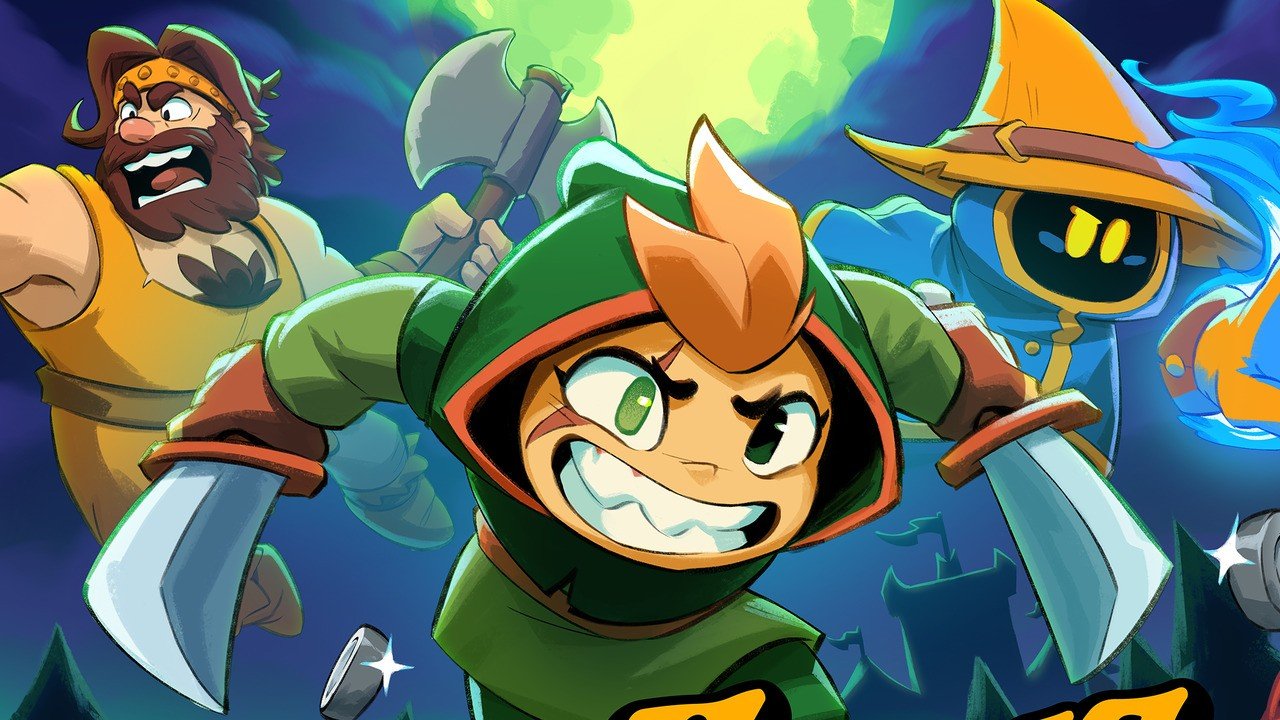

There are few better ways to spend $9.99 / £8.99 than on Dark Scrolls. The indie Soulslike side-scroller is something I’ll spend the rest of the year dipping into every now and again, itching for a run as a way to kill a train journey. It doesn’t offer the deepest gameplay, nor does it have a sprawling world hidden away in its depths, but strikes the right chord for the price point.
Describing Dark Scrolls as a ‘Soulslike side-scroller’ is more of a shorthand than an all-encompassing label. The game possesses significant influence from roguelikes, as well as Sonic the Hedgehog. Developer Doinksoft (Gato Roboto, Gunbrella) throws you right into the action, giving you a choice of three characters and little else to engage with before starting your first run. I was immediately drawn to Pigeon for his very silly name and his resemblance to Link. Pigeon attacks and moves far more quickly compared to his fellow start characters, launching into long jumps and tossing knives at a rapid rate.

I found Pigeon’s pace to be a problem in my first hour with Dark Scrolls. The game is littered with obstacles and enemies and I found myself bumping into everything and losing all my health before I could get a good few licks in.
This led me to main Grizz for a while, who, as you can tell from his name alone, is an absolute unit of a man, wielding an endless supply of axes with a long attack range and — most crucially — moving at a much more manageable pace. I also fell in love with Grizz’s special ability, a ground pound that instantly KO’s enemies from above. This was particularly useful for an irritating frog-like enemy whose jumps wildly vary in height.
The third starter character, Emerys, is a wizard-type, casting balls of energy as he floats from left to right. I found Emerys uninspiring as he operates in a middle ground between Grizz and Pigeon. As I spent more time with him, I found his special move — a pointy dash in upwards and sidewards directions — to be endearing, but using him never felt as satisfying as the other two.

When I finally gave Pigeon another go, the design philosophy finally began to speak to me. The roguelike elements are obvious. Each run sees you collect currency. If you hit 100 coins, you gain a blue crystal which can be exchanged in a shop for upgrades like faster movement, expelling thorns upon being hit and creating a protective bubble for yourself.
However, the Sonic influence came to the fore once I harnessed the power of Pigeon’s special move, a double jump that sees him throw knives downwards and leaves him momentarily invulnerable. This, along with making use of the many Sonic-like springs, meant I was more able to take the higher route through the stages. Just like Sonic, these paths are incredibly hard to maintain, especially with Pigeon’s erratic jump, but are much more rewarding. With that strategy established, I was finally able to clear the boss of the first stage.
True to the Soulslike genre, I died a hell of a lot in Dark Scrolls. The first moments of getting your sea legs are brutal and had me reading the manual repeatedly to see if I was missing some sort of trick. At some point, it all just clicked and sections I found impossible before were suddenly a breeze.

Still, an errant move can land you in pools of hot water, but the incremental upgrades, as well as mid-stage level-ups, provide a much-needed reprieve. Dark Scrolls clearly isn’t shy about its FromSoft influence, even including bonfires between levels.
Once I got familiar with the game, it didn’t feel as punishing as a typical From game can be. Dark Scrolls’ presentation helps with that, its music is jovial and adventurous, its 16-bit art style irresistibly charming. The level structure of enemies doing their best to get in the way of your platforming, a mid-level enemy rush where you have to survive a set amount of time in a pit of creepy crawlies, and a boss at the end of the stage will always be a challenge, but you don’t get the same level of satisfaction as when you finally conquer a boss in Elden Ring. Dark Scrolls isn’t trying to be too mean, instead stuffing the From experience in breezier packaging.

A couple of minor problems do rear their heads. Anyone attempting to play this with an analogue stick is going to have a rough time. Dark Scrolls feels designed for a D-Pad, the analogue stick being extremely sensitive to vertical movement when you’re trying to move horizontally. I found myself ducking when I wanted to be sprinting away from advancing enemies.
Also, for as much as the game tries to clamp down its meanness, there are a few enemies that feel at odds with that. The game looks good, but every frame is very busy, and sometimes it’s hard to see a zombie burrowing up from the ground when you’re fighting the giant spider above you.
Conclusion
Dark Scrolls does a good job of balancing the cosy repetitiveness of a roguelike with the challenge inherent to the Soulslike genre. There are so many different ways to play, with six characters unlockable on top of the original three, all with their own unique abilities, movement and attack patterns.
For the price, there’s very little reason to not give this a shot, especially for those who gravitate towards pixel art or any of the genres encompassed within Dark Scrolls.