dailynewsnblog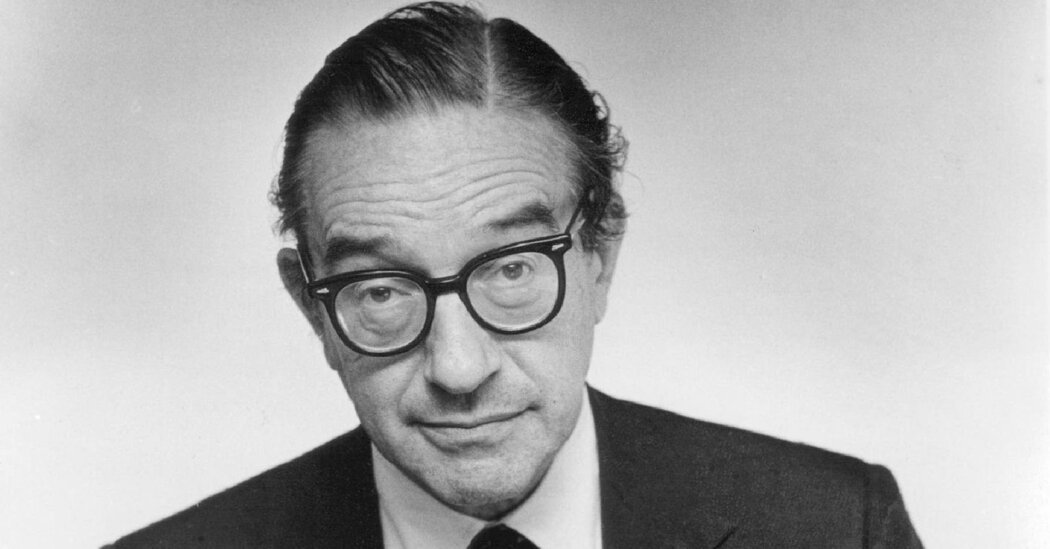
Alan Greenspan, who in nearly two decades as chairman of the Federal Reserve nurtured a long run of prosperity, navigated crises and was a powerful and polarizing force in shaping market-friendly policies, died on Monday at his home in Washington. He was 100.
The cause was complications of Parkinson’s disease, his wife, Andrea Mitchell, the chief Washington correspondent for NBC News, said in a statement.
The pre-eminent economic policymaker of his time and arguably the most recognizable economist of any era, Mr. Greenspan led the central bank under four presidents of both parties from 1987 to 2006.
Much of his tenure coincided with a streak of affluence in which he stood as the embodiment of a triumphant, post-Cold War strain of American capitalism: optimistic, faithful in the power of markets to improve living standards, captivated by the power of technology and averse to regulation.
But the ideological stamp he put on policymaking came to be associated as well with the destructive consequences of forces that emerged on his watch, including deregulation of banking and Wall Street, the loss of American jobs to free trade and persistent concerns about bubbles in stock and housing prices.
Even as Mr. Greenspan skillfully managed interest rates in a way that kept the economy humming along, he remained leery of confronting a danger he well recognized: that the low-inflation, easy-money environment he had helped create was putting the United States at risk by fueling unsustainable investment booms. And he remained reluctant to act as banks and investment firms adopted complex new trading techniques that would come to wreak great damage.
At the Fed, he was remarkably successful at what he considered the central banker’s primary task of holding down inflation. He also helped the United States deal with periodic shocks, including a stock market crash just weeks after he took office, the near-meltdown of Asian financial markets a decade later and the aftereffects of the 2001 terrorist attacks.
Only after he stepped down in early 2006 — and especially following the crisis on Wall Street in 2008, the near-collapse of the mortgage market and the ensuing deep recession — were his legacy and philosophy challenged in a concerted way.
By that point, one group of critics blamed him for not heading off a housing bubble by pushing interest rates higher. Another accused him of promoting a corrosive free-market fundamentalism that left the financial system to operate unchecked as it adopted increasingly risky practices.
After overseeing a period of immense wealth creation, he was often portrayed as among those responsible for the 2008 crisis and the economic and political shocks that followed it.
His failure to put greater focus on keeping the financial system stable once he had shown he could keep inflation in check “was Greenspan’s most consequential error, one that he did not have to make,” his biographer, Sebastian Mallaby, concluded.
His record — and the degree to which he deserves either the praise or the blame heaped on him — remains a subject of intense debate. There is no doubt that he was a pivotal figure during a period of immense ferment in the economy and deep ideological divides over how to manage it.
At the peak of his fame, as the economy boomed in the late 1990s, his merest phrase could send the markets sharply up or down, and his face, behind his thick glasses, was as familiar as any movie star’s.
In public, he often spoke in an elliptical jargon that even his fellow economists had trouble deciphering.
Behind the scenes in Washington, Mr. Greenspan was a master of the political power game. Schooled by his experiences as a policy adviser to Richard M. Nixon’s 1968 presidential campaign and his role as President Gerald R. Ford’s chief economist, he developed into a wily operator who skillfully protected the Fed’s independence while shaping the agendas of successive presidents and steering legislation on Capitol Hill.
His predecessor, Paul A. Volcker, had established that the central bank could hold off political pressure for lower interest rates with a tight-money strategy in the late 1970s and early 1980s. In the process, Mr. Volcker gave the Fed tremendous credibility in the financial markets and bequeathed to Mr. Greenspan plenty of room to shape policy in Washington.
Mr. Greenspan used his influence shrewdly on issues that, strictly speaking, went beyond his mandate at the Fed, weighing in regularly to shape policy on taxes, the budget deficit and trade policy. A Republican with strong libertarian leanings — in his younger days he was an acolyte of Ayn Rand, and he was appointed to the Fed by President Ronald Reagan — he nonetheless managed to infuriate Republicans as well as Democrats even as he won reappointment from presidents of both parties.
Allies of President George Bush blamed Mr. Greenspan in part for Mr. Bush’s loss of the White House to Bill Clinton in 1992, saying Mr. Greenspan had kept interest rates too high as the economy was coming out of recession. Mr. Greenspan built close ties to Mr. Clinton and his team, helping to infuse the Democratic administration with a distinctly market-friendly stance on financial regulation and encouraging Mr. Clinton early on to embrace deficit reduction, over the objections of liberals.
But in 2001, when Mr. Greenspan backed President George W. Bush’s big income-tax-cut package, Democrats howled that he had sold out his deficit-reduction beliefs to curry favor with the new Republican administration.
The Washington Life
Alan Greenspan worked all the angles, cultivating allies across the aisle and at both ends of Pennsylvania Avenue. Ever-present in social Washington, he was a genial if reserved figure as he mingled at parties with Supreme Court justices, cabinet secretaries and journalists, sporting an amused smile and offering a soft handshake.
He dated Barbara Walters of ABC News in the late 1970s (“I’m not threatened by a powerful woman,” he wrote in his autobiography). In 1997, he married Ms. Mitchell, who by his account never entirely forgave him for discussing antitrust policy on their first date many earlier; their wedding was presided over by Justice Ruth Bader Ginsburg. She survives him.
“He was a giant of a man who helped shape the U.S. economy for decades under presidents of both parties but was always honest in acknowledging his mistakes,” Ms. Mitchell said in her statement. “To me he was my husband, who shaped my life from our very first date in 1984.”
He was an avid tennis player, picking the game up in earnest on the White House court while serving in the Ford administration and pursuing it in spirited competition well into his 80s against a succession of Treasury secretaries and senior officials from both parties.
He eschewed formulas and rules other central bankers often relied upon in favor of a more intuitive approach based on deep analysis of data about decisions being made by businesses, consumers and investors. (He admitted doing some of his best thinking while soaking in a hot bath.)
At the Fed, he perceived how a set of powerful forces, chief among them rapid advances in technology and increased global competition, were altering the outlook for inflation and therefore the economy’s ability to grow and create jobs without undue upward pressure on prices.
Because of technology, Mr. Greenspan concluded in the mid-1990s, all kinds of industries were able to produce more for less. In economic terms, they were generating improved productivity gains.
Acting on that belief, Mr. Greenspan tended to keep interest rates lower than traditional economic models suggested they needed to be. As a result, he was able to allow the economy to keep expanding at a rapid clip even as unemployment descended to levels that previous generations of central bankers would have regarded as warning signals of inflation and a reason to raise rates.
For much of his time as Fed chairman, especially in the late 1990s, Mr. Greenspan appeared to be right. His policies helped create conditions in which price increases were negligible, the economy created millions of new jobs, businesses were able to borrow at attractive rates and the stock market boomed.
But the productivity gains began fading away after the turn of the century. And even as monetary policy under Mr. Greenspan appeared to have triumphed to a remarkable degree over the business cycle, he and the Fed were confronted with what proved to be troublesome and ultimately disruptive forces that they failed to fully understand, much less tame.
The Revenge of Risk
The cheap-money environment in the United States coincided with two other developments. The first was a sense among investors that the Greenspan Fed would always step in to curb the damage from financial crises, limiting their risk and arguably breeding complacency.
The other was the emergence of a vast pool of global savings, generated in large part by rapid growth in China and other developing nations. That capital washed over borders in search of profitable investment opportunities, often driving down long-term interest rates, like those on mortgages. But it could be fickle, fleeing again when trouble arose or opportunity beckoned elsewhere.
As it helped fuel first the stock market and then the housing market in the United States, the global savings pool made many households wealthier than they had ever been, at least on paper. It also helped push asset prices to what proved to be unsustainable levels in the United States and elsewhere, creating boom and bust cycles.
Mr. Greenspan had long been interested in the interplay between the economy and prices of assets — stocks, bonds and homes. He set off financial tremors in 1996 simply by raising the question publicly of whether “irrational exuberance” was creating bubbles.
He proved reluctant to intervene to head off or prick bubbles when they appeared during his time in office, even as he fretted about the problem in private. Mr. Greenspan often suggested in public that it was all but impossible to avert or deflate bubbles without damaging the economy — in part, he said, because it is hard to identify a bubble until it has burst.
“It is far from obvious that bubbles, even if identified early,” Mr. Greenspan said in 2004, “can be pre-empted at lower cost than a substantial economic contraction and possible financial destabilization — the very outcomes we would be seeking to avoid.”
The risk from bubbles was amplified by the rapid growth of new and risky financial instruments. Although Mr. Greenspan had concerns about the housing market in particular — he tried for years, in the face of bipartisan congressional opposition, to rein in Fannie Mae and Freddie Mac, the government-chartered companies that fueled the securitization of mortgages — he was generally a leading advocate of allowing financial markets to police themselves as much as possible.
His position was that the market could expose and punish risky behavior much more efficiently than regulations enforced by government officials. His views were influential with, among others, top Clinton administration officials, who often came down on his side during debates over financial regulation.
Mr. Greenspan’s general philosophy, and his influence, survived the bursting of the technology-stock bubble in 2000, which foreshadowed the end of what at the time was the longest economic expansion on record — 10 years, from 1991 to 2001.
The economy bounced back within a year, despite the financial and psychological shock of the Sept. 11, 2001, terrorist attacks. Mr. Greenspan turned aside warnings that the real estate market was becoming a bubble during the first decade of the new century and continued to keep interest rates at relatively low levels.
By the time the mortgage market started to implode in 2007, triggering the broader crisis that led to the worst recession since the 1930s, Mr. Greenspan had left office. He faced intense criticism that he had failed in his role as a financial regulator and that his easy monetary policy had backfired, destroying much of the wealth that it had helped to create.
One of the most stinging critiques came from John B. Taylor of Stanford University, one of the foremost monetary economists and the developer of a widely accepted approach to determining the proper level of official interest rates. Writing in The Wall Street Journal in early 2009, Professor Taylor laid the blame for the housing bubble squarely, if not solely, on the Greenspan Fed, saying it had kept rates too low for too long.
“The Fed held its target interest rate, especially in 2003-2005, well below known monetary guidelines that say what good policy should be based on historical experience,” Professor Taylor wrote. “Keeping interest rates on the track that worked well in the past two decades, rather than keeping rates so low, would have prevented the boom and bust.”
In the face of that kind of criticism, Mr. Greenspan spent much of his time after leaving office in February 2006 defending his legacy. Known at the height of his power by terms like “maestro” and “oracle,” he confessed in late 2008 to being “in a state of shocked disbelief” at the failure of market forces to avert the economic calamity. His belief that markets were guided by rational actors, he acknowledged, had been shaken.
More even than his conduct of interest rate policy, his laissez-faire approach to the regulation of increasingly complex and interconnected financial markets exposed him to second-guessing.
Derivatives and the Markets
The criticism was focused in particular on his attitude toward derivatives. Financial instruments that allow companies and investors to spread risk, derivatives were later blamed for spreading and accelerating the financial shocks that rocked the economy in 2007 and 2008.
Mr. Greenspan played a key role in the late 1990s in heading off efforts to regulate derivatives more tightly. He was close allies in those years with most members of the Clinton economic team, including Treasury Secretary Robert E. Rubin and Lawrence H. Summers, Mr. Rubin’s deputy and successor. (The three were dubbed “The Committee to Save the World” on a Time magazine cover in 1999 after addressing a succession of financial crises.)
Together with them, Mr. Greenspan worked to block a proposal put forward in 1998 by Brooksley Born, the head of the Commodity Futures Trading Commission, that called for greater transparency in derivatives trading and more cushions against losses.
Mr. Greenspan and his allies asserted that the proposed regulation could destabilize the markets. Throughout the debate, Mr. Greenspan argued that the financial markets, and investment firms themselves, would do a better job of policing excess risk than the government could ever do.
The risks that financial instruments like derivatives could cause huge losses throughout the financial system were well known even at the time. The Fed was deeply involved in efforts in the summer of 1998 to keep the failure of a firm called Long-Term Capital Management from bringing down much of Wall Street when its use of derivatives and other sophisticated instruments went sour.
Nonetheless, the financial collapse of 2008 did little to alter his view that markets are better than governments at regulating risk, despite the damage done to entire economies when markets failed.
“It seems superfluous to constrain trading in some of the newer derivatives and other innovative financial products of the past decade,” he wrote in a postscript to an updated version of his autobiography in 2008. “The worst have failed; investors no longer fund them and are not likely to in the future.”
From Juilliard to Ayn Rand
Alan Greenspan was born on March 6, 1926, in New York City. He was the only child of Herbert and Rose (Goldsmith) Greenspan. His parents were divorced when he was 5, and he was raised by his mother in the Washington Heights section of Manhattan.
With the enthusiastic encouragement of his mother, who enjoyed singing, dancing and playing the piano, he became an accomplished musician in his teenage years. After graduating from George Washington High School, he went on to the Juilliard School of Music and spent several years playing saxophone in a swing band.
During the band’s gigs, Mr. Greenspan would spend breaks reading books he had borrowed from the library. “And one day I got a book out on business, finance or something on the stock market,” he said in a 1989 interview with The New York Times Magazine, “and I found it really fascinating.”
Recognizing that economics might prove a more fruitful field for him than music, Mr. Greenspan left Juilliard and entered New York University, where he earned a bachelor’s degree in 1948 and a master’s in 1950, both in economics. (He started work on his Ph.D. at Columbia University, where he studied under Arthur F. Burns, who would later become Fed chairman. Mr. Greenspan eventually received a doctorate from N.Y.U. in 1977.) Mr. Greenspan was married in 1952 to Joan Mitchell, an art historian; the marriage ended after a year.
His specialty was forecasting, built around intense study of arcane statistics rather than grand theories. As he was building a professional reputation during the 1950s, Mr. Greenspan was also developing an intense free-market philosophy, one that was heavily influenced by Ms. Rand, whose novels espoused laissez-faire capitalism built around a “rational selfishness,” or the idea that society functions best when individuals pursue their self-interest.
Mr. Greenspan met Ms. Rand in 1952 and soon became part of her inner circle, spending hours debating the relationships among individuals, governments and markets. Mr. Greenspan, who had come of age during the reign of Keynesian theory — which came to justify the idea of an activist government role in the economy, including the use of government spending to stimulate growth and redistribute wealth quickly — found his assumptions under sustained intellectual attack from Ms. Rand.
Eventually, Mr. Greenspan said, Ms. Rand taught him that capitalism was not only efficient and practical, but moral.
“What she did for me, which was an extraordinary experience, was to demonstrate — that is, aggressively backing me into a corner — that the positions I was holding were wrong, fundamentally contradictory,” Mr. Greenspan said in the 1989 Times Magazine interview. “I was really fascinated and, over the years, as I got to know her better and read her materials and had conversations with her, she had a sort of effect similar to that of a favorite college professor.”
In the G.O.P. Camp
Mr. Greenspan first got involved in politics in 1967, when he signed on as an adviser to Mr. Nixon’s presidential campaign, an experience that exposed him to the trade-offs between ideological principle and winning campaigns. In 1974, shortly before Mr. Nixon resigned in the Watergate scandal, Mr. Greenspan was named chairman of the White House Council of Economic Advisers, a post he took up just after Mr. Ford took office, a period when the nation was enduring not just the political shock of Watergate but also the economic shock of soaring oil prices and roaring inflation.
After Mr. Ford’s loss to Jimmy Carter in 1976, Mr. Greenspan remained active in Republican politics. At the 1980 Republican convention, he played a key role in negotiating an ultimately aborted deal that would have made Mr. Ford the vice-presidential nominee on the Republican ticket with Mr. Reagan as part of a power-sharing arrangement.
After Mr. Reagan’s election as president, Mr. Greenspan was handed the sensitive job of heading a commission to keep the Social Security system from running out of money.
The commission reported in 1983, recommending a mix of benefit cuts and tax increases. Given the real danger that Social Security would soon be unable to meet its obligations, most of the recommendations were adopted by Congress, and Mr. Greenspan’s stock in Washington went up.
Over the next few years, Mr. Greenspan was a regular presence in Washington, advising the Reagan administration, testifying before Congress and serving on various commissions.
As early as 1986, there was speculation in Washington and on Wall Street that Mr. Greenspan would succeed Mr. Volcker as Federal Reserve chairman should Mr. Volcker not be nominated to a third four-year term in 1987. When Mr. Volcker, whose rigorous anti-inflation strategy brought on two recessions but largely succeeded in breaking a pattern of spiraling prices, decided to step down, the Reagan administration viewed Mr. Greenspan as the obvious choice.
On Aug. 3, 1987, Mr. Greenspan’s nomination was approved by the Senate on a 91-2 vote, and eight days later he was sworn in as the Federal Reserve’s 13th chairman.
The Crash of ’87
Mr. Greenspan took office very much in Mr. Volcker’s shadow, and with many people both on Wall Street and in Washington wondering if he was up to the job. His first test came quickly, when the stock market crashed on Monday, Oct. 19, 1987, falling 508 points, or 22.6 percent, a bigger drop even than on Black Friday in 1929.
The question until that point had been whether Mr. Greenspan would show the same inflation-fighting fortitude Mr. Volcker had shown — and especially whether he would be able to resist pressure from a Republican White House to keep the economy humming along through the 1988 election.
The market crash forced Mr. Greenspan to shift, at least temporarily, from tightening monetary policy to an abrupt easing. He flooded the financial system with money, greasing the system and averting brokerage and bank collapses. The economy ended up suffering no lasting harm.
The episode brought Mr. Greenspan new respect on Wall Street and in Washington. Over the next few years, he gradually developed the same kind of clout within the Fed that Mr. Volcker had enjoyed at the peak of his power in the early 1980s, with other Fed governors and the presidents of the Federal Reserve Banks reluctant to challenge his authority or question his judgment.
By the late 1990s, Mr. Greenspan had achieved what most economists considered price stability — Consumer Price Index increases below 2 percent, and a psychological change among businesses and consumers, who no longer factored inflationary expectations into their planning and who benefited from the ensuing drop in long-term interest rates.
To some degree, the disappearance of inflation resulted from a confluence of helpful factors.
For much of the 1990s, the dollar was strong, holding down the cost of imports. The advent of managed care helped to control runaway health care costs. Economic weakness in much of the rest of the world held down commodity prices, especially oil prices. Huge investments in technology were paying off in improved rates of productivity growth, perhaps the most important indicator of an economy’s potential for sustainable expansion.
Economists also gave Mr. Greenspan considerable credit. He engineered a series of rate increases starting in 1994 that sought to squelch inflationary pressures before they could take root — and indeed before it was completely clear that inflation was a danger.
His pre-emption strategy angered many liberals, who thought he was sacrificing job and wage growth to a fight against an illusory enemy. By making it clear that he would not tolerate inflation, Mr. Greenspan convinced all the main actors in the economy — Wall Street, labor unions, producers, retailers — that they no longer needed to assume that wages and prices would rise.
So cost-of-living adjustments in union contracts declined. Producers stopped trying to ram through price increases. Investors demanded less of an “inflation premium.” Most important, Mr. Greenspan concluded, the break in inflationary psychology gave him more latitude to hold down official interest rates as the economy boomed in the second half of the 1990s.
With inflation largely under control, Mr. Greenspan increasingly confronted challenges starting in the mid-1990s stemming from an ever-more-complex global financial system.
Abroad, there were crises in Mexico, the emerging Asian economies and Russia that at various points threatened not only investors and financial institutions but the livelihoods of working Americans who found their jobs and savings tangled up in policy decisions made in far-off capitals and boardrooms.
Within the Fed, there were debates about deflation, a chronic decline in prices and wages that appeared to have beset once-mighty Japan.
With the economy at home booming, Mr. Greenspan chose to sidestep concerns about the dangers of an increasingly complex financial system and the risks that stock and later housing prices might collapse and bring the economy down with them.
The bursting of a housing bubble, Mr. Greenspan said in 2003 as concerns grew about just such an outcome, was “most unlikely.”
On Jan. 31, 2006, at age 79, Mr. Greenspan engineered a small rise in interest rates at a Fed policy-setting session, his last act in office. A few hours later, the Senate confirmed his successor, Ben S. Bernanke. Mr. Greenspan departed with a souvenir — his chair from the central bank’s vast boardroom — and what no doubt seemed at the time to be the likelihood of a secure legacy.