dailynewsnblog
As the reigning world champion of air power, the US Air Force (USAF) livery has adorned some of the most innovative and exciting fighter jets to ever grace the skies. In the modern era of air warfare, lethality is defined by stealth and computational power, neither of which typically prioritizes handling or performance. In the eyes of many aviators, the finest planes on the flightline have already been sent to the boneyard, and their successors pale in comparison.
The defining traits that make one aircraft superior to another are generally subjective and often controversial. However, many aircraft have endeared themselves despite the years that have passed them by. An excellent example of the shifting priorities in the USAF is the fact that the fastest jet in the service is far from the newest. The venerable  Boeing F-15 Eagle is not only faster than its immediate heir, the Lockheed Martin F-22 Raptor, but also the even newer F-35 Lightning II. So without any further ado, let’s review a sampling of some of the most storied American warbirds of yesteryear.
Convair F-106 Delta Dart
Supersonic defender of the homeland

The Convair Delta Dart was a pioneer of data-link and integrated air defense systems, with onboard electronic weapon control systems that paired with semi-automatic ground environment targeting radars on the ground. The jet debuted in 1959 as an evolution of the F-102 Delta Dagger and boasted a top speed of Mach 2.3 in the role of premier all-weather interceptor for the Aerospace Defense Command. The jet was a clean tailless delta-wing design powered by a single Pratt & Whitney J75-P-17 afterburning turbojet.
The Delta Dart spent decades standing on quick-reaction alert duties along America’s borders to intercept Soviet strategic bombers. It was even capable of being armed with nuclear-tipped air-to-ground Genie rockets in an internal belly bay. While it was deployed to West Germany and South Korea, it never saw active combat. The jet hung on until the late 1980s, with the final examples retiring from the Air National Guard to become QF-106 drone targets.
Republic F-105 Thunderchief
Vietnam Veteran: The thud

The Thunderchief was one of the largest single-seat fighter jets ever commissioned by the US Air Force. While the jets that came before it may have had some internal bays for air-to-air missiles, like the F-106, the F-105 was the first to have a bomb bay for air-to-ground strike. Affectionately known as the Thud by its aircrew, the big jet began as a nuclear strike platform before being widely employed as a conventional fighter-bomber during the Vietnam conflict.
Pilots love the Thunderchief for its very high speed, over Mach 2.0, especially at low altitudes, and the heavy-duty construction of the airframe that made it feel like a ‘flying tank.’ The Thud was also a pioneer of the extremely hazardous ‘Wild Weasel’ surface-to-air missile suppression missions. Its internal bomb bay, which was designed for nuclear weapons, would actually be repurposed to house more fuel, as the D variant was capable of carrying 12,000 pounds (5,443 kg) of ordnance on just the external hardpoints.
The big jet flew over 75% of the bombing missions against the North Vietnamese military, and more than half of the over 800 production airframes were lost to enemy action in combat or accidents in theater. In fact, it earned its nickname from its design, which, in earlier variants, led to hazardous characteristics during engine malfunctions. The heavy airframe had a very rapid descent rate in a glide, according to the Aviation Geek Club. Pilots jokingly called it the ‘Thunderthud,’ shortened to just ‘Thud,’ as an onomatopoeia representing the sound of impact on the ground.
Lockheed F-104 Starfighter
The manned missile of the Cold War

Notorious for its difficult handling and low air speeds, the Starfighter was the first American fighter to achieve Mach 2.0 in an operational airframe. Debuting in 1958, the F-104 was the first USAF jet to set both a speed and altitude record simultaneously. The F-104 entered active service in 1958 but had a relatively short career with the USAF Tactical Air Command. Despite its speed, it suffered from limited combat radius and payload capacity, which relegated it to ANG duty rather than widespread deployment to Vietnam.
Designed by Kelly Johnson at Lockheed’s Skunk Works, the F-104 was built as a lightweight day fighter optimized strictly for high-speed, high-altitude performance. It featured a long, pencil-thin fuselage wrapped around a powerful General Electric J79 engine. The F-104 endeared itself to pilots stateside, performing air defense patrols with the North American Aerospace Defense Command and the Guard.
After it was exported to 14 foreign militaries, it would also become one of the first shared fighter jet platforms operated by both the US and its allies in the North Atlantic Treaty Organization. Despite its notoriously poor handling characteristics at low speed and stall, the intense analog flying experience held a unique appeal to many aviators. Pilots still want to fly the F-104 to this day for the raw, visceral, and ‘hands-on’ flying experience unlike any modern fighter.
The 5 Fastest Fighter Jets In Service Today
A closer look at the world’s highest performance warbirds.
Catch what other flight trackers miss
Emergency squawks, holds, NOTAMs — live signals, no signup.
Open tracker
Catch what other flight trackers miss
Emergency squawks, holds, NOTAMs — live signals, no signup.
Open tracker
Lockheed F-117 Nighthawk
The first combat stealth fighter

Instantly recognizable by its flat, angular geometry, the Nighthawk represents a watershed moment in the history of air warfare. Designed by 1970s supercomputers that were incapable of calculating how to defeat radar signals with curved surfaces, the jet maximized angular deflection with its faceted panels and radar-absorbing materials. The General Electric F404 non-burning engines were buried deep inside its slotted inlets and exhaust vents, and it famously flew almost exclusively during the dark hours of the night.
Flying secretly out of Tonopah Test Range starting in 1983, the F-117’s existence was completely hidden from the public until late 1988. It achieved legendary status during the 1991 Gulf War, where it flew high-risk missions over downtown Baghdad, striking heavily defended targets with total impunity.
Only one Nighthawk was ever lost to enemy fire, shot down by a Serbian surface-to-air missile in 1999. The USAF officially retired the fleet from active combat roles in 2008, though a small handful continues to fly today as specialized stealth aggressors for training. For many pilots, the chance to fly this incredibly unique and historic aircraft would be the culmination of a lifetime career in aviation.

The 10 Most Superior Fighter Jets Flying Today
Counting down the best of the best.
General Dynamics F-111 Aardvark
The tomcat’s other half

Despite its ungainly name, the F-111 is still one of the fastest fighter jets ever built in America. The immensely powerful swing-wing warplane could push Mach 2.5 with its Pratt & Whitney TF30 afterburning turbofans at full military power. That would put the Aardvark near the top of the charts with the F-15 Eagle, were it still flying today. The last operator of the type, the Royal Australian Air Force, largely retained the plane for as long as it did, specifically for its extremely impressive top speeds.
The jet would stun air show crowds when it performed the ‘torch’ maneuver, dumping fuel from a tail-mounted vent with the afterburners engaged, igniting a huge fireball in its wake. The F-111 was a controversial and ambitious project when it began, aiming to craft a common platform for the USAF and US Navy. Ultimately, the USN opted for the pure air superiority fighter, the iconic Grumman F-14 Tomcat. The USAF, however, prized the Aardvark as a deep strike penetrating fighter-bomber. It could fly over Mach 1.0 just a couple of hundred feet off the ground using ground mapping sensors to ‘hug the Earth.’
Entering service in 1967, the F-111 faced early deployment issues in Vietnam during Project Combat Lancer but later redeemed itself spectacularly during the 1972 Linebacker II campaigns. The platform went on to strike Libyan targets during Operation El Dorado Canyon in 1986 and decimated Iraqi armor during the 1991 Gulf War. The electronic-warfare variant, the EF-111A Raven, extended the airframe’s life until the entire fleet was officially retired by the USAF in 1998. On the contrary, it wasn’t until 2010 that the RAAF would finally sunset its last ‘Vark.

America’s 5 Fastest Fighter Jets Of All Time
A closer look at the nation’s speed kings.
Lockheed SR-71 Blackbird
The uncontested champion of airspeed

It’s not an exaggeration to say that if you ask nearly any pilot in the world if they would take a chance to fly the SR-71 Blackbird, the answer would be a very enthusiastic and immediate ‘Yes.’ Its incredible speed has yet to be surpassed by any crewed, air-breathing airplane to date. Crafted by the famous Lockheed Skunk Works division under the leadership of the legendary Kelly Johnson, the jet remains an icon of both the Cold War and of American aerospace engineering.
Built to operate continuously at Mach 3.2 and altitudes above 85,000 feet (25,908 m), the SR-71 is an engineering marvel. Over 85% of its structure was constructed from titanium alloy to withstand skin temperatures exceeding 500°F (260°C) caused by aerodynamic friction. It used unique Pratt & Whitney J58 bleed-bypass turbojets featuring movable forward-facing inlet spikes that acted as supersonic ramjets at high speeds.
How Fast Can The F-4 Phantom Fly?
A closer look at what made the McDonnell Douglas F-4 Phantom II so special.
McDonnell Douglas F-4 Phantom II
The triumph of thrust over aerodynamics

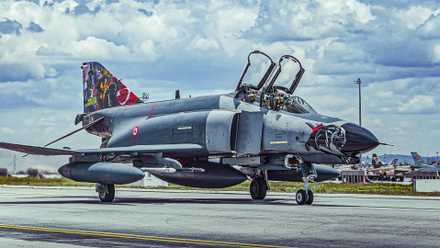
Originally designed as an air-superiority fighter for the US Navy, it was thrust upon the US Air Force by Secretary of Defense Robert McNamara in 1963. The F-4 Phantom went on to become the archetypal multi-role jet of the US Armed Forces and allied partner nations worldwide. Subsequent aircraft in the years since its creation, such as the General Dynamics F-16 Fighting Falcon and Lockheed Martin F-35 Lightning II, have drawn heavily on its design.
Much like many of the other planes on this list, it had a controversial debut. This time, not for any lack of performance, but rather the absence of a gun on a fighter jet for the first time. The F-4 was always popular with pilots for the brutal speed that it was capable of. Like the Starfighter before it, the Phantom set numerous speed and altitude records in its early years. It evolved into the definitive American combat aircraft of the Vietnam War, scoring 107 aerial victories while simultaneously conducting heavy ground-attack, close-air support, and reconnaissance missions.
It was initially designed without an internal gun, relying entirely on advanced radar-guided AIM-7 Sparrow and heat-seeking AIM-9 Sidewinder missiles. Initially suffering an abysmal rate of combat losses, the jet even inspired the Navy to establish the famous Top Gun school. The last test and drone-target modified examples were phased out by the USAF in 2016, and some Coalition Air Forces still fly F-4s to this day.