dailynewsnblog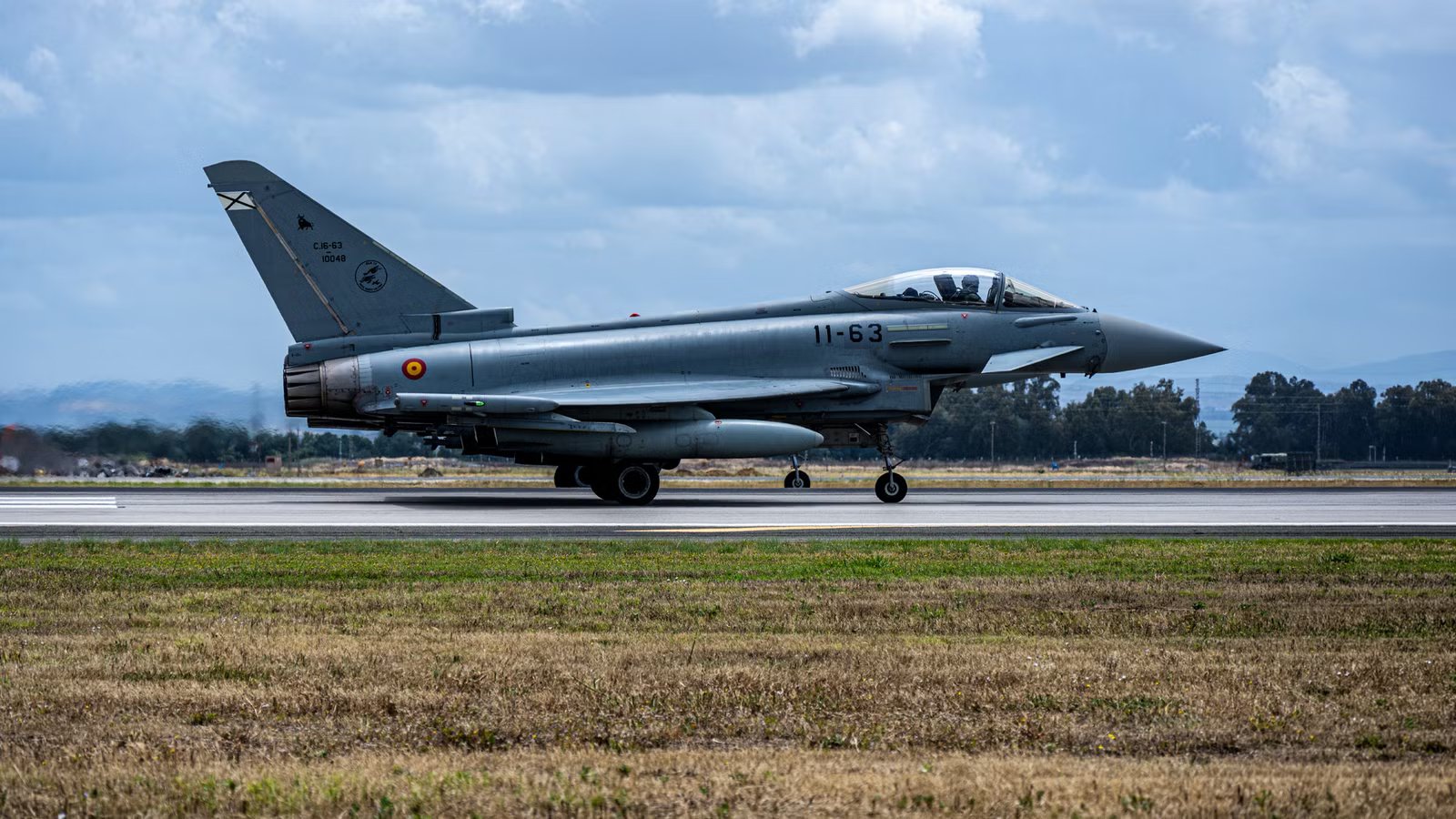
Spain’s fighter jets modernization plans have become one of the most closely watched defense stories in Europe. As many NATO allies expand their fleets with American-made stealth aircraft, Madrid has chosen a different path—one that prioritizes industrial participation, long-term strategic autonomy, and the continued evolution of an aircraft it helped create. Understanding that decision offers valuable insight into how European air forces are balancing capability, sovereignty, and future combat requirements.
Drawing on data from Airbus, Turdef, Army Recognition, and Simple Flying, this article examines why Spain expanded its Eurofighter Typhoon fleet through the Halcon program instead of acquiring the Lockheed Martin F-35, how the latest Tranche 4 upgrades are reshaping the aircraft’s capabilities, and what these choices reveal about Spain’s broader defense strategy. It also explores the role of domestic industry, the significance of the ECRS Mk1 radar, and how emerging projects such as FCAS, the Hürjet, and Turkey’s KAAN fighter are influencing Madrid’s long-term vision for air power.
Spain And The Eurofighter: A Partnership Built Into The Airframe

Spain is more than a passive buyer of the Eurofighter. It is one of four founding partner nations, alongside Germany, Italy, and the United Kingdom, that jointly developed the aircraft, sharing design responsibility, production workshare, and the long-term upgrade roadmap. That history matters enormously to understanding why Spain ordered more Eurofighters rather than switching to the F-35.
For Spain, the Typhoon is a 100% European platform whose industrial DNA runs through numerous Spanish companies, Spanish engineers, and Spanish facilities that have been producing and supporting the aircraft for over two decades.
The Getafe facility south of Madrid where the first Halcon I rolled out is the Spanish final assembly line, where Eurofighters destined for the Spanish Air and Space Force are assembled, tested, and prepared for service. Spain’s Indra, the national defense electronics group, plays a direct role in the ECRS Mk1 radar development, the most significant capability upgrade in the Tranche 4 package.
According to Army Recognition, Airbus has stated that the Halcon program supports more than 16,000 direct and indirect jobs in Spain — a figure that encompasses Airbus, the engine consortium, radar developers, avionics suppliers, and national maintenance organizations across the country. Switching to the F-35 would have transferred much of that industrial activity to a US-controlled supply chain, with maintenance and upgrade decisions made in Fort Worth rather than Madrid or Getafe.
Spain’s existing Eurofighter fleet at the time of the Halcon I contract comprised approximately 70 aircraft across three wings, including Ala 11 at Morón, Ala 14 at Albacete, and the units at Gando Air Base in the Canary Islands. The training backbone, composed of the simulators, qualified instructors, and maintenance organizations, is already Eurofighter-oriented. Any switch to the F-35 would have required rebuilding that infrastructure from zero, at high cost and over a timeline incompatible with the retirement schedule of Spain’s aging Boeing F/A-18A/B Hornet fleet. Spain’s Typhoon force is also deeply embedded in NATO air operations, with multinational exercises such as the NATO Tiger Meet, highlighting the interoperability and tactical cooperation that have become central to modern European airpower.
Why The F-35 Was The Obvious Choice Spain Declined

As already covered by Simple Flying, the F-35A’s main advantages are fifth-generation stealth, the AN/APG-81 AESA radar, a distributed aperture system that gives pilots 360-degree situational awareness through their helmet displays, and an electronic warfare suite that has no peer among Western combat aircraft of its size. Together with the advantages, the F-35A would have introduced a US-controlled sustainment chain requiring extensive government-to-government licensing for every spare part, every software update, and every capability modification — a dependency that Spain’s defense planners deemed strategically unacceptable for the long term, particularly given Spain’s equal core partnership alongside France and Germany in the Future Combat Air System (FCAS) program, having officially joined the initially Franco-German initiative in 2019.
Catch what other flight trackers miss
Emergency squawks, holds, NOTAMs — live signals, no signup.
Open tracker
Catch what other flight trackers miss
Emergency squawks, holds, NOTAMs — live signals, no signup.
Open tracker
Italy and the UK provided the most effective model to combine the F-35 and the Eurofighter, as written on Simple Flying, operating the two as complementary assets: the F-35 can penetrate high-threat airspace and share data; the Typhoon can offer kinetic payload, range, and sustained presence at a lower cost per flight hour. That dual approach is available to any air force that can afford both types simultaneously, but in Spain it is currently impossible, and with current tensions between Spanish PM Pedro Sanchez and US President, highly unlikely to happen in the near future.
As written by Aerospace Global News, Spanish press reporting in 2025 subsequently confirmed that Madrid had formally suspended plans to acquire the F-35, signaling its preference for European combat aviation solutions through both the Halcon program and FCAS.
According to Turdef, the Halcon I contract was not the result of a conventional open competition between the F-35, Eurofighter, Dassault Rafale, and Saab JAS 39 GripenE as equal bidders. Spain acquired additional Eurofighters through the existing NETMA framework specifically to minimize transition risk, preserve its industrial position, and maintain operational continuity.
The Rafale and Gripen E were theoretically available as European alternatives, but neither met Spain’s specific combination of requirements. The Rafale had no existing Spanish operational base, no workshare connection to Spanish industry, and would have required building a support network from scratch. The Gripen E, while technically capable and competitively priced, did not offer the scale of industrial engagement that Spain’s defense sector expected. The Eurofighter already had all of those things in place, plus the upgrade trajectory of Tranche 4 — and it did so through a procurement framework that required no new contract architecture and no new political negotiation with a non-European partner.

6 Aircraft That Represent The Future Of Air Combat
Discover six aircraft redefining modern air warfare, from stealth fighters to missile trucks, shaping the balance of air power in 2026 and beyond.
What Tranche 4 Actually Delivers: The E-Scan Radar And Beyond

The most significant operational upgrade in the Halcon I package is the E-Scan radar, specifically the ECRS Mk1, a next-generation active electronically scanned array (AESA) system developed in partnership with Hensoldt and Indra participation, replacing the older mechanically scanned Captor radar that equipped earlier Typhoon tranches.
Active electronically scanned arrays differ from mechanically scanned radars in a fundamental way: instead of physically rotating an antenna to steer a beam, an AESA uses hundreds of individual transmit/receive modules to electronically steer the radar beam in microseconds, allowing near-simultaneous scanning across multiple modes and targets. That capability translates directly into faster target detection, the ability to track more contacts simultaneously, and far greater resistance to electronic jamming.
According to Interesting Engineering, the ECRS Mk1 also incorporates an electronic attack capability — the ability to deliberately jam or suppress enemy radar systems and communications — which is a qualitative leap beyond the earlier Captor’s purely passive or defensive electronic warfare role. As discussed in a previous Simple Flying analysis of how raw speed has become strategically marginal in modern air combat, the decisive variable in a contemporary beyond-visual-range engagement is not how fast your aircraft flies, but whether your sensors can find the enemy before their sensors find you, and whether your electronic warfare suite can degrade their picture. The ECRS Mk1 is the direct response to that logic. A Halcon I aircraft equipped with it and carrying the Meteor beyond visual range can engage targets at ranges where neither supersonic cruise speed nor visual-range maneuverability is remotely relevant.
The Halcon aircraft will also benefit from the full Eurofighter weapons roadmap. Meteor integration, already in service on Spanish Typhoons, extends the aircraft’s air-to-air reach to ranges that were previously the exclusive domain of dedicated long-range air defense missiles. The Brimstone III precision strike missile, if fully integrated into the Spanish configuration, would add a lethal capability against armored vehicles and time-sensitive targets, expanding the Halcon’s usefulness well beyond traditional air defense intercept missions. The Tranche 4 airframe also brings updated avionics, enhanced human-machine interface, and improved data-link connectivity, keeping the platform relevant in a networked battlespace even without stealth, the one capability where the F-35 retains an advantage the Eurofighter does not contest.
The Halcon I Contract: What Was Signed, When, And For What

The Halcon I contract was signed on June 23, 2022, during the ILA Berlin Air Show, when NETMA contracted 20 Eurofighter Typhoon aircraft for Spain on behalf of the Spanish Air and Space Force. Eurofighter GmbH, NETMA, and Eurojet Turbo GmbH all signed the agreement, covering 20 aircraft, their associated EJ200 engines, and the full modernization package required to begin replacing the McDonnell Douglas (now  Boeing) F/A-18A/B Hornets operated by the 462 Squadron at Gando Air Base in the Canary Islands.
The contract value was €2.043 billion (approximately $2.1 billion at the time of signature), covering 16 single-seat and four twin-seat aircraft to Tranche 4 standard. According to Defence Blog, the Canary Islands deployment context is strategically significant. Gando Air Base sits on Gran Canaria, roughly 872 miles (1,403 km) southwest of mainland Spain, giving it a commanding position over the eastern Atlantic approaches and the African coast.
The F/A-18A/B Hornets it currently hosts are among Spain’s oldest remaining Hornet airframes, carrying sensors and avionics that are increasingly limited against modern threats. Replacing them with Tranche 4 Eurofighters equipped with AESA radar and Meteor missiles transforms the Spanish southern flank, as it is a NATO priority area covering the approaches from North Africa, the Canary Islands exclusive economic zone, and the Atlantic corridor. These new Eurofighters provide a substantially more capable air defense posture in this strategic area.
The first aircraft to roll out on June 1, 2026, carrying manufacturer serial ST015, is a twin-seat variant. Engine runs have already begun at Getafe ahead of a maiden flight, and first delivery is expected before the end of 2026. According to Scramble NL, the timeline positions Spain to begin replacing the oldest Hornet airframes at Gando this year, closing a capability gap that has widened as maintenance costs on the legacy jets have risen and spare parts availability has tightened. The Eurofighter EJ200 engines powering the Halcon aircraft produce approximately 20,000 pounds of thrust (89 kN) each in afterburner, giving the aircraft a thrust-to-weight ratio that exceeds 1:1 at combat weight — a figure that underpins its exceptional climb rate and sustained supersonic cruise performance.
From Dogfights To Drone Strikes: The Military Aircraft Rewriting The Rules Of Combat
Modern air warfare is splitting into two: stealth aircraft and AI drones at one extreme, and improvised low-cost countermeasures at the other.
The Turkish Connection: Why Spain Also Bought The Hürjet — And Is Now Talking KAAN

In October 2025, Spain approved a separate €3.12 billion ($3.4 billion) contract for 45 TAI Hürjet advanced jet trainers under the SAETA II designation, the largest Turkish defense export deal ever signed, and a deal whose structure reveals the logic that could soon extend to far larger and more consequential aircraft. The Hürjet is a single-engine, tandem-seat, supersonic advanced jet trainer developed by Turkish Aerospace Industries, with its first prototype flying in April 2023.
Under the SAETA II arrangement, Airbus España takes on the integration of mission computers and selected avionics, positioning the Spanish industry inside the supply chain of a Turkish aircraft, the same industrial-participation model that made the Eurofighter attractive in the first place, now applied to a non-European partner. Deliveries are expected to begin in 2028, with reports in the Spanish press noting that the aircraft could eventually be used to train pilots destined for a more advanced Turkish type.
That more advanced Turkish type is the TAI TF-X KAAN, a twin-engine, low-observable air superiority fighter whose maiden flight took place on February 21, 2024. As Simple Flying has detailed in its analysis of the KAAN versus the F-35, the aircraft is powered in its current prototype configuration by two General Electric F110-GE-129 turbofans producing 29,000 pounds of thrust (128.9 kilonewtons) each in afterburner, carries an AESA radar developed by ASELSAN, features internal weapons bays for reduced radar cross-section, and is designed to achieve supercruise — sustained supersonic flight without afterburner. Indonesia has committed to acquiring 48 KAANs in a deal valued at approximately $10 billion.
According to Army Recognition, TAI CEO Mehmet Demiroğlu confirmed at the SAHA 2026 International Defense and Aerospace Exhibition in Istanbul on May 7, 2026, that Spain and Turkey had entered preliminary government-to-government discussions regarding a potential Spanish KAAN acquisition. These talks directly mirror the SAETA II structure by emphasizing technology transfer and Spanish industrial participation as central to any deal. A TAI source speaking to Spanish outlet El Español confirmed Spain had the strategic intent and the requirement to acquire a fifth-generation fighter jet and associated drones.
The KAAN’s emergence as a viable Spanish option is inseparable from Spain’s frustration with FCAS delays. The Future Combat Air System, the sixth-generation program Spain is developing alongside France and Germany, has faced repeated schedule slippages, and the Spanish government had earmarked €6.25 billion for new fighter acquisition with no clear delivery timeline from FCAS before the 2040s.
According to The Eurasian Times, TAI is deliberately positioning the KAAN as an answer to exactly this problem: a fifth-generation-capable aircraft offering sovereign software control, national avionics integration, and reduced US supply-chain dependency. That is exactly everything Spain cited as reasons to reject the F-35. Now both NATO nations will work under a bilateral framework. It is worth noting that Turkey’s ambitious project to build a 5th-gen fighter took place after the country was expelled from the F-35 program, and it provided an unexpected advantage that attracted Spain: independence from the US support network.
But there is still one real risk: the KAAN’s current dependence on US-made GE F110 engines creates a potential Washington veto over any export, and the indigenous TF35000 engine that Turkey is developing to replace them is not expected to be integrated into production KAANs until 2032 at the earliest. Talks remain, in TAI’s own words, at a very initial phase.
What The Halcon Decision Tells Us About European Combat Aviation

What makes Spain’s recent fighter decisions interesting is not that they reject American technology. Spain remains a NATO member, operates American equipment across multiple services, and continues to work closely with allies that have embraced the F-35. The more important story is that Madrid appears increasingly focused on preserving freedom of action in how it acquires, supports, and upgrades its future combat aircraft.
That logic explains why the Eurofighter remains central to Spain’s plans despite the global success of the F-35. It also helps explain why Spain was willing to bring Turkey’s Hürjet into its training pipeline and why early discussions about the KAAN fifth generation fighter have attracted attention despite the program’s immaturity. In each case, industrial participation, access to technology, and long-term control appear to matter almost as much as raw performance.
Whether that strategy ultimately succeeds remains an open question. FCAS continues to face delays, the KAAN has yet to enter operational service, and the F-35 remains the benchmark against which every Western fighter is measured. But the rollout of the first Halcon I aircraft suggests that Spain has already made its near-term choice. Rather than buying into an existing fifth-generation system, it is investing in the industrial and technological foundations it believes will matter most when Europe’s next generation of combat aircraft finally arrives.