dailynewsnblog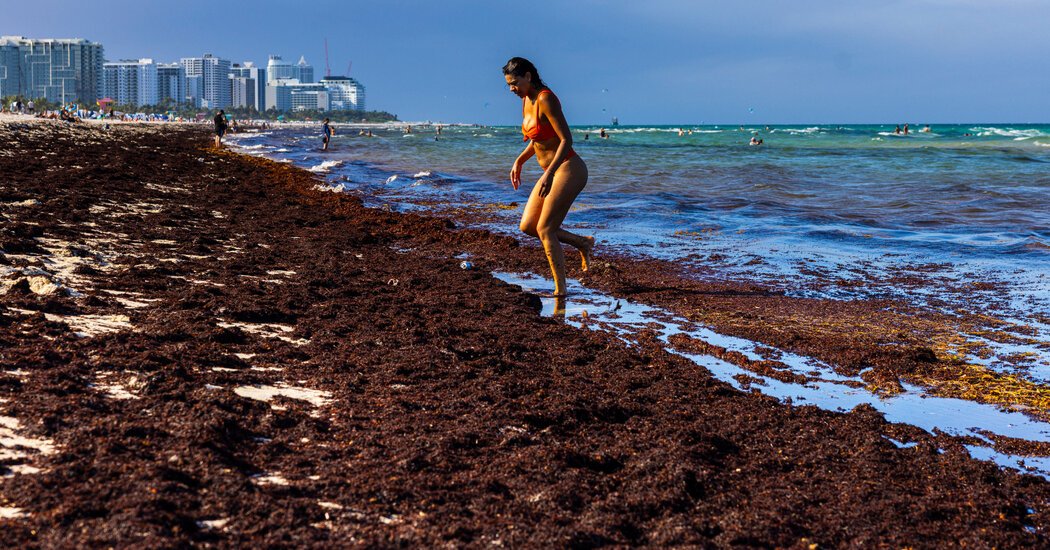
Visitors from around the world are reveling in Miami’s World Cup games and events, spirited soccer watch parties and steamy weather.
They are less enthused about the masses of sargassum seaweed coating South Florida beaches and turning the aqua ocean the color of watery coffee. The brown tangles smell of rotten eggs as they bake under the scorching sun. Flies swarm the piles as tourists pluck itch-inducing strands from their hair and bathing suits.
Kirsty Douglas and her family flew from Scotland to attend World Cup matches in two states. They visited South Beach for the first time on Tuesday.
“We weren’t sure if this was normal,” Ms. Douglas, 40, said. “It was like walking on a sponge getting into the sea.”
Her children were collecting the seaweed in piles as a game. But it’s been no fun for South Florida tourism officials and businesses to watch the sargassum wash ashore just as thousands of people arrive for World Cup festivities and other early-summer pursuits.
The seasonal problem is not new, but it has gotten worse in recent years.
Sargassum is a naturally occurring algae that grows in the middle of the Atlantic Ocean. But starting in 2011, researchers believe, it began spreading amid shifting wind and sea currents. Since then, a patch of the algae has grown explosively, stretching in a gigantic belt from the west coast of Africa toward the Caribbean Sea and Gulf of Mexico.
Scientists remain divided on why, said Matthieu Le Hénaff, a NOAA research oceanographer. Some theorize particles from dust storms and wildfires in Africa, or agricultural fertilizer in river runoff, may be fueling the algae growth.
Whatever the reasons, the blobs have wreaked havoc on beaches across the Caribbean and Florida in recent years. Researchers estimate the sargassum blooms may be costing the state’s economy billions of dollars because of its impact on the tourism and fishing industries.
While the Portugal star Cristiano Ronaldo was filmed shirtless and sculpted this month on the sands of Palm Beach, with little seaweed visible, social media has been flooded with images farther south of beachgoers wading through brownish waters clogged with the stuff.
“It’s so uncomfortable,” said Eduardo Mujica, a Colombian tourist who was sunbathing with his family on Tuesday in Miami Beach before attending the FIFA Fan Festival in downtown Miami. “My daughters didn’t want to go in the water because they were afraid.”
Large amounts of sargassum began washing up on South Florida beaches in April and May, earlier than usual, marring Memorial Day weekend.
Researchers have already estimated that there are nearly 30 million metric tons of sargassum in the Atlantic this year, said Chuanmin Hu, a University of South Florida professor of physical oceanography who tracks its movement using satellite data. That could eventually break last year’s record.
“This is likely going to be a new normal,” Dr. Hu said.
Miami-Dade County officials can’t do much about the floating carpets of sargassum. State environmental rules bar removal of sargassum from the water because they provide habitat for sea animals, particularly protected sea turtles.
“We can’t touch it until it hits the beach,” said Chris Bumpus, chief of conservation for Miami-Dade County’s parks department.
So every morning, the Sisyphean task of clearing 17 miles of Miami-Dade beachfront of sargassum falls to county crews whose every move is choreographed to comply with environmental regulations. They start only after surveyors have checked on sea turtle nests buried under the sand. The county recently got state permission to deploy bulldozers to break up heavier piles.
Crews play a cat-and-mouse game to find hot spots, monitoring winds and currents. “Just depends what Mother Nature brings us,” Mr. Bumpus said.
On Friday, tractors mixed the sargassum into the sand on South Beach. In designated hot spots, contractors load sargassum into dump trucks that ferry it to a special facility to dry out before it gets transferred to a landfill.
Beachgoers in the know can check a Facebook page where users report sargassum conditions on various Florida beaches. The Walker family, visiting Miami Beach from Jacksonville last week, did not know about the page.
“It smells like sewage out here. It’s disgusting,” said Minisha Walker, 48, as she witnessed her 10-month-old grandson’s first dip in the ocean. He emerged with strands of sargassum clinging to his hair and diaper.
Still, she said: “It’s not going to make me stop coming to the beach.”
Farther north in Bal Harbour, the beach sat largely empty. Sargassum caked the sand, pelicans hovering overheard.
“No money. No tips. Nobody comes out. And nobody goes in the water,” said Daniel Cook, a 21-year-old attendant who rents beach chairs and umbrellas.
One of the few who hit the beach was Lucela Perez, 58. She lounged in a chair on her first day in Miami escaping wintry conditions back home in Argentina. Ms. Perez, who planned to watch Argentina play in World Cup matches with family, had heard a bit about the seaweed.
“But I didn’t think it would be like this,” she said. “I’m just waiting for it to go away.”
A consolation prize was in store: Hours later, her nation’s team won its World Cup match in resounding fashion.