dailynewsnblog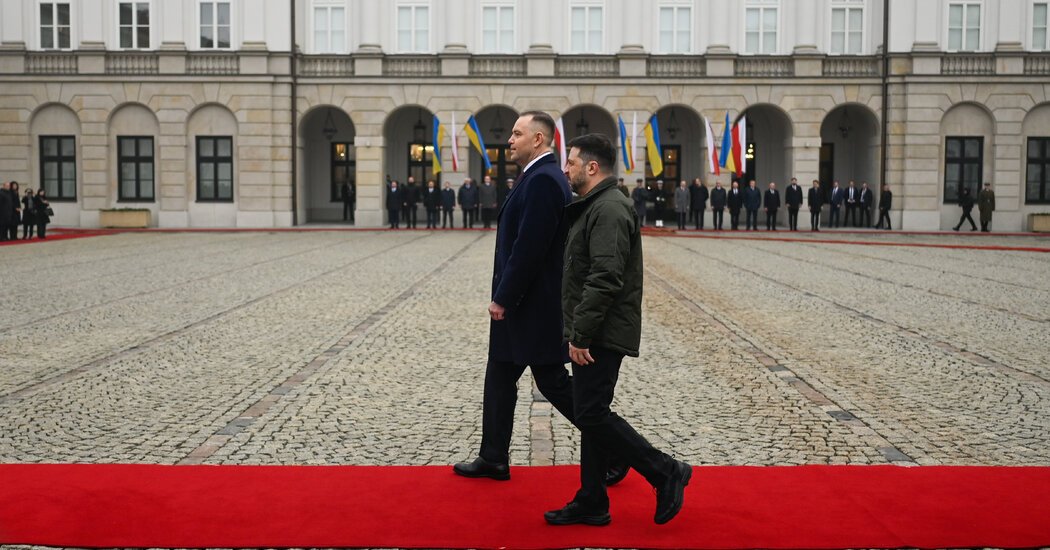
The two neighbors wholeheartedly support allying with the West and cooperating closely on military affairs, and are fully in agreement today in opposing Russian expansionism. But history gets in the way.
Tensions between Poland and Ukraine escalated sharply on Saturday over a rancorous dispute over the commemoration of World War II-era figures. Poland’s president, Karol Nawrocki, said he would revoke his country’s highest state award, which was given to President Volodymyr Zelensky of Ukraine — and then Mr. Zelensky said he would return it first.
The blowup was set off by Mr. Zelensky’s signing of a decree on May 26 in honor of World War II Ukrainian nationalist fighters whom Poles hold responsible for the killing of tens of thousands of Polish civilians. The fighters were in the Ukrainian Partisan Army, which in 1943 committed what Poland remembers as the Volhynia Genocide. Ukrainians remember them for fighting against the Soviet Union.
The rupture over history risks one of the closest alliances in Eastern Europe in maintaining the eastern front against Russia, a priority for NATO. Much of the American and European weaponry and ammunition provided to Ukraine passes through bases and travels on highways and railroads through Poland.
The roughly decade-long underground struggle during and after World War II in the forests, villages and mountains in western Ukraine of the Ukrainian Partisan Army, known by its acronym U.P.A., is the biggest historical bone of contention between Poland and Ukraine.
The two neighbors, united by their hostility toward Russia, worked hard after the start of Moscow’s full-scale invasion of Ukraine in 2022 to calm passionate disagreements over what happened during World War II. Mr. Zelensky’s decree honoring the U.P.A., however, revived the rancor.
“Russia is opening the champagne now,” said Oleksandra Iwaniuk, a Ukrainian who is an assistant professor of political science at the University of Warsaw.
Poland and Ukraine have both been reckless on the historical issues, matters of fierce pride that can inflame emotions in both countries, Dr. Iwaniuk said. Dipping back into this history endangers their relationship for the sake of temporary internal political gains, with Russia the ultimate beneficiary, she said.
“Both sides are strategically shooting themselves in the foot while the one who is winning is Moscow,” she said.
Ukraine’s political elite rallied to Mr. Zelensky’s side. On Friday, Mr. Zelensky’s chief of staff, Kyrylo Budanov, and foreign minister, Andriy Sybiha, announced they were handing back their Polish state awards. Then on Saturday, three former presidents of Ukraine, Leonid Kuchma, Viktor Yushchenko and Petro Poroshenko, said they were giving theirs back, as well.
The U.P.A., formed in 1942, was created by one branch of the Organization of Ukrainian Nationalists, the political wing of the mid-20th century Ukrainian independence movement. At the start of World War II, it collaborated with Nazi Germany, hoping Hitler would support the creation of a Ukrainian state.
It soon became clear that this would not be the case. By mid-1943, partisan army units were clashing with German occupying forces as well as with the Soviets. They also fought the Poles, who had ruled parts of western Ukraine known as Galicia from 1918 until the Soviet Union invaded the area in 1939.
Members of the army attacked Polish villages in a campaign of ethnic cleansing during and after World War II in clashes that the Ukrainians refer to as the Polish-Ukrainian war, but that the Polish Parliament designated as the Volhynia Genocide. Historians say the fighting that took place amid the broader violence of the war killed about 80,000 Polish civilians and about 10,000 Ukrainian civilians.
To the Poles, the U.P.A. is synonymous with the massacres of Polish civilians in the 1940s. To Ukrainians, it is remembered for something entirely different: the armed struggle against the Soviet Union. In Ukraine, the war today is seen as a continuation of this struggle.
While united in fear of Russia, many Eastern and Central European nations have nursed historical grudges against one another as the war in Ukraine stretches into its fifth year. But the feud over the U.P.A. could be the most damaging.
To honor the U.P.A. is “outrageous and damaging to trust between our nations,” said Mr. Nawrocki, the Polish president, in a statement on Friday. “This is a blow not only to historical memory but also to the trust we have built over the years.”
Mr. Zelensky issued an acerbic response.
He noted that Poland had not withdrawn similar honors given to Benito Mussolini or Gerhard Schröder, the Kremlin-friendly former German chancellor.
In a more conciliatory tone, however, he added, “Ukraine will remain open to all meaningful formats of engagement with Poland in order to try to avoid conflicting interpretations of the difficult and painful chapters of our shared past and to ensure proper respect for all innocent victims of the 20th century.”
On Friday, Poland’s prime minister, Donald Tusk, a steadfast supporter of Ukraine at odds with Poland’s nationalist camp, criticized the escalating conflict on social media, and, like Mr. Sybiha, Ukraine’s foreign minister, and numerous political analysts from both countries, said it served Russia’s interests and undermined Western unity.
The Polish political commentator and writer Ziemowit Szczerek said that Mr. Tusk “might be the only grown-up in the room,” and explained that a lot of hopes now ride on the prime minister to react correctly and tone down the emotions.
Mr. Tusk has not yet said whether he will sign the decree to take back the award to Mr. Zelensky. But he, too, seemed anxious to restore peaceful relations between the two allies.
“The conflict between Poland and Ukraine pleases Putin and shocks our allies,” Mr. Tusk said. “The task of Presidents Zelensky and Nawrocki is to calm emotions, not to fuel tensions. The front line is elsewhere.”
In Poland, political analysts see the conflict as serving the right-wing opposition to Mr. Tusk’s party. He faces a tough choice of either refusing to sign off on revoking the award, or signing off on it to avoid angering a significant portion of Polish public opinion that leans nationalist.
Slawomir Mentzen, a far-right nationalist and libertarian who got 14 percent of the vote in last year’s presidential elections and leads the Konfederacja party, wrote on Facebook that it was good the Ukrainians were giving back their awards, but that “it’s just a pity that we handed them out like candy in the first place.”
He added that “once they’ve returned all the awards, they can also return the money, weapons, ammunition and everything else we previously gave them.”
His statements reflect the growing feeling among many Poles that Ukraine has shown insufficient gratitude for unwavering Polish support, both to its military and to more than a million refugees sheltering in Poland.
Mr. Zelensky received the Order of the White Eagle, Poland’s highest state honor, in April 2023 from the Polish president at the time, Andrzej Duda. The award honored what the Poles called Mr. Zelensky’s contribution to strengthening peace and security in Europe.
Poland accepted millions of Ukrainian refugees at the outset of the war, including many who passed through Poland to other countries. About two million Ukrainians remain in Poland today.
But over the past two years, Polish attitudes toward the Ukrainians in their country have hardened. “It really spilled onto the streets,” said Dr. Iwaniuk, the political science professor.
Anna Colin Lebedev, an assistant professor in political science at Paris Nanterre University, said the recent U.P.A.-related commemorations in Ukraine were not intended to be anti-Polish, but anti-Russian.
“Every time Ukrainians celebrate the fighters for their nation’s sovereignty, they trigger the Poles,” she said. “The main enemy today is Russia, and everything that can remind Ukrainians how hard they were fighting in the past against Moscow is legitimized and made visible.”
Andrew Higgins contributed reporting from Warsaw, and Dzvinka Pinchuk from Kyiv.