dailynewsnblog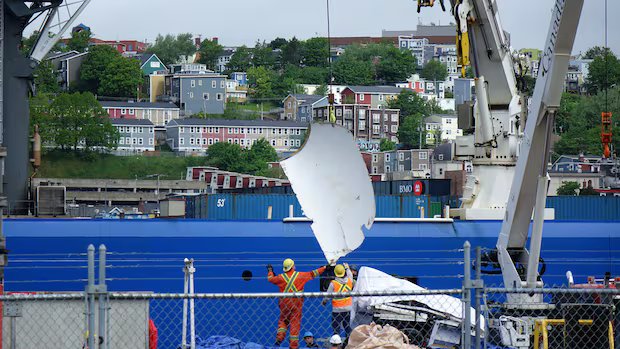

Listen to this article
Estimated 4 minutes
The audio version of this article is generated by AI-based technology. Mispronunciations can occur. We are working with our partners to continually review and improve the results.
The executive director of the World Submarine Organization says countries like Canada must make submersible regulations as simple as possible, or companies will take cost-cutting risks in the future.
Will Kohnen, a California-based veteran of the submersible industry, watched with interest as Canada’s Transportation Safety Board (TSB) released its findings from the OceanGate Titan disaster on Wednesday.
He agreed with many of the findings, including a recommendation that Transport Canada ensure submersibles operating in Canadian waters or with Canadian support vessels adhere to international standards.
Kohnen is urging Transport Canada to trust the industry to take the lead in establishing those standards, rather than getting bogged down with bureaucracy.
“This has to be efficient for economic reasons, because if it’s not economically efficient, people are going to find loopholes and ways around it. And that’s what OceanGate did,” Kohnen told CBC News.

There are already generally accepted standards within the submersible industry, which have been set by a number of classification societies. Those groups assess the vast majority of submersibles operating around the world and determine whether or not they are safe.
At the time of the OceanGate disaster, there were 10 submersibles in the world capable of diving to the depths of the Titanic wreckage. Titan was the only one not classed.
“This is standard,” Kohnen said. “Ninety-five per cent of all submersibles in the world are classed by some classification society, so OceanGate was way offline and off base not classing their submersibles.”
Kohnen was among a group of industry leaders who warned OceanGate CEO Stockton Rush against taking that approach in a 2018 letter that became public after Titan went missing. They warned that OceanGate’s decision not to class its submersibles could have “catastrophic” consequences.
They were right. Titan went missing on June 18, 2023, early in a dive to the Titanic wreckage. An intense four-day search followed, before a debris field was found on the ocean floor on June 22. Five people, including Rush, were killed.
Canada among countries with lax regulations
In the aftermath, questions were raised about how Titan could have left a Canadian port with a Canadian support vessel if it wasn’t classed or certified in any way.
Those questions were central to the TSB report released this week.
“Some countries, including the Bahamas, the Cayman Islands, and Japan, require submersibles to be classified with a classification society,” the report reads. “Other countries have regulatory frameworks that cover the operation of submersibles. Some countries, such as Canada, have limited or no regulations in place.”
The International Marine Organization (IMO) — an agency of the United Nations responsible for regulating marine transportation — does have guidelines on passenger submersibles, which it established in 2001.
However, those guidelines are not enshrined in any international codes or conventions, meaning they are non-binding and member states like Canada do not have to follow them.
The TSB has recommended Transport Canada advocate to the IMO to make those standards enforceable.

Why were passengers allowed on the experimental Titan sub?
Kohnen said the submersible industry is on board with the recommendation, but the IMO guidelines need updating before they become part of any code or convention. He said they were first drafted with larger submersibles in mind, and likened it to regulating cars with rules designed for buses.
Still, it’s an important effort — and one that could prevent another disaster in the future.
“To get through to the IMO, it’s probably a three to five-year effort, but this will stand for the next generation of submarine operators and developers,” Kohnen said. “So it really is our legacy after 30 years of doing this.”
Updating those regulations and further establishing industry standards will be a key component of the upcoming International Submarine Symposium in Hamburg, Germany, in September. More than 150 experts and operators will meet for three days to work out the details.
Download our free CBC News app to sign up for push alerts for CBC Newfoundland and Labrador. Sign up for our daily headlines newsletter here. Click here to visit our landing page.