dailynewsnblog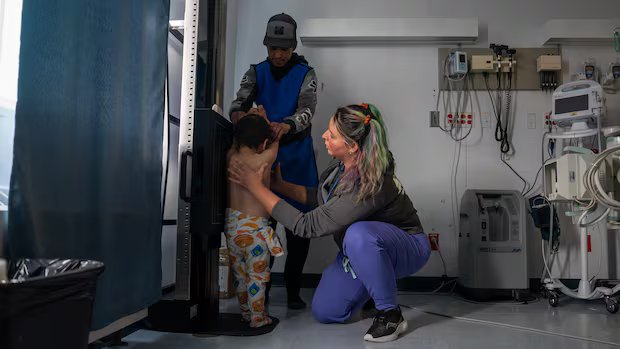
After losing his partner to tuberculosis in February, Tumassi Anauta has become a single parent to his three children.
Anauta and his partner were diagnosed with latent TB last year, which can remain in the body for years and later turn into an active case.
While treatment is relatively straightforward today, usually taking antibiotics over several months, the disease can still turn deadly if left unmanaged.
“We weren’t taking it seriously,” says Anauta. “We were like, ‘We’re not even sick’.”

Now the 25-year-old is urging fellow Nunavimmiut to be more careful with their health.
“I gotta tell my people that please take the TB pills, cause you don’t know who you might lose.”

In early June, there were about 20 active cases of tuberculosis in Anauta’s home community of Akulivik.
“It’s way too many,” says Jenifer Moisan, the assistant head nurse at Akulivik’s local community service centre. Since arriving in 2022, she says she’s never seen so many cases.

That echoes the reality in the rest of the region: Alukivik is one of eight communities across Nunavik currently dealing with a growing tuberculosis outbreak.
The total number of cases has grown annually for the past five years. Last year, health workers detected 116 cases — a new record high. With 60 cases already discovered so far this year, things aren’t looking any better.
Trust issues slowing treatment
In late May, the Nunavik Regional Board of Health and Social Services (NRBHSS) sent a team to Alukivik to screen community members in an attempt to slow the spread of the disease.
Health workers are going door-to-door and to various workplaces to give residents the opportunity to do a sputum test, used to determine whether someone has the bacteria that causes the disease.

Those efforts have had mixed results, Moisan says.
“There are many concerns and conflicting information,” she said.
In Québec, people with active TB are legally required to undergo treatment.
That mandatory treatment plus a mistrust in the health-care system creates fear in residents, says Moisan.
“People are scared to be arrested and then forced to be treated,” she says.

Larry Hubert, the community’s mayor, says the system needs to better integrate Inuit way of life into treatment to try and regain residents’ trust.
With the field team only in the community for a month, the mayor says the response also has to be more sustained.
“It has to be a community-based initiative and an ongoing initiative, because when they’re gone, it spreads again,” he says.
The NRBHSS says it’s trying to hire local workers to help support the response, but that it’s struggling to do so in each community.

A historical hurt
In the 1950s and 60s, Inuit with TB were uprooted from their communities and sent for treatment down south, with many never returning home.
Elisapi Aliqu remembers her mother being sent to Hamilton, Ont., for treatment. While her mother eventually returned, having her gone for so long left a lasting impression.
“She was there for two whole years, not even able to get up off the bed,” says Aliqu. “They had a lot of patients back then. There was no communication, no telephone.”

Today, limited resources in most small communities mean residents sometimes still need to leave their homes and travel to health centres in either Puvirnituq or Kuujjuaq for lung X-rays.
Natasha Ita MacDonald, an Inuk researcher, says that reality remains a major hurdle in managing the tuberculosis crisis.
“When Inuit are forced to leave their own home, some mothers with infants or parents that need to leave their jobs, […] it’s unacceptable and I can understand why there can be such a distrust of the system.”

Ita MacDonald recently coauthored a study which called for more resources close to home.
“The value of Inuit lives are still treated as less than that of non-Inuit or non-Indigenous, and that has to stop,” she says.
The threat of police action if not following treatment also contributes to that mistrust, she adds.

More than just a health problem
The current living conditions in Nunavik are also a major factor in the rise of tuberculosis cases, says Dr. Marie-Jo Ouimet, the region’s director of public health.
“If we invested in better infrastructure, more housing to avoid overcrowding, if we could curb food insecurity, and poverty, we wouldn’t be faced with this crisis,” she says.

On the medical side, a lack of clinic spaces in communities, limited screening capacity, and staff shortages are all hindering the teams on the ground, she adds.
For Jennifer Munick-Watkins, NRBHSS’s executive director, it comes down to a lack of support from the Quebec government.
She’d like to see a budget carved out at the provincial level to better address tuberculosis in the region.

“I feel like they don’t care,” she says. “Are we not worthy of being helped more? … It’s sort of hard to be kind in a devastating situation.”
The province’s Department of Health and Social Services said in an email that it’s taking the crisis seriously. It adds it has not dedicated a budget to fight the disease, but says the funding agreement between the department and the NRBHSS is currently being renegotiated.
Munick-Watckins says she hopes those discussions will lead to the “same services” being available in Nunavik as they are in the rest of the province.
“I just want equality. That’s all I want, nothing more, nothing less.”