dailynewsnblog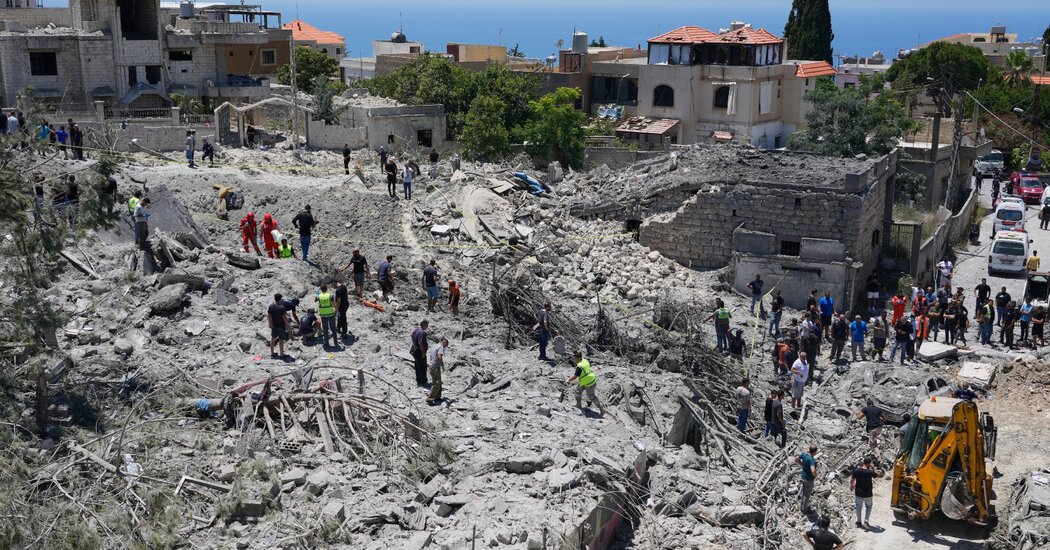
After a cease-fire was announced in Lebanon on Friday afternoon, the sixth such effort in a matter of weeks, little had changed 24 hours later as the truce once again devolved into more Israeli strikes and Hezbollah fire.
Israel pounded towns and villages across southern Lebanon on Saturday, killing at least seven people and wounding more than a dozen, according to Lebanon’s health ministry.
The Israeli military said the attacks came after Hezbollah, the Iran-backed Lebanese militant group, fired more than 50 projectiles overnight at Israeli troops in southern Lebanon, where Israel has occupied large swathes of territory since March.
The fighting punctured a truce announced only a day earlier, an effort to tamp down a sharp escalation that threatened to derail a preliminary peace deal between the United States and Iran. With an end to military operations in Lebanon stipulated in that deal, Iran’s military upped the ante on Saturday: announcing that the Strait of Hormuz had been closed to maritime traffic, citing Israel’s continued attacks.
For the second time in two days, Lebanon was again at the center of whether the fragile U.S.-Iran deal would hold.
In Hezbollah’s account of the overnight exchange, the group said it had attacked Israeli forces advancing toward Ali al-Taher, a strategic ridgeline overlooking the large city of Nabatieh which has emerged as a flashpoint in the conflict in recent days.
With both sides accusing one another of violating the latest truce, Hezbollah said that while the group remained “committed” to the agreement, it would “not tolerate any attempt by the enemy to seize additional territory or expand its occupation.”
Israeli officials maintain that they will continue carrying out operations in what they call the “security zone,” a stretch of territory which now extends more than six miles deep into Lebanon.
The impasse has left the latest cease-fire looking less like a realistic end to the conflict than a return to a familiar, if precarious, status quo of tit-for-tat attacks.
With Israel and Hezbollah both still claiming a right to strike, analysts say any attack could snowball into another rapid escalation, and once again imperil pending peace talks between the United States and Iran.
As the death toll grew on Saturday, the Lebanese military said that one of its soldiers had been killed in an Israeli strike in southern Lebanon. In unusually forthright language, the military accused Israel of seeking to “obstruct any solution” that could restore stability in Lebanon.
The Israeli military said it was looking into the incident when asked for comment.
The Lebanese military, which is backed and funded in large part by the United States, is not party to the conflict between Israel and Hezbollah, but Lebanese soldiers have been repeatedly sucked into the violence and killed in Israeli strikes.
Dayana Iwaza, Isabel Kershner and Heedo Abu Laban contributed reporting.