dailynewsnblog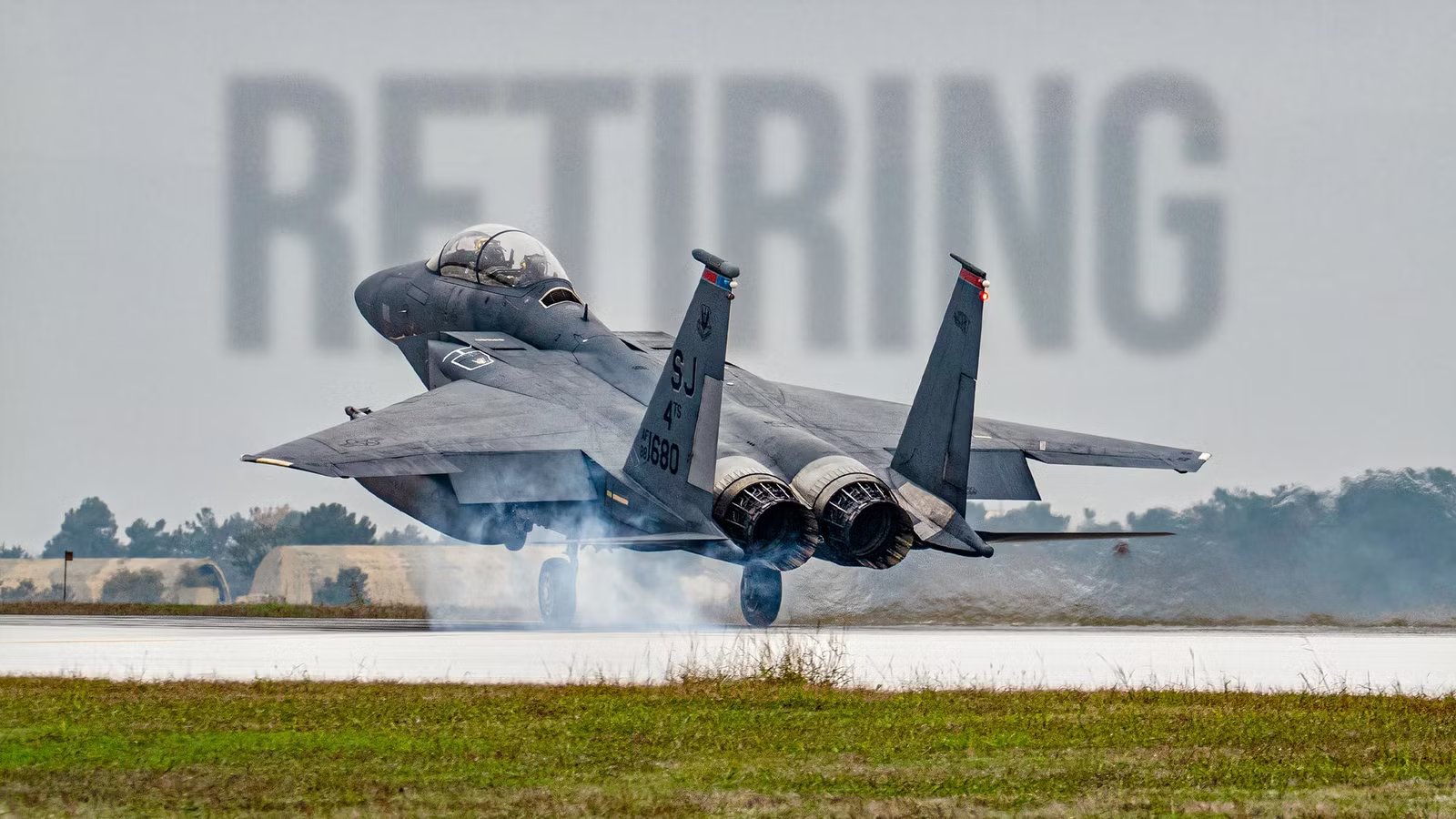
On January 24, 2025, the 18th Wing at Kadena Air Base in Okinawa conducted the final active-duty operational flight of the McDonnell DouglasF-15C Eagle, the same aircraft that entered service in 1976 and went 104-0 in air-to-air combat without a single recorded loss to an enemy fighter. The retirement closed one of the most storied chapters in post-war American airpower. But it did not end the F-15C’s story entirely. A carefully selected subset of airframes, the structurally best-preserved jets in the entire legacy fleet, now referred to by Air Combat Command as the “Platinum Eagles”, are being flown at Fresno, California, through fiscal year 2031.
This article breaks down how the final active-duty F-15C operations led to the creation of the “Platinum Eagles” program and why a few carefully selected airframes are being retained beyond the wider fleet retirement. It explores the condition-based logic behind which jets were chosen, how Air Combat Command is managing structural fatigue and readiness across the remaining fleet, and what this extended service period reveals about the challenges of replacing a long-serving air superiority platform.
An Icon Built For A Different Era: Why The Fleet Is Being Retired

The F-15C Eagle first flew in 1972, and entered service in 1976. It was designed around a single idea, with no compromises: total air superiority. Built by McDonnell Douglas around two Pratt & Whitney F100 turbofans producing a combined 47,000 pounds of afterburning thrust, it could reach Mach 2.5, pull 9 Gs, and operate at altitudes above 65,000 feet (19,812 meters). For nearly half a century, it was the standard against which all other Western air superiority fighters were measured. The problem, as with any airframe of that age, is that the metal remembers every flight it has ever flown — and the F-15C has flown a lot of them.
According to the United States Air Force‘s “Long-Term Fighter Force Structure” report, as covered by Air & Space Forces Magazine, more than 75% of the remaining F-15C/D fleet is in some way performance-limited due to structural fatigue accumulated over four decades of intensive flying. That limitation manifests in two specific ways: maximum speed restrictions and G-load limits, the two performance parameters most critical to an air superiority fighter’s ability to fight and survive. An interceptor that cannot pull maximum Gs in a turning engagement, or that cannot accelerate to full speed during a hot scramble, is an interceptor with a compromised ability to execute the mission it was designed for.
The fatigue problem was foreseeable from the moment the Lockheed MartinF-22 Raptor program was truncated. Originally, the Air Force intended to replace the entire F-15C/D fleet with F-22s beginning in the late 2000s, with a planned purchase of up to 750 Raptors. Congressional and budgetary pressure cut that number to just 187 operational aircraft, too few to replace the Eagles fleet entirely. The result was that F-15C/Ds continued flying for years beyond their intended service lives, accumulating hours and fatigue damage that no amount of inspection or maintenance could reverse.
What “Performance Limited” Means In Practice For A Fighter Jet

The term “performance limited” understates what it means for a fighter to have speed and G-load restrictions. These are structural boundaries beyond which an airframe risks failure, either immediately or, more likely, through accelerated crack propagation in load-bearing structures. For the F-15C, those restrictions are the direct consequence of metal fatigue in the wing spars, fuselage frames, and other primary structures that were cycled through high-stress maneuvers thousands of times over decades of operations.
In practical terms, a G-limited F-15C pilot flying an Aerospace Control Alert scramble, which is the 24/7 homeland defense mission that requires launching at short notice to intercept unknown or potentially hostile aircraft entering USA air defense identification zones, may find themselves unable to maneuver aggressively if an intercept evolves into a defensive engagement. As previously outlined on Simple Flying, the F-15 family’s core value has always been its combination of speed, range, and weapons capacity, and G-loading restrictions directly compromise the first of those assets in a tactical sense.
As reported in Military Machine, speed is critical in getting to a launch point where missiles can be employed against a hostile aircraft, provides energy, giving a variety of options in combat to the pilot, and contributes to tactical advantage. A speed-restricted airframe struggles to execute even that basic intercept geometry reliably.
The sustainment picture is further complicated by rising cannibalization rates. According to the Air Force report discussed earlier, cannibalization across the F-15C/D fleet has increased sharply, while sources for many replacement parts are disappearing as suppliers end production runs for systems that have been out of production for decades. Once an aircraft fleet reaches this stage of its service life, managers face an unavoidable tradeoff: either distribute scarce components across the entire inventory and accept uniformly lower readiness, or concentrate those parts on the most structurally sound aircraft and retire the rest more quickly.
Air Combat Command chose the latter approach, preserving a smaller number of highly mission-capable aircraft rather than a larger fleet with declining availability. From an operational perspective, that was the correct decision.
This Is The Oldest Fighter Jet In The US Air Force Still Flying
We are now in the final chapter of an iconic aircraft as it prepares for retirement from active duty.
The “Platinum Eagle” Strategy: Not Every F-15C Is Created Equal

As previously covered by Simple Flying, the term “Platinum Eagles” is Air Combat Command’s informal label for the structurally sound minority of the surviving F-15C/D fleet,the airframes without the performance limitations affecting the 75%+ majority. These jets retain their full speed envelope and unrestricted G-load capability, making them genuinely mission-capable for the Airspace Control Authority role rather than merely technically airworthy.
Air Combat Command is actively managing the fleet to concentrate available spare parts, maintenance effort, and operational flying hours on these specific aircraft while diverting everything else to Davis-Monthan Air Force Base in Tucson, Arizona. That is where the 309th Aerospace Maintenance and Regeneration Group facility is located, informally known as the Boneyard — which is where retired USAF aircraft are stored, preserved, or eventually scrapped.
According to an Air Force spokesperson statement reported by Air & Space Forces Magazine, the plan is explicit: “Until that time [FY2031], we plan to maintain the 21 most viable F-15C/Ds at Fresno”. That location, Fresno Yosemite International Airport (FAT) in California, is the home of the California Air National Guard’s 144th Fighter Wing.
The 144th has long performed the Aerospace Control Alert mission for the western continental United States under NORAD, and concentrating the Platinum Eagles there reflects both the Wing’s existing infrastructure and the strategic logic of keeping homeland defense assets at a location well-positioned to respond to threats approaching from the Pacific.
The Aerospace Control Alert mission the Platinum Eagles support is largely invisible to the public but represents one of the most demanding readiness postures in the American military. Pilots and maintainers are on standby 24 hours a day, seven days a week, able to be airborne within minutes of receiving a scramble order.
According to a previous Simple Flying coverage of USAF jets still flying decades after they were built, the F-15C/D in its final ANG service finds itself doing exactly the work it was designed for: protecting US airspace while simultaneously being the oldest front-line aircraft in the inventory. Some of the airframes at Fresno were built during the Reagan administration, and they are older than the pilots strapping into them: despite age, they still get airborne on legitimate defense scrambles.
Why The F-15C Cannot Yet Be Replaced: The F-15EX Production Math

The most important context for the Platinum Eagle decision is the production rate of the  Boeing F-15EX Eagle II, intended to replace the F-15C/D for homeland defense and air sovereignty missions. The F-15EX is a genuine generational leap over the aircraft it replaces. It carries an APG-82 active electronically scanned array (AESA) radar, a digital fly-by-wire flight control system, the Eagle Passive/Active Warning and Survivability System (EPAWSS) electronic warfare suite, and a structure rated for 20,000 flight hours — roughly double the design life of many legacy F-15C airframes.
It can carry up to 22 air-to-air missiles, nearly double the F-15C’s typical load, and its open mission systems architecture allows rapid software and weapons upgrades. The aircraft entered operational service with the Air National Guard’s 142nd Wing at Portland in June 2024.
The challenge is that aircraft production takes time, and the Air Force’s F-15EX procurement numbers have been in flux. The service initially planned a fleet of 144 aircraft, then proposed in its fiscal 2025 budget to cap the purchase at just 98. Congress pushed back, with the House Armed Services Committee directing an additional 24 aircraft for a total of 122, but that budget was never enacted into law. As of early 2026, the USAF had received only 27 F-15EX airframes, per Simple Flying’s current fleet analysis, against an eventual requirement that spans multiple Air National Guard wings performing the homeland defense mission across the country. Until enough F-15EXs are delivered and operational, the 144th Fighter Wing at Fresno cannot receive them, and, without a replacement, the Platinum Eagles must keep flying.
The F-15EX’s planned arrival at Kadena Air Base in Japan illustrates both the ambition and the timeline pressure of the transition. When the 18th Wing’s last active-duty F-15C completed its final flight on January 24, 2025, the base shifted to a rotational force of F-22 Raptors, F-35s, F-16s, and F-15E Strike Eagles to cover the gap. An article on Stripes.com mentioning the testimony of Air Force Secretary Troy Meink before the Senate Armed Services Committee, reported that the F-15EX deployment to Kadena to replace the 44th and 67th Fighter Squadrons’ previous complement of 48 F-15Cs, is expected for 2027. That transition at Kadena demonstrates that the F-15EX can fill the gap the F-15C leaves; the question in the continental United States is simply one of timing and numbers.
Is It True That The F-35’s Maintenance Cost Is 45% Higher Than The F-16’s?
The F-35’s ‘45% higher cost’ claim is partly true, but it depends on how you compare data, and may stem from misinterpreted program figures.
The Kadena Retirement And What It Tells Us About The Indo-Pacific Gap

Kadena Air Base on Okinawa, Japan, occupies a position in the Indo-Pacific that is almost impossible to overstate. Located approximately 400 miles (644 kilometers) from Taiwan, within range of the Chinese mainland, and sitting astride the Ryukyu island chain, it is the USAF’s most strategically critical forward base in the Pacific.
For more than four decades, the 44th and 67th Fighter Squadrons of the 18th Wing operated two full squadrons of F-15C/Ds from Kadena: a permanent, forward-deployed air superiority force that served as one of the most visible symbols of the American security commitment to Japan and the broader region.
The phased withdrawal that began in December 2022, when the first Eagles departed for stateside units, prompted significant concern from Japanese officials and US lawmakers about the interim period of reduced permanent air superiority capacity. Those concerns were legitimate. While the rotational force of F-22s, F-35s, and F-15Es maintained a continuous presence at Kadena, a rotational force is not the same as a permanently based one in terms of maintenance infrastructure, local familiarity, and deterrence signaling.
China’s People’s Liberation Army Air Force expanded its fourth- and fifth-generation fighter inventory significantly over the same period the F-15C was being drawn down at Kadena, a juxtaposition that added urgency to the transition timeline. The F-15EX’s permanent arrival at Kadena in 2027 will close most of that gap. The F-15EXs replacing the F-15Cs represent an increase in per-aircraft capability that the USAF argues more than compensates for the smaller squadron count.
The Last Eagles And What Their Retirement Means For American Airpower

The F-15C’s retirement is gradual, managed, and politically complicated by procurement delays. But it is in many ways the defining fighter jet transition of this decade in American airpower. It closes a chapter that began during the Cold War, when the Eagle was conceived specifically to counter the Soviet Mikoyan Gurevich MiG-25 Foxbat and establish clear air superiority over any adversary operating fourth-generation fighters. The aircraft that never lost in air combat is being retired because the airframe itself has simply reached the end of what metal can endure.
For the Air National Guard and the 144th Fighter Wing at Fresno, the Platinum Eagle period represents something more nuanced: a deliberate extension of useful service life through concentrated maintenance and parts management. A smaller number of fully capable, structurally unrestricted F-15C/Ds performing the homeland defense mission is preferable to a larger number of performance-limited aircraft that cannot reliably execute the scramble and intercept profile the mission demands. As we have highlighted in the context of F-22 operating costs, maintaining aging fighter fleets is expensive, but the alternative would be a gap in the Aerospace Control Alert posture, which would carry a strategic cost that has nothing to do with money.
The F-15EX is ultimately the resolution to every tension the Platinum Eagle story reveals. It provides the homeland defense mission with a purpose-built, fully capable replacement rather than a downgraded legacy airframe. Its 20,000-hour airframe life means the Air Force will not face the same fatigue-driven retirement dilemma until the 2040s at the earliest. And its weapons capacity, radar, and electronic warfare capabilities make it better suited than the F-15C to the threat environment that will define the 2030s. The last Platinum Eagles will leave Fresno sometime in FY2031. When they do, they will have performed exactly the mission the Air Force needed from them: holding the line while the next generation caught up.