dailynewsnblog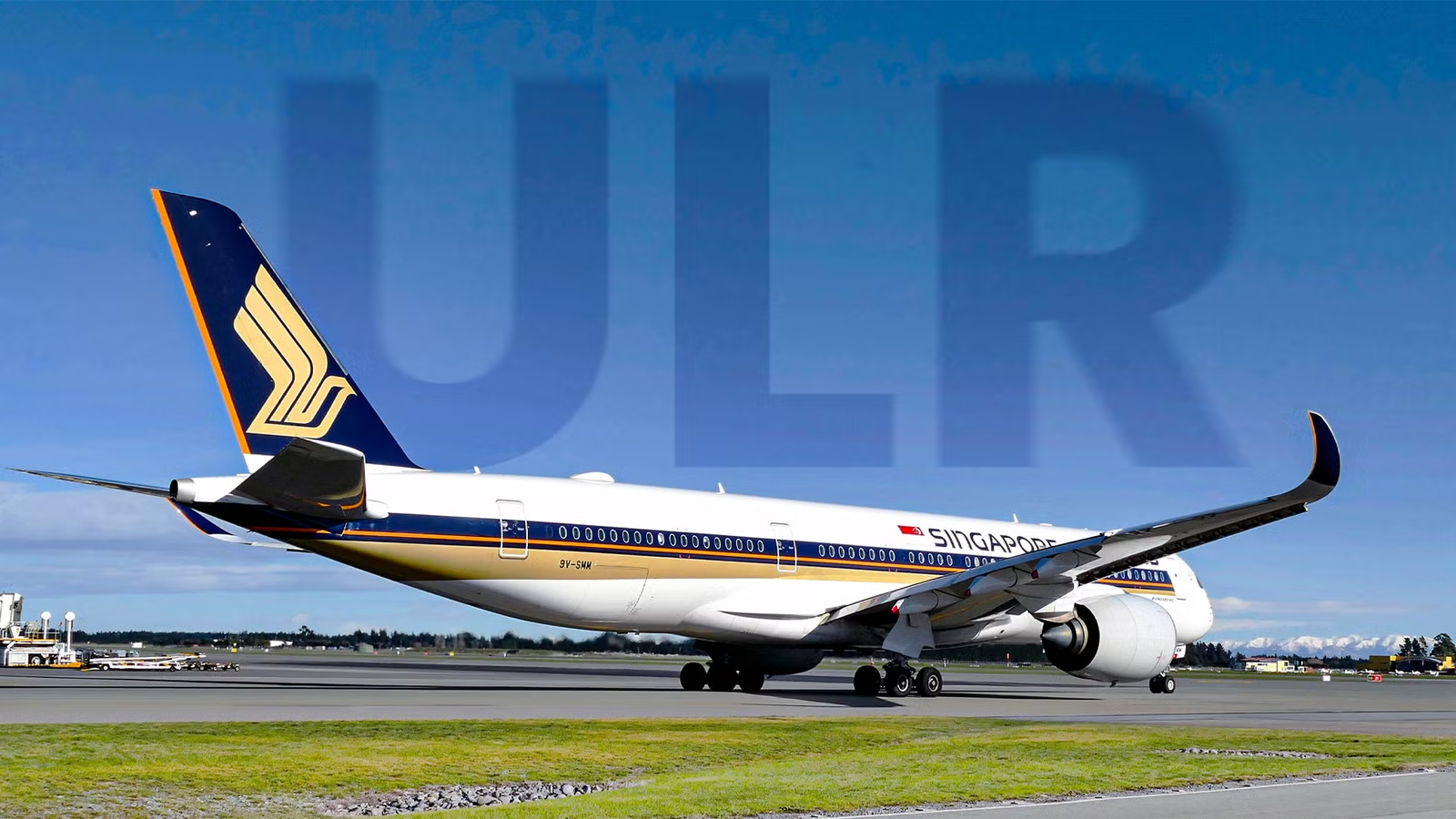
The operational economics of ultra-long-haul commercial aviation have historically been plagued by severe financial risks and engineering bottlenecks. Deploying widebody aircraft on non-stop routes spanning vast oceanic distances meant that an often unprofitable balance between fuel capacity and passenger payload had to be made. This guide examines the fascinating structural and mechanical evolution of the Airbus A350-900ULR, an aircraft engineered to push the absolute boundaries of modern commercial flight.
Instead of relying on traditional bolt-on auxiliary fuel tanks, Airbus achieved this engineering milestone through a calculated process of structural subtraction and volumetric optimization, by quietly deactivating entire cargo sections and eliminating dense passenger cabins. Contrary to how many of the world’s leading airliners are made, the airframe trades mass-market volume for extreme range efficiency.
From Four Engines To Ultra-Long-Haul Twins

The quest to connect distant global financial hubs non-stop reached a major turning point during the early part of the twenty-first century.  Singapore Airlines pioneered the ambitious longest non-stop link in the world between Singapore Changi Airport(SIN) and
  Newark Liberty International Airport(EWR), designating it as flight SQ21. However, the initial iteration of this ultra-long-haul service relied on the Airbus A340-500, a heavy, four-engine widebody designed specifically to carry immense fuel loads over long distances.
Although that four-engine aircraft successfully overcame the physical distance, its underlying economic model collapsed when global oil prices experienced dramatic spikes. Operating four separate powerplants created an unsustainable fuel burn profile, rendering the high-profile route financially unviable and forcing its temporary suspension. The failure of the quad-jet highlighted a critical need for a highly efficient, twin-engine platform capable of matching that extreme range without draining corporate cash reserves.
Catch what other flight trackers miss
Emergency squawks, holds, NOTAMs — live signals, no signup.
Open tracker
Catch what other flight trackers miss
Emergency squawks, holds, NOTAMs — live signals, no signup.
Open tracker
The development of the Airbus A350-900ULR directly addressed this industry challenge, showing the world that twin-engine operations could totally alter ultra-long-haul economics in favor of the new twin-engined era. Equipped with advanced Rolls-Royce Trent XWB engines, the clean-sheet design offered a massive leap forward in aerodynamic efficiency and fuel burn reduction. Achieving a maximum operational range of 9,700 nautical miles (11,163 miles / 17,964 km), the twin-engine variant allowed network planners to sustainably reopen the world’s longest commercial air bridges.
Reworking Existing Space

A pervasive misconception is that an aircraft can only achieve ultra-long-range performance by installing heavy, bolt-on auxiliary fuel tanks inside the lower cargo decks. Historically, older models followed this exact design philosophy, sacrificing structural efficiency to carry extra fuel weight. However, the engineering team behind the modified twin-engine jet completely rejected this traditional layout strategy.
Instead of adding heavy physical structures to the A350-900ULR, engineers gained an additional 24,000 liters (6,340 US gallons) of fuel capacity by cleverly modifying the internal architecture of the existing wing and center wing box. Technicians achieved this by repurposing the existing internal vent space and strategically relocating complex fuel sensors. This brilliant optimization pushed the total usable fuel capacity from the baseline standard of roughly 141,000 liters (37,248 US gallons) up to a massive 165,000 liters (43,588 US gallons) without changing the exterior skin of the wing tanks.
The volumetric optimization shown here is a masterclass in modern aerospace design, as it avoids the inherent weight penalties of auxiliary tank frames. Utilizing existing, under-allocated internal spaces, the aircraft maintains its clean aerodynamic lines and structural integrity. It allows the wings to flex and efficiently support the increased fuel weight during the initial stages of long-haul flight.
Simple Flying Quiz
Think you really know Singapore Airlines?
Answer 10 questions and put your knowledge to the test
Think you really know Singapore Airlines?
Answer 10 questions and put your knowledge to the test
Easy (15s)Medium (10s)Hard (5s)
The Tradeoffs For Range

Lifting off with a fully loaded fuel system containing 165,000 liters (43,588 US gallons) of combustible jet fuel introduces immense physical stress to any airframe. To accommodate this massive liquid weight, the aircraft’s certified maximum takeoff weight was raised significantly. Engineers officially pushed the maximum takeoff weight parameter to a substantial 280 tonnes (617,294 lbs) to ensure structural safety during departure.
However, increasing the maximum takeoff weight parameter alone is insufficient to offset the intense physical forces concentrated across the forward fuselage sections. To successfully balance the overall weight distribution, Singapore Airlines has to completely deactivate the forward cargo hold on these specialized airframes. Such a drastic operational measure requires giving up exactly 19 tonnes (41,888 lbs) of high-yield commercial belly freight payload capacity.
Forgoing commercial cargo space is a massive operational trade-off that completely flips the traditional revenue model of widebody operations. On standard international flights, cargo carried beneath the passenger deck provides a highly reliable financial baseline that subsidizes fluctuating ticket yields. Stripping out this capability means that network planners must rely entirely on the passenger cabin to turn a profit on every single frequency.
The Elimination Of Economy Class

The second critical step in managing the aircraft’s strict weight limits takes place directly within the passenger cabin architecture. A standard baseline variant of this twin-engine jet typically accommodates well over 300 travelers arranged across a traditional three-class layout. To enable a non-stop journey across 9,700 nautical miles (11,163 miles / 17,964 km), the internal density required an aggressive structural reduction.
Singapore Airlines resolved this challenge by configuring its specialized subfleet with a low-density layout containing only 161 total seats. The layout is notable for completely eliminating the traditional economy class cabin from the aircraft entirely. Instead, the ultra-long-range interior features a premium-heavy configuration split cleanly between 67 spacious business class seats and 94 dedicated premium economy slots.
Removing standard economy rows eliminates a massive amount of physical dead weight before the aircraft even fuels up. This subtraction goes far beyond the physical weight of the seats themselves, wiping out the mass of more than 150 additional passengers, their heavy checked baggage, and their carry-on items. Furthermore, the reduction allows the airline to trim down galley equipment, heavy food carts, and thousands of pounds of potable water, creating the necessary weight margin to carry maximum fuel.

Airbus A350-900 Vs A350-1000: Features Compared
Comparing and contrasting the modern widebody variants.
ETOPS-370 Certification

Twin-engined jets were never in a position to reach such incredible range, leaving four-engined jets to be the only types that would make such extensive journeys. The reason for this was that two engines were considered unsafe to use when crossing expansive ocean areas, as an engine failure would leave these aircraft in a much more dire situation than that of a four-engined aircraft. When operating thousands of miles away from emergency runways, maintaining a rigorous regulatory buffer is paramount to protecting passenger safety.
The solution came from an extraordinary regulatory benchmark known as ETOPS certification, which dictates how far twin-engine aircraft can stray from diversion hubs. The widebody platform achieved a historic ETOPS-370 approval, which legally permits the aircraft to operate up to 370 minutes away from the nearest suitable airport. It provides a massive six-hour single-engine operational window, ensuring the aircraft can safely chart direct trajectories across 99.7% of Earth’s surface.
Operating safely under such an extensive diversion window requires that extreme system redundancies be built into the core airframe architecture. Electrical generators, hydraulic lines, and automated fire suppression systems are completely duplicated across the airframe to withstand a prolonged single-engine diversion. Furthermore, advanced fuel cross-feed mechanics ensure that the remaining powerplant can access the entire fuel load if an engine shuts down over open ocean.
The Next Generation Of Ultra-Long-Range Airframes

The innovative engineering choices that defined this ultra-long-range variant continue to shape the broader trajectory of global widebody manufacturing. Aerospace designers have realized that custom weight management strategies offer a highly viable alternative to building completely separate clean-sheet airframes for niche routes. The resulting paradigm shift has totally rewritten the rules for connecting distant global markets without relying on intermediate stopovers.
Singapore Airlines has laid the structural foundation for the highly anticipated Project Sunrise operations spearheaded by Qantas. In June 2026, the newly developed Airbus A350-1000ULR successfully completed its inaugural flight, pushing the boundaries of global range to an impressive 10,000 nautical miles (18,520 km). Unlike its smaller predecessor, which relied on deleting forward cargo infrastructure, the larger variant introduces a specialized rear center wing tank to carry its transoceanic fuel load.
The ongoing rollout of these ultra-long-range platforms confirms that point-to-point travel has permanently triumphed over traditional hub-and-spoke networks on elite global corridors. Airlines can now target hyper-specific passenger demographics, offering premium-heavy environments that cater directly to corporate travelers who value time over all else. With manufacturing techniques continuing to mature, the lessons learned from optimizing internal vent spaces will keep these twin-engine flagships highly profitable for those brave enough to take a chance on range at all costs.