dailynewsnblog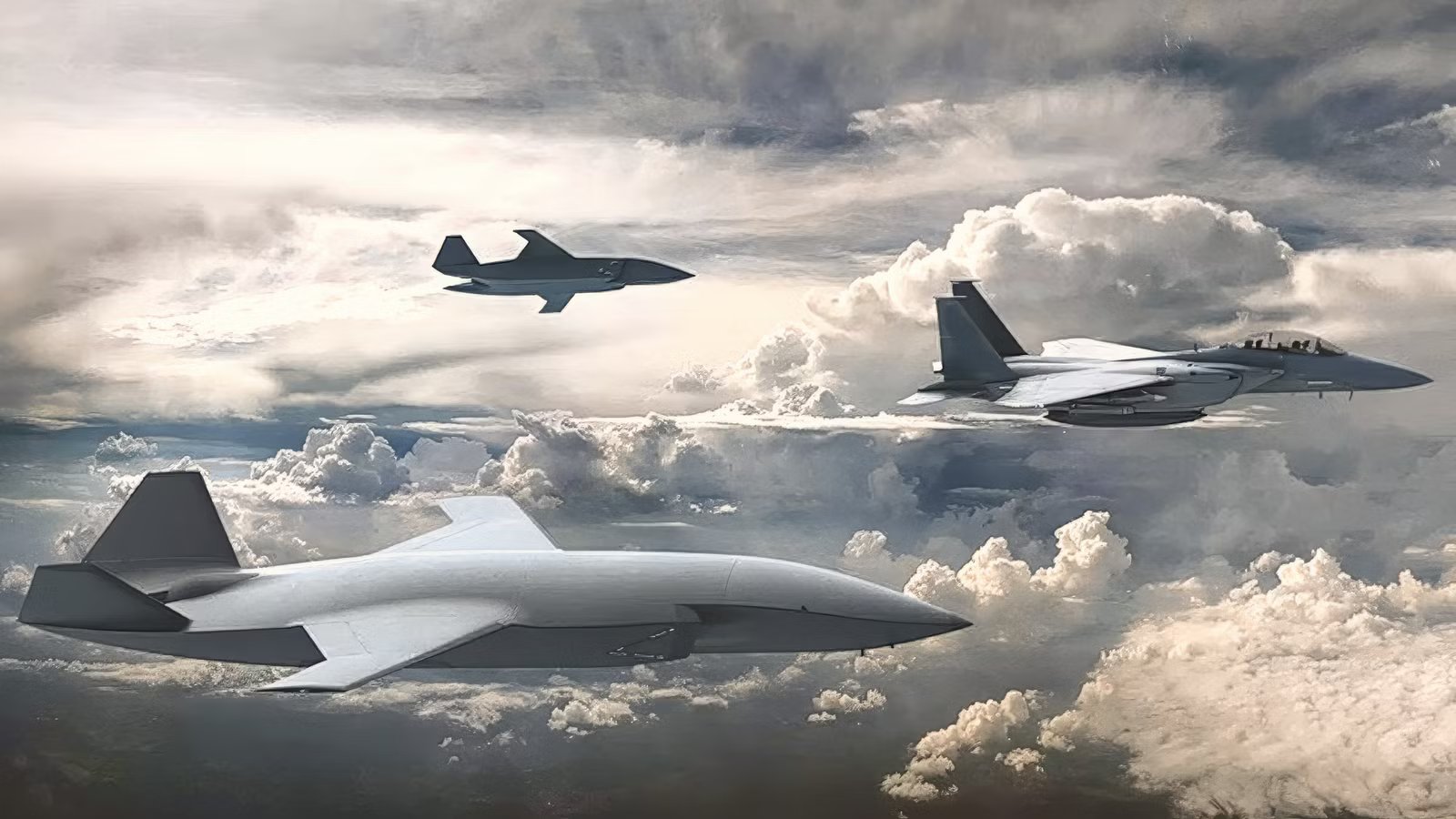
The Boeing Australia MQ-28 Ghost Bat Collaborative Combat Aircraft (CCA) has been designed to meet Royal Australian Air Force (RAAF) requirements, and is also one of the leading contenders for future US Air Force CCA increments. Boeing pitched it to the Air Force as its solution for the Increment 1 program, only to be rejected and lost to Anduril and General Atomics.  Boeing has continued to develop the Ghost Bat for Australia while also designing it for export to allies and maturing it for the future Air Force.
The US Navy has previously signaled interest in the Ghost Bat. Former Air Force Secretary Kendall has previously said that the MQ-28 could be useful as a “risk reduction” tool and that it would be a “technology feeder” for developing future Air Force unmanned aircraft. The War Zone reports that the USAF previously said it had used at least one MQ-28 to support advanced uncrewed aircraft and autonomy development efforts.
The Collaborative Combat Aircraft Program

The United States Air Force (and increasingly the Marines and Navy) sees the Collaborative Combat Aircraft program as the future of air combat. However, the program remains in development, and the Air Force and industry are still working to develop the doctrine and what form CCAs should take. This is a very complex project and one that may have many answers. At the moment, it seems everyone agrees that CCAs are the future, but no one seems to agree on what that future really is.
For example, the Air Force rejected the rail-launched Kratos X-58 Valkyrie as too small and incapable of meeting its program requirements, only for the Marines selected a modified version for its Increment 1. The Air Force rejected Lockheed Martin’s “gold-plated” concept in favor of the cheaper, less capable General Atomics YFQ-42 and Anduril YFQ-44. But Lockheed believes the Air Force needs a high-end, stealthy CCA, so it is developing its Vectis drone at its own expense.
The Navy has just started looking for a CCA usable by its carriers, but has indicated it may want a low-end CCA that could fly a few missions before ending its short life as a one-way attack munition. Most CCA prototypes and concepts are subsonic, except for Hermeus, which is building the high-Mach CCA Darkhorse/Quarterhorse with the aim of it becoming hypersonic. Shield AI is seemingly rejecting the CCA concept and designing its own tail-sitting autonomous X-Bat combat aircraft that it sees as a fully fledged fighter jet, not just a complement to fighter jets.
The World’s 6th-Generation Fighter Programs Ranked
The US, China and the UK/Japan/Italy coalition are leading the race to field 6th-gen fighter jets with some programs experiencing deep problems.
The CCA’s Increment 1

Rolls-Royce’s Kaare Erickson, Senior Vice President of Strategic Campaigns for Combat and Strategic Systems, believes its AE 3007 and Orpheus engines are well-placed for the Air Force’s Increment 2 program, even if they are sidelined in Increment 1. He explains, “The first wave of CCA development has understandably prioritized speed and rapid fielding. Speed mattered more than optimization.”
He adds, “As the mission evolves, the conversation naturally expands to the harder operational questions around range, payload, survivability, electrical power generation, affordability, and long-term sustainment.” Put another way, the Air Force has selected the YFQ-44 and YFQ-42 for Increment 1 as they are good enough to kick-start the program and get CCA’s flying and operational. But the real development work and problem-solving start with Increment 2.
Increment 1 can afford to be a “minimum viable capability”, but Increment 2 cannot. Increment 2 must solve challenging payload, range, electrical generation, low-observable, and cooling engineering problems associated with being an effective platform against a peer adversary in the vast distances of the Asia-Pacific. The Air Force has stated its F-47 will have a combat radius of 1,000+ nautical miles far higher than today’s F-15s, F-35As, and F-22s with a 500–700 nautical mile range. Importantly, it lists the CCAs as having a 700-nautical-mile range.
A Very Crowded Field

Anduril and General Atomics succeeded in getting their foot in the door with the Air Force’s Increment 1. The Air Force is expected to announce a winner of the two in September 2026. But the real competition starts with Increment 2, and this is where the Boeing Ghost Bat comes in. This is a very competitive field. For example, after losing Increment 1 for being too expensive, Northrop Grumman’s “Project Lotus” has shed 1,000 lbs, used 50% fewer parts, and built it 30% faster. The aircraft has now become the third USAF CCA to receive an official designation: the YFQ-48A Talon Blue.
Anduril, General Atomics, Northrop Grumman, Lockheed Martin, Boeing, Hermeus, Shield AI, Kratos, and others are all competing for Increment 2 or beyond. Boeing is developing the MQ-25 Stingray tanker drone for the US Navy. It can also be noted that Boeing also developed the E-7 AEW&C aircraft for Australia, and that aircraft was later selected by the US Air Force.
Boeing Australia MQ-28 Ghost Bat (per Boeing) | |
|---|---|
First flight | 2021 |
Role | Loyal wingman/CCA |
Operator | Royal Australian Air Force (8 in service mid-2026) |
Range | 2,000 nautical miles (advertised ferry range) |
Length | 38 feet long (11.7 meters) |
Importantly, as an Australian aircraft, the MQ-28 is designed to operate alongside the same aircraft often operated by the (F/A-18, EA-18G, E-7, F-35A). Its advertised range is also impressive. Boeing says the aircraft is “able to fly more than 2,000 nautical miles to support crewed and uncrewed assets.” However, the realistic combat radius is a fraction of that, though it may still meet the Air Force’s requirement for at least 700 nautical miles.
Boeing Australia’s Ghost Bat

Boeing Australia’s MQ-28 Ghost Bat is the first aircraft designed and built in Australia in decades. It has been built to meet the requirements of the Australian Air Force, including operating as an escort for high-end platforms like the E-7 Wedgetail. Like other CCAs, it employs advanced “Artificial Intelligence” and is designed to complement combat aircraft.
Boeing announced in May 2026 that the Ghost Bat is now flying in the US, with test flights validating autonomous operations and demonstrating rapid deployment and sustained operations. It added that there is a growing “global interest in autonomous combat capabilities.” The Ghost Bat comes with some advantages, like being a CCA that’s comparatively deep in its development cycle. Others, like Vectis and X-Bat, remain conceptual. Ghost Bat development started in 2017 and achieved its maiden flight in 2021.
The Ghost Bat has completed over 150 flights and several flight demonstrations. One test involved teaming two in-flight MQ-28s and a digital aircraft with an airborne E-7A Wedgtail that completed “a mission against an airborne target.” Boeing also claimed in June 2026 that it had “validated another advanced capability for the MQ-28 collaborative combat aircraft, which gives customers a decisive edge in combat: stealth performance.“
A Review Of UAVs In The USAF’s Collaborative Combat Aircraft Programs
The Air Force has numerous aircraft testing and developing the next generation of AI-driven loyal wingman drones.
MQ-28 Ghost Bat Is Comparatively Developed

The MQ-28 Ghost Bat has not just gatecrashed the CCA program out of nowhere. Boeing used its MQ-28 to compete for Increment 1 and lost. However, as explained, losing Increment 1 was not a deal-breaker for defense contractors. Boeing continued to develop the Ghost Bat, while others like Northrop and Lockheed have heavily modified their concepts, and new players are entering the game.
As of mid-2026, perhaps the most developed CCA projects in terms of development cycle are the Anduril YFQ-44, General Dynamics YFQ-42, Lockheed Martin YFQ-48A, and Boeing MQ-28, as they are representative examples of all four aircraft flying. The Australian Air Force has already received eight Ghost Bats in a pre-production Block 1 configuration. Shield AI and Lockheed have yet to unveil representative flying prototypes, while Hermeus’ flying examples are not representative.
It can also be noted that European countries have their own loyal wingman drone programs, like the Airbus Wingman and the Helsing CA-1 Europa. The CA-1 Europa looks very similar to the MQ-28. However, the US is overall considered well ahead of developing wingman drones. Kratos, Anduril, and General Atomics have announced partnerships to build versions of their drones for European customers. Besides the US, the UK, Japan, and Germany are all actively considering the MQ-28 for their own requirements.
The Prospect Of A Family Of CCAs

As of mid-2026, it seems there will not be a singular universal Air Force CCA, but rather a family of CCAs. Boeing’s Ghost Bat is not likely to become “the” Air Force CCA, so much as it has later block upgrades that have a realistic chance of joining a family of CCAs. It is possible that the Air Force will have a selection of low and high CCAs for different missions.
For example, the Air Force may want a highly stealthy, long-range, and survivable CCA to serve alongside its high-end F-47 fighter jet, which is being designed for air dominance. Any CCAs paired with the upcoming B-21 Raider strategic bomber would almost certainly require a very long range.
However, CCAs designed to escort tankers or AEW&Cs further back from contested airspace may not have the same stealth or range requirements. It is unclear what niche the Boeing MQ-28 has a realistic chance of filling, but it can be considered one of the leading contenders for the Air Force’s future CCA increments. Importantly, this extends well beyond the Air Force, as the Marines and Navy have their own programs, while European and other allied air forces are also looking for loyal wingman solutions.