dailynewsnblog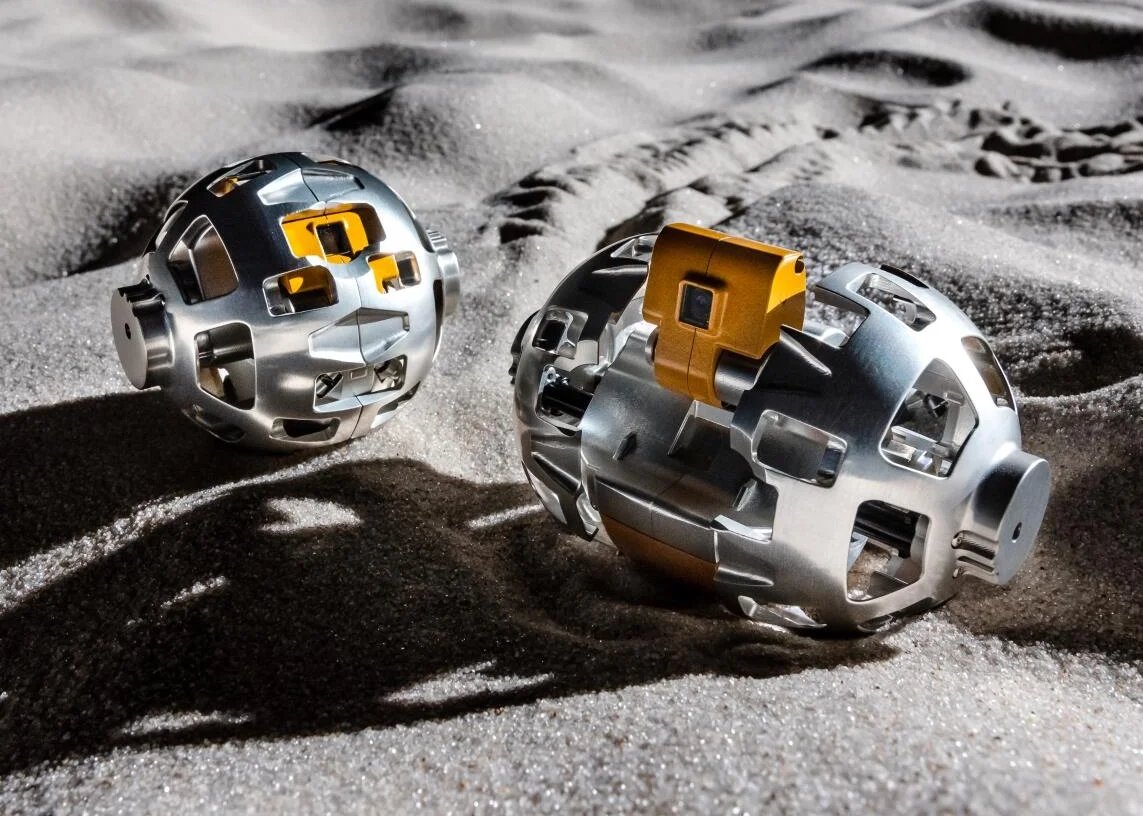
Exploring the moon’s surface lays crucial groundwork for future crewed settlements, and swarms of tiny robots could be the key. Now researchers have given the first demonstration of the idea after a palm-sized rover autonomously navigated the moon and transmitted images back to Earth.
The moon is a tough environment for robots. Its surface is strewn with craters and abrasive moon dust, and communication delays make remotely piloting vehicles a painstaking and risky process. The cost of launching and landing hardware and the real prospect of losing expensive equipment justifies an extremely cautious approach that can significantly slow down exploration.
One way around these challenges is to replace traditional rovers with many small, cheap, and hardy robot explorers, which could increase coverage and introduce redundancy. And now Japan’s space agency JAXA has given us the first compelling demonstration of the approach.
In a paper published in Science Robotics, JAXA researchers provide a technical report detailing the successful deployment of the agency’s LEV-2 robot during the its SLIM mission, which touched down near the Shioli crater in January 2024. LEV-2 is a three-inch-wide sphere that converts into a wheeled robot after landing. The robot operated autonomously for more than 100 minutes, covering an estimated 24 meters and relaying a series of images back to Earth.
“Although the capabilities of an individual small rover are inherently limited, the results highlight the potential of such platforms as independent explorers, capable of accessing environments beyond the reach of a primary large spacecraft,” the authors write.
Nicknamed SORA-Q—derived from the Japanese words for space and sphere—the robot weighs just eight ounces. Upon arrival, the shiny metal sphere splits open and expands horizontally, allowing its two hemispheres to become wheels that spin around a central shaft. This central area also features a front-facing camera and a tail to help stabilize the robot.
JAXA developed the device in partnership with Sony and toymaker TOMY. The design borrows directly from technology used in transformer toys that convert from vehicles into robots. But the team had to make considerable modifications to account for the harsh lunar environment.
One of the biggest challenges for any lunar robot is maneuvering in the dust, or regolith, that coats the moon’s surface. The fine, powdery material can be hard for smaller wheeled robots to navigate as they lack the traction of their larger counterparts.
To solve this problem, the team designed the wheels to rotate around a point slightly offset from their center, causing a lopsided spinning motion that lifts the rover up slightly on every rotation. This helps the wheels to dig into the surface and generate enough traction to keep moving in the loose regolith.
Communication delays also present a significant barrier to smooth operation, so the team engineered the robot to handle most operations autonomously. An onboard image-processing system allowed the rover to detect the SLIM lander in its camera feed and use this as a navigational reference point, estimating its own position relative to the spacecraft in real time.
Because of its diminutive size, it was impractical to give SORA-Q the equipment needed to communicate directly with Earth, so the team paired it with a hopping robot called LEV-1 that can transmit data. Power constraints and narrow communication windows still cap the amount of data the robot can send to Earth, so SORA-Q has an onboard image-processing algorithm that picks out the best photos to share.
Due to power and mass constraints, the team fitted the robot with a low-power chip designed for small devices rather than complex tasks like image processing. The algorithm relies on a very simple approach—it detects the SLIM lander’s distinctive gold insulating material and then picks the photos where this is featured prominently in the frame.
Around seven minutes after activation, the rover had moved roughly five meters from the lander, selected the two best images from 12 it had captured, and transmitted them to LEV-1. One of those images actually proved unexpectedly useful as it showed the lander had landed at an odd angle with its solar panels facing the wrong direction. This gave ground teams critical information that helped them diagnose the spacecraft’s operational status.
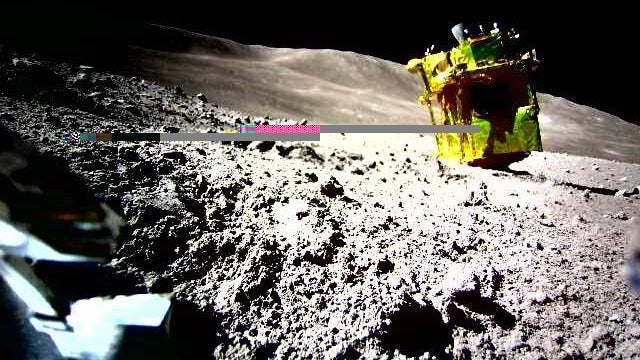
Image SLIM lander taken by LEV-2. Image Credit: JAXA/TOMY/Sony Group Corporation/Doshisha University
But the system wasn’t flawless. It lost some data in transmission, partly because LEV-1’s hopping maneuvers appeared to disrupt the wireless link and partly due to changing antenna orientations as the rover moved. The team also lost telemetry data before the mission ended, making it impossible to determine exactly how far the rover ultimately traveled or when it stopped working.
Still, the mission was strong evidence that small, cheap vehicles like SORA-Q could greatly expand the scope of robotic exploration. That could prove invaluable as we attempt to scope out promising locations for future scientific missions or even permanent bases on the moon.