

 dailynewsnblog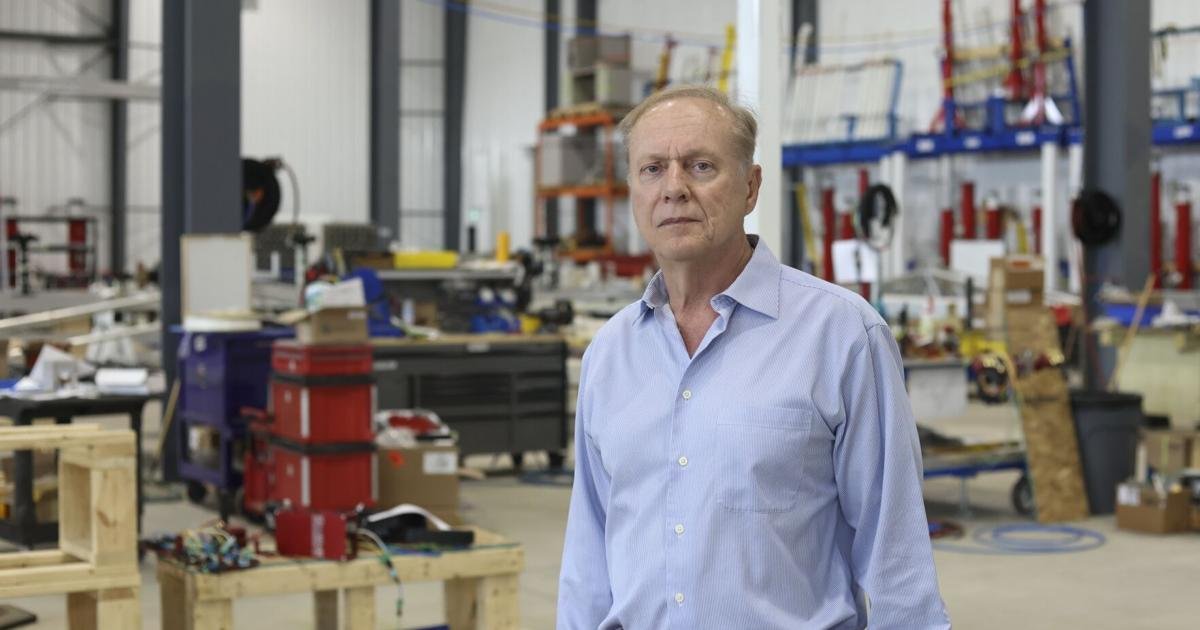
PARIS—When Ray Givens decided to establish a branch of his London, Ont.-based company in Europe, he proposed partnering with a German-born fellow entrepreneur.
They could share a workshop, employees, the steep startup costs — and the anxiety.
“The owner of that company said, ‘No, not a chance,’” Givens recalled. “He said it was way too risky, the chances of success were way too low, and that it was not worth it at all.”
Spooked by U.S. President Donald Trump’s escalating steel and aluminum tariffs on the giant cranes and customized machinery that Givens Engineering produces for automotive assembly lines, he pressed ahead anyway.
Since January — and with a friend in Germany serving as his translator and chief administrator — Givens has been struggling with corporate documents, bank accounts and the many rules and specifications of this strange new world.
He has one employee on the payroll, another on the way, and not a sale in sight. The floor of his rented German shop is littered with parts of cranes, manipulators and machines awaiting shelves and forklifts and tools and workers.
“The Germany expansion is in case tariffs go off the scale,” he said of a gamble that, by his own estimation, has a 50 per cent chance of success. “If tariffs go crazy, I want to be ready for this. I want another option to sell into Europe.”

U.S. President Donald Trump says he is not inclined to renew the Canada-U.S.-Mexico Agreement on free trade that he signed in 2020.
U.S. President Donald Trump says he is not inclined to renew the Canada-U.S.-Mexico Agreement on free trade that he signed in 2020.
With the July 1 deadline to renew the Canada-United States-Mexico free trade agreement fast approaching, Canadian companies big and small are facing similar choices.
Hope as they might for a return to a harmonious status quo that would allow them to sell tariff-free south of the border, the long-term survival of their businesses — and the health of the Canadian economy — is reliant on them exporting to new markets.
And they’re being spurred to action by Prime Minister Mark Carney, who has set the goal of doubling exports to non-U.S. countries by 2035.
In an interview with the Star in Paris, International Trade Minister Maninder Sidhu said the number of Europe-focused clients served by Export Development Canada, a federal agency that offers financial aid and advice to exporters, had gone from 1,740 in the first quarter of 2026 from about 900 in 2025 — “so it’s a big double,” he said.
“The growth is driven by those who are big and already doing international trade,” said Catherine Fortin LeFaivre, vice president of international policy and global partnerships at the Canadian Chamber of Commerce.
“The gap is companies — especially smaller ones — that maybe didn’t ever think they’d have to find alternative markets. And now they’re asking themselves: ‘How do I start with this?’”
Interest from Canadian firms growing
This is the hidden face of a fragile Canadian economy.
The federal government is negotiating free trade agreements, signing strategic partnerships, and doing defence procurement deals, pitching Canada as the land of energy, minerals and stability.
But the long and winding path between opportunity and profit is strewn with uncharted barriers and potential pitfalls.
“You get a lot of small- and medium-sized companies that want to export, but they don’t know how,” a trade official at the Canadian embassy in Paris told the Star.
Being “export-ready” is a rather lengthy process. It involves the creation of market-specific business plans based on a country, the matching of particular standards and specifications, the translation of websites and corporate documents and a host of often-overlooked hurdles.
The cliché example is the person making jams out of their kitchen, but who aspires to sell to the world.
“Is it professional? No, but it could be. A lot of (companies) started that way,” the official said. “They say, ‘Oh, I’m going to try and export to France.’ Well, just because your jams are popular in Montreal, doesn’t mean that you’re going to have a great success exporting.”
But the growing interest of Canadian companies in reaching new markets is tangible.
Two years ago, at the Eurosatory defence industry trade show in Paris, there were about 50 Canadian companies shopping their wares to potential clients. When it reconvenes later this month, some 170 Canadian exhibitors will be present.
To spur their chances of success abroad, the federal government is creating or expanding Export Development Canada branches in Sweden, Poland and France while also posting additional defence attachés to Canadian embassies in Europe. The attachés have an explicit mandate to help promote and sell Canadian-made military goods — something of a shift in both military and diplomatic circles, where matters of trade and defence have been kept separate.
“I’m getting more and more calls to Canada saying, ‘How can you help me with mining? How can you help me with energy? How can you help me with defence?’” said Sidhu, adding that he gave a “strategic directive” to help sell more Canadian energy and defence equipment to the world.
“Everybody wants to do more with Canada.”
‘Turbocharge the economy’

The reassurances coming from the Carney government aren’t just political spin, writes Adam Radwansky. It would be wise for the rest of us to stay
The reassurances coming from the Carney government aren’t just political spin, writes Adam Radwansky. It would be wise for the rest of us to stay
Part of this is down to the Carney government beating the bushes for more business, investment and trade opportunities. But it is also the result of a world seemingly strewn with economic and geopolitical fault lines, and the fact that much of the resources the world is seeking are buried under Canadian soil.
That is the good fortune of Northern Graphite, an Ottawa-based mining company with mines and mineral deposits in Quebec and Namibia and northern Ontario.
The company is mining graphite for use in electric vehicle batteries and military applications, and is developing battery-material plants in France, Saudi Arabia and Baie-Comeau, Que.
The U.S. market has been “a little bit slower than expected” since Trump canceled electric vehicle incentives and subsidies, said Hugues Jacquemin, Northern Graphite’s chief executive officer.
But the company won a “strategic project” status in March 2025 under the European Union’s Critical Raw Materials Act.
“I think any critical mineral that is available outside of China … right now is definitely getting a lot of attention,” Jacquemin said.
“If, tomorrow, China decides that they don’t want to export this material, which is 95 per cent of what is being used in batteries today … we can’t make batteries.”
He credited Carney with trying to “turbocharge the economy.”
But meeting the goal of doubling non-U.S. exports to $600 billion a year by 2035, will require significant scaling up of Canada’s more than 1 million small and medium enterprises (SMEs) — defined as companies that have, respectively, fewer than 100 and fewer than 500 employees.
Currently, only 15 per cent of SMEs export their goods. The vast majority of those who do so sell into the U.S., which is geographically closer, culturally familiar, and until recently, has been far easier to navigate.
It will also require Canada to get its own economic house in order.
Vito Ferrone, director of operations at Toronto-based Gem Windows and Doors, said counter-tariffs and interprovincial trade barriers currently make it cheaper for him to import material from Europe than to outfit his clientele with Canadian-made products.
“I’ve never liked Trump as a person, but what he’s doing for his country is the right thing,” he said, referring to Trump’s stated desire to build up the U.S. manufacturing sector. “That’s what’s going to give you a strong economy. That’s what’s going to give you the ability to defend yourself against economic issues outside your border so that you don’t have to be as dependent on the rest of the world.”
Tariffs triggered chaos
For three decades, Innovative Automation, a Barrie-based company that provides automated machine solutions primarily for the car industry, thrived under the North American free trade regimes, working on projects for clients across the continent.
But the ground started to shift as the car market transitioned toward electric vehicles, then hesitated, before Trump finally scrapped subsidies for plug-in cars outright.
“We had a lot of projects forecast that all of a sudden disappeared, but we also had projects that we were building that, mid-build, the project would be cancelled,” said Michael Lalonde, the company’s chief executive.
The tariffs and Trump’s call for carmakers to move operations to American soil compounded what Lalonde refers to as “the chaos.”
“One of the things that its’ hard for us to fully understand is how many opportunities have we not been asked to bid on,” he said, noting how an ill-timed presidential social-media post or rant to a reporter these days has the power to crash markets and scrap the best-laid business plans.
“It comes back to that general theme of just the chaos in the market and uncertainty, and we all know businesses don’t like uncertainty.”
Innovative Automation has found some stability with the invention of an automated taping machine, RoboTape, which it is now selling in Japan, Britain, Italy, Germany, Brazil and South Korea.
“That’s the product of our growth,” Lalonde said. “It was really an effort to try to normalize things and reduce our reliance on a single industry and a single geography.”
But the great hope, he admitted, is that “things go back to normal and we are able to even further increase our revenues in the U.S.”
That was the mindset when Trump first came to office in 2016, imposed tariffs on Canadian steel, aluminum and lumber and forced the renegotiation of NAFTA in 2018. The uncertainty prompted Justin Trudeau’s Liberal government to increase the number of trade commissioners abroad and add the word “diversification” to the International Trade Minister’s title.
But the imperative was always to reach a back-to-business deal for Canadian exports south of the border.
More trade, more traders
The feeling is different this time around.
“This is a long-term thing. It’s not going to happen overnight, but it’s really shifting how we think about who does trade,” said Fortin LeFaivre, of the Canadian Chamber of Commerce, which is leading a business delegation to meet with business and government leaders in Brussels and Paris this week.
“It’s not just about more trade. It’s about more traders, and that’s going to take a bit of time.”
To implant and spread that message, the chamber of commerce invited three local-level business associations to join its European tour, including the Abbotsford Chamber of Commerce from British Columbia, where many local businesses are reliant on American exports and sales.
Alex Mitchell, the Abbotsford chamber’s chief executive officer, said some member companies have a wealth of experience exporting to Europe and some are ramping up. But for others, she said, “the spark is just starting now.”
Local blueberry producers, she noted are particularly motivated to sell to Europe.
“We know that they’re currently undersupplied with that type of product,” Mitchell said. “That’s just one example of one product in one industry but, for us at the Chamber, it is really trying to figure out ways where we can provide some exposure and help to remove some of those barriers.”
The biggest barrier standing in the way of the expansion of Givens’ automotive crane expansion to Germany is the Atlantic Ocean.
“In this business, no one will buy from us unless they can see that we already have a presence in Europe,” he said. “Can we install it easily with people in Europe? Can we repair in Europe, or are we going to have to fly people over from Canada?”
He expects to lose about $300,000 over three years before he starts earning money from sales.
“It will be a long, slow process, I’m sure with lots of setbacks along the way,” Givens said. “But I’m sure, in the end, the effort will be worth it.”





![8-Hour Nonstop Flights: Alaska Airlines Launches Brand-New Boeing 737 MAX Route [Map]](https://dailynewsnblog.com/wp-content/uploads/2026/06/alaska-airlines-boeing-737-max-8-departing-lax-shutterstock_2575958599.jpg)