dailynewsnblog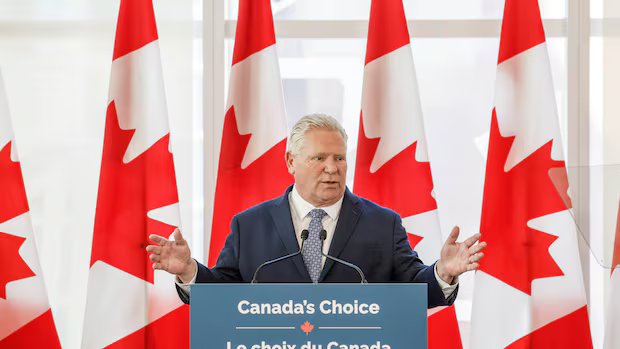

Listen to this article
Estimated 6 minutes
The audio version of this article is generated by AI-based technology. Mispronunciations can occur. We are working with our partners to continually review and improve the results.
Doug Ford appears to be throttling back on aggressive anti-Trump rhetoric with key trade talks looming with the United States, stepping up a charm offensive aimed at politicians and lobby groups in the mercurial president’s orbit.
Earlier this week, Ford wrapped the first of three planned trips to the U.S. in June to pitch Ontario’s “Fortress North America” plan to policy-makers and industry leaders.
The premier has been an outspoken critic of Donald Trump since the U.S. president imposed his tariff plan on Canada. Ford made his fight against Trump the centrepiece of his successful re-election bid in early 2025 and even vowed to campaign against Trump in the mid-terms.
Asked Wednesday about the apparent disdain with which he’s viewed by the U.S. administration, Ford was subdued.
“Well, you know something, I just love the American people,” he said. “I love the U.S. I’ve said it a thousand times no matter what broadcast I’m on. The reception I get when I go down there is second to none.”

After signing a memorandum of understanding on Tuesday to strengthen the economic partnership between Ontario and Pennsylvania, Premier Doug Ford and Gov. Josh Shapiro were asked about U.S. President Donald Trump’s comments that morning that he is ‘not looking to renew’ the Canada-U.S.-Mexico Agreement on trade and that the U.S doesn’t need anything from Canada.
Ford has sparked anger of Trump administration before
Ford has raised the ire of the Trump administration on several occasions, first threatening to impose a 25 per cent surcharge on hydro exports to three U.S. states in March 2025 in response to Trump’s tariffs. Ford backed off the threat when Trump’s commerce secretary offered to meet with the premier in Washington.
Last fall, the Ontario government ran an anti-tariff ad during the World Series that featured the voice of former president Ronald Reagan. The spot angered Trump, who said it was the reason he was cancelling trade talks with Canada.
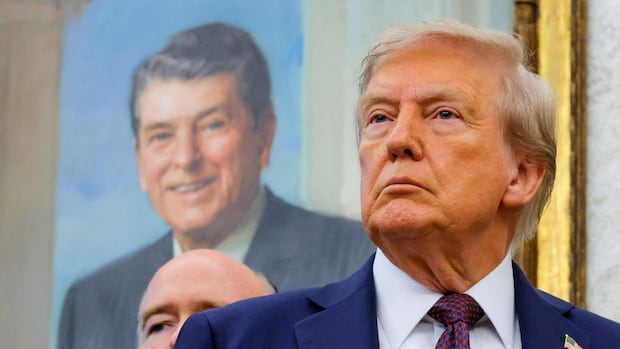
U.S. President Donald Trump says he is cancelling trade talks with Canada over a TV ad that uses the late U.S. president Ronald Reagan’s own words to send an anti-tariff message to Americans. ‘CANADA CHEATED AND GOT CAUGHT,’ Trump wrote on social media, calling the Ontario government ad ‘FAKE’ and a ‘FRAUD.’
Liberal strategist Charles Bird said at times that heightened rhetoric has given voice to the frustration of many Canadians. But with CUSMA talks getting serious, it might be time to strike a different tone, he said.
“The Premier has emerged as something of a lightning rod in the United States, and with the Trump administration,” said Bird, a principal at Earnscliffe Strategies.
“He’s not been afraid to say things that Prime Minister Carney hasn’t been in a position to say, but obviously you can only push that so far.”
Ford’s government has pushed those limits. Last fall, the Ontario government ran an anti-tariff ad during the World Series that featured the voice of former president Ronald Reagan. The spot angered Trump, who said it was the reason he was cancelling trade talks with Canada.
CUSMA trade deal up for review on July 1
CUSMA officially comes up for review on July 1 and Ford’s message has been focused on reaching a deal that will be mutually beneficial to every signatory.
Conservative strategist Laryssa Waler, founder of Henley Strategies, said while the premier is not at the negotiating table, he will play an important role in the broader discussions.
Waler, who once worked in Ford’s office, said all of Canada’s premiers will be acting in co-ordination with the prime minister and federal negotiators. That level of co-operation will be required in what are certain to be unpredictable talks with the US administration, she said.
“Sure, (the premier is) a bit of an antagonist, but only specifically to Donald Trump,” she said. “The people who surround Donald Trump, and who frankly, donate to Donald Trump and influence Donald Trump, they like Doug Ford. They think that Doug Ford has a point.”
Opposition parties have criticized Ford for not meeting directly with the Trump administration officials while he was in Washington. Waler said those meetings need to be left to the federal negotiators, but Ford can take other meetings that will help.
“Sending (Ford) into a meeting with the farmers, or the automotive industry, or the aviation industry is going to go very well,” said Waler.
“And those people waltz into the Oval Office because they’ve done so much to help get this president elected. And if they waltz in there and take a position that’s beneficial to Canada, that’s the win.”
Trade talks come after rocky session at Queen’s Park
Ford wading back into the broader trade discussion comes after a rocky spring session at Queen’s Park. Controversies over his purchase, and subsequent sale, of a private jet, changes to freedom of information legislation and the plan to expand Toronto’s Billy Bishop Airport have dogged his government.
Public opinion polling has been volatile for the premier, showing him in a statistical tie with the Ontario Liberals in April, but seeming to rebound in May. However, an Angus Reid Institute survey on premier approval ratings released earlier this week shows Ford at his lowest level of support since he was elected in 2018.
University of Ottawa political science professor Geneviève Tellier said trade and tariffs have been more politically stable ground for the premier since late 2024.
“About trade with the Americans, he’s fighting for Ontarians, he’s on the offensive,” she said. “It seems that he’s more comfortable and the benefits are there when he talks about trade and economic development.”
Tellier said even if Ford isn’t at the bargaining table, the stakes are high in these talks for Ontario’s trade exposed economy, especially the auto sector.
“It will be for Doug Ford to come up with some creativity and show to the Americans that the automobile industry should be integrated in North America and that Ontario is an important partner,” she said. “But it may be difficult to change the view of the president.”