dailynewsnblog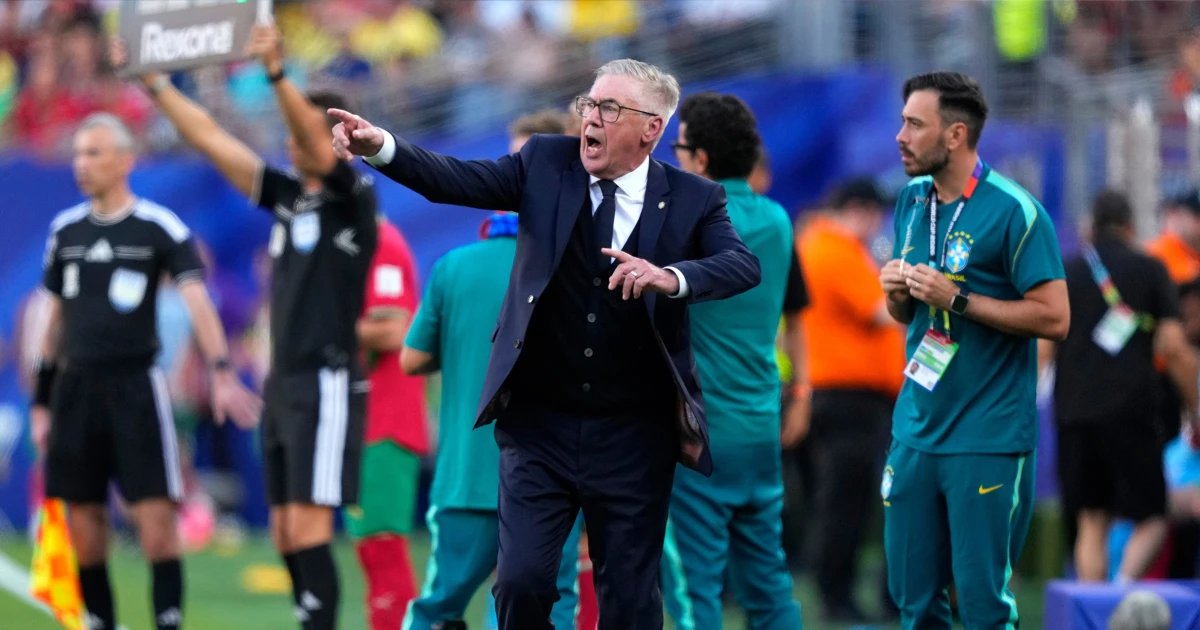
EAST RUTHERFORD, N.J. — On Saturday afternoon, thousands of Brazil fans, clad in highlighter yellow jerseys, made the trek to MetLife Stadium to watch their team play Morocco in its first game of this World Cup. They sang on the train in from Manhattan and waved flags and chanted throughout the warm, sunny day.
Subscribe to read this story ad-free
Get unlimited access to ad-free articles and exclusive content.

But after 90 minutes of tense, back-and-forth play that ended in a 1-1 tie, those fans were less than thrilled.
“That was a terrible performance,” one said as he left the stadium. “Terrible!”
Soon, Brazil manager Carlo Ancelotti was sitting at a lectern, taking questions from another tough crowd: the Brazilian media. They peppered him with questions about his starting lineup, his substitution patterns, every tactical decision one could imagine.
“You don’t win a World Cup based on your first match,” Ancelotti said through a FIFA interpreter.
Maybe not. But Brazil didn’t look like a world power in the first half.
Morocco’s speed and aggression gave it an early 1-0 lead. In the 21st minute, after a Brazil turnover, Morocco’s Brahim Diaz had the ball near midfield when he saw Ismael Saibari streaking toward the goal, his left arm extended, calling for the ball as if he were a wide receiver.
Diaz made a perfect pass, in between two Brazilian defenders but in front of the Brazilian goalkeeper, Alisson Becker. On his first touch, Saibari chipped the ball over Becker’s head and into the net.
Brazil seemed to be playing hesitantly, on the back foot except for left winger Vinícius Júnior. About 10 minutes later, he manufactured a goal on his own, essentially out of thin air.
Vini Jr., as he’s known, received a pass on the left side, with one defender in front of him and two more lurking. He took a touch to his right, around the first defender, and then ripped a powerful shot. Moroccan goalkeeper Yassine Bounou dove, but he never stood a chance. Up in the press box, a contingent of Brazilian media couldn’t suppress some cheers.

In the second half, Brazil had more chances, mostly thanks again to Vinícius.
Midway through the half, he made a run and received a pass down the left, drawing the defense’s attention, only to slip a pass to Raphinha, who had space in front of the net. As the pass came in, Raphinha tried to shoot on the first touch rather than settle the ball first, and his shot went directly into Bounou’s waiting arms. Vinícius raised his hands, his palms to the sky, and on the bench, the injured Neymar Jr. put his hands on his head.
If not for Vinícius’s heroics, Brazil might have lost the match. “He was very dangerous,” Ancelotti said, “and I think he has everything in his power to have a great World Cup.”
Ancelotti probably wished he received more questions about Vinícius. One reporter asked the manager if Brazil could possibly recover and be “competitive” at this World Cup.
“I think this was a tough match, especially in the beginning,” Ancelotti said. “I think the team was a bit anxious and … nerves were all over the place. Didn’t keep a lot of ball possession. In the second half, we did a lot better. But it was still tough. I’m sure the team will do better the next match.”
That might have surprised some Brazil fans — nerves? For the five-time World Cup champs? “That’s something we’ll have to look into,” Ancelotti added. “There’s a lot of pressure. That’s natural. But I think little by little, we’ll also improve in that sense, as well.”
Ancelotti is considered one of the greatest managers of all time. He’s coached some of the biggest, most storied clubs in Europe — Real Madrid, AC Milan, Juventus, Chelsea, Paris Saint-Germain, Bayern Munich — before taking the Brazil job in 2025. He’s learning now, though, that coaching Brazil comes with a whole other level of scrutiny and criticism.
After the match, reporters pressed Ancelotti about his substitution patterns. For instance, why hadn’t he played Endrick, the talented 19-year-old striker, especially when Brazil needed a goal? “I’m not here to talk about any player individually,” Ancelotti said. “I only talk about the team.”
Reporters pressed Ancelotti about his substitution patterns. For instance, why hadn’t he played Endrick, the talented 19-year-old striker, especially when Brazil needed a goal?
“I’m not here to talk about any player individually,” Ancelotti said. “I only talk about the team.”
The manager indicated there would be changes coming to the lineup, but he didn’t reveal what those changes would be. He simply said he wanted to see a more balanced, more aggressive attack.
“I’m not disappointed, and I’m not satisfied, either,” Ancelotti said, offering an answer that, to some fans, might not be satisfying, either. “This was the result we had,” he added. “It wasn’t bad. But we’ll keep picking up from the second match on.”
The questions kept coming and seemed to get increasingly dramatic. Toward the end, a reporter asked, was Ancelotti’s confidence in his team still unshakeable?
“We’re absolutely confident,” he said. “Not everything goes perfect in football. And when it doesn’t, you have to accept criticism and you have to do better. And that’s what we’ll do.”