dailynewsnblog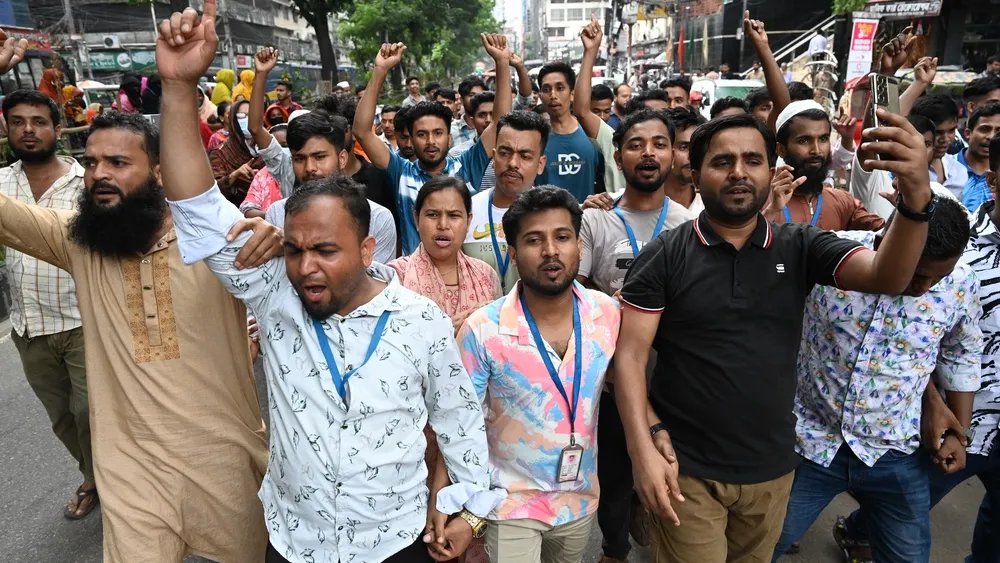
On the Line is a weekly roundup of sourcing and labor quick hits in the apparel and footwear industry, from worker protests to boardroom maneuvering, tracking the developments shaping conditions on the factory floor and beyond.
Bangladesh in decline
The Bangladesh Garment Manufacturers and Exporters Association held an emergency board meeting earlier this week to address a persistent decline in garment exports that shows few signs of easing.
Faisal Samad, a director at the trade group, told local media the downturn has dragged on for a year and that tariff-related pressures are only part of the problem. Other factors, he said, include geopolitical tensions, longer lead times due to security threats in the Red Sea and Gulf region, India’s trade deals with the European Union and United Kingdom, and challenges tied to Bangladesh’s upcoming graduation from least-developed country status, all of which have thrown the country into a state of uncertainty.
The numbers bear this out: From July to May of fiscal year 2025/26, garment exports totaled $35.3 billion, a 3.41 percent year-over-year drop from the previous $36.6 billion, according to data from the Export Promotion Bureau.
The result has been a spate of mass layoffs, with at least 79 factories shedding as many as 7,784 workers in the five months through May 31, according to law enforcement data.
The cuts spanned six industrial zones and excluded the Dhaka metropolitan area, which falls under the Industrial Police’s jurisdiction. Ashulia saw the steepest losses, with 35 factories dismissing about 5,000 workers between January and May, followed by Gazipur, where 33 factories cut 1,946 jobs. In Chattogram, five factories let go of more than 500 workers, while a single factory in Mymensingh cut 250 jobs.
Al-Muslim Group in Savar, just outside the capital of Dhaka, laid off nearly 1,900 workers across its seven garment factories, including AKM Knitwear and Pacific Blue (Jeans Wear). The layoffs triggered protests at the company’s factories on Saturday, after workers learned of their termination via text message during the Eid holiday.
“We were compelled to undertake the process due to a shortage of purchase orders,” Md. Abu Raihan, deputy general manager at Al-Muslim Group, told The Daily Star. “However, we will reinstate the workers in the future if purchase orders increase. All dues of the laid-off workers have been paid properly. If there are any exceptions, we will settle them following due process.”
Call for sanctions
IndustriALL Global Union, which represents more than 50 million workers in more than 140 countries, has urged the International Labour Organization to cut off funding to Myanmar’s ruling military junta through sanctions, diplomatic isolation and an end to preferential trade agreements.
Addressing the International Labour Conference at a special sitting in Geneva on Saturday, IndustriALL general secretary Atle Høie said 450,000 workers in Myanmar’s garment sector earn less than $100 a month—roughly half of what they need to survive. With garment factories in industrial zones operating under martial law, workers face military checkpoints, intrusive searches of personal property, including cellphones, and sexual harassment. He added that they also endure forced unpaid overtime and the risk of military conscription.
Høie noted the garment sector is a key source of foreign exchange for the junta, which enforces a law requiring all incoming foreign currency to be converted at a preferential rate within 24 hours. Myanmar also benefits from preferential access to the EU market under the Generalized System of Preferences and the Everything but Arms scheme, he said, with 54 percent of the country’s exports destined for the bloc.
Despite the ILC invoking Article 33 of the ILO constitution last year—which should have prompted governments, employers and trade unions to review and suspend engagements with Myanmar—the EU maintains its system of preferences, Høie said. The EU also funds a program called MADE in Myanmar to support—and, according to unionists, whitewash—manufacturing in the country.
“IndustriALL wants to see an end to preferential trade access, including under the EU’s Generalized System of Preferences and Everything but Arms scheme,” Høie said. “We are calling on garment brands to commit to a responsible exit from Myanmar.”
Waste to cash
The International Finance Corporation, a member of the World Bank Group, said Wednesday that pilot trials in Morocco demonstrate recycling textile waste is not only technically viable and commercially feasible but that scaling it up could attract $1.9 billion in additional private investment and generate more than 30,000 jobs.
The recently concluded Morocco Textile Circularity program, led by the IFC, more than doubled its original targets by turning 427 metric tons of textile offcuts into new manufacturing materials and earmarking a further 2,400 metric tons for recycling.
Equally important, recycled-content fabric met standard commercial quality benchmarks across all tested parameters, meaning it can re-enter the supply chain without compromising performance or quality. On top of that, a life-cycle analysis found that using recycled materials can cut carbon emissions by roughly 18 percent and water use by more than 60 percent compared with virgin materials.
Research conducted as part of the initiative also found that up to 75 percent of Morocco’s textile waste collectors—most of whom operate informally—could transition to formal status within five years with sufficient institutional support, boosting economic security for some of the country’s most vulnerable workers.
But maximizing the opportunity requires policy action: reclassifying factory offcuts as industrial by-products instead of waste; reforming customs rules to let brands transfer legal ownership of the materials to local manufacturers; establishing a national traceability platform to meet the EU’s upcoming Digital Product Passport requirements; and investing in domestic spinning capacity so recycled fiber can be processed and reused locally without having to be exported.
“Scaling textile circularity in Morocco will create tens of thousands of jobs and build a globally competitive industry,” said David Tinel, IFC’s regional manager for the Maghreb. “The proof is in place. Scaling now establishes Morocco at the forefront of sustainable manufacturing for global markets.”