dailynewsnblog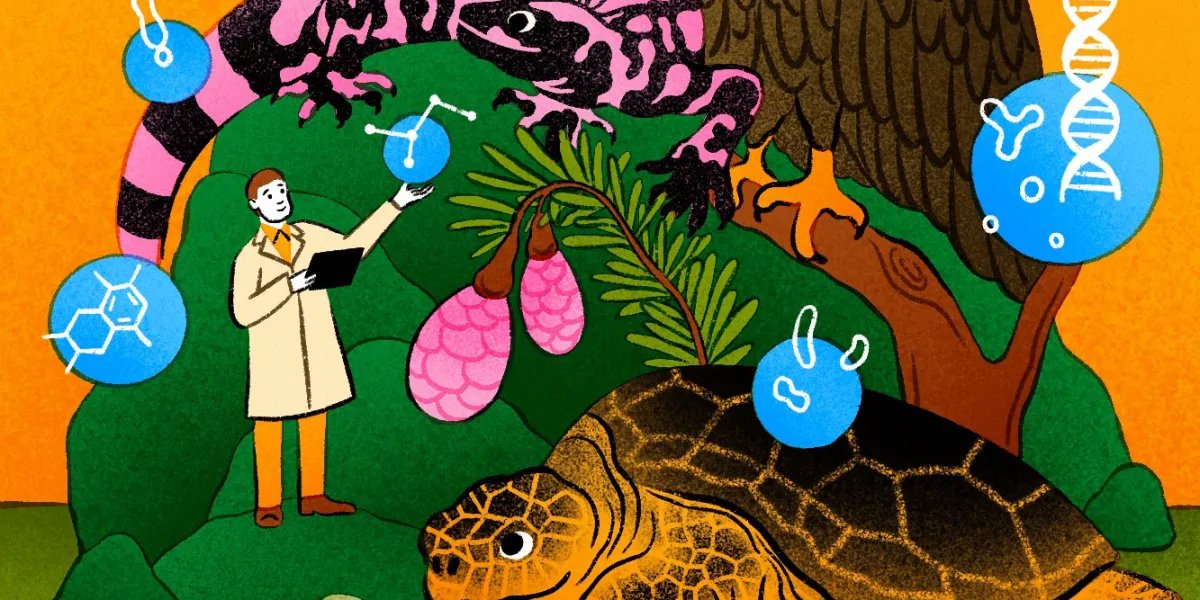
Cernak imagines a world where “the patient was always meant to be a frog in the first place, from the beginning to the end.” Now an associate professor at the University of Michigan, he’s worked on all types of creatures, from a Gila monster with a parasite to bald eagles with avian flu. Here’s what it takes to treat nature’s patients.
Experience with protein-modeling software
Developing any type of drug is extremely expensive, failure-prone, and slow-going. But AI can speed up the entire drug-design workflow, says Cernak. Google DeepMind’s AlphaFold model allows him to visualize a mutant protein’s three-dimensional structure on a screen—rather than growing it on a plate, the traditional methodology—and then quickly generate possible new drugs that would latch onto that structure. The next step is to run a series of reactions and see which potential drugs may be effective; with the help of robots in the lab, he can speed through as many as 1,500 per day.
Curiosity about creatures of all sizes
Cernak isn’t selective with his patients. For example, he worked on a treatment for loggerhead sea turtles after he was shocked to learn that the iconic species suffered from contagious tumors. He feels especially drawn to creatures that have helped humans, like the Gila monster, whose hormones have informed popular weight-loss drugs like Ozempic. And it’s not just animals; he’s also developing a precision insecticide to treat hemlock trees under attack from invasive species.
A pioneering spirit
Cernak refers to this new discipline as “conservation chemistry.” It’s a combination of words with a loaded history, from DDT decimating US bald eagle populations in the 1960s, to cow painkillers killing millions of Indian vultures in the ’90s. He recognizes the risks, but Cernak feels that excluding chemists from conservation is a missed opportunity.
“I’m just sick of looking at the chemical tools that are used in the conservation space, and they’re not cutting-edge,” he says. “It’s like, how do you have this super high-tech engine over here for making human medicines, while we’re living through a mass extinction?”
Anna Gibbs is a journalist who covers the intersection between science and society.