dailynewsnblog
The Airbus A321XLR is the longest-range narrowbody aircraft ever built, capable of flying 4,700 nautical miles (8,700 km) nonstop on routes that previously required a widebody. It achieves that range through a design feature no previous narrowbody has used: a permanent fuel tank integrated directly into the lower fuselage structure rather than stored in the wings or installed as a removable unit in the cargo hold.
That tank, known as the Rear Center Tank, sat at the center of the longest and most heavily scrutinized certification process in the A320 family’s history. Both EASA and the FAA concluded that existing airworthiness standards did not cover a fuel tank in this position and issued Special Conditions requiring Airbus to prove the tank could survive a crash landing without rupturing catastrophically. The engineering Airbus developed to meet those requirements changed the aircraft’s materials, structure, and lower fuselage design.
Why The A321XLR Needed A Fuel Tank Where No Narrowbody Had One Before

The standard Airbus A321neo carries fuel in its wing tanks and an optional auxiliary center tank housed in the cargo hold, giving it a range of approximately 3,500 nautical miles (6,500 km). That is enough for most short and medium-haul routes, but falls short of what airlines need for transatlantic or other thin long-haul operations. Airbus wanted the A321XLR to reach 4,700 nautical miles (8,700 km), enough to fly routes like Madrid to Boston or London to Denver nonstop, but the wings could not carry enough fuel to reach that range, and the cargo hold auxiliary tanks used on the A321LR variant could only bridge part of the gap.
The solution was the Rear Center Tank, a permanent 3,407 gallons (12,900 liters) fuel tank integrated directly into the aircraft’s fuselage structure rather than installed as a removable unit in the cargo hold. The RCT sits in the lower fuselage, aft of the main landing gear and partially replacing what would otherwise be the rear cargo compartment space. Rather than building a separate container and mounting it inside an existing fuselage section, Airbus made the tank a structural component of the aircraft itself. The tank walls contribute to the fuselage’s overall load-bearing capacity, which reduces the weight penalty compared to a non-structural bolt-in installation.
No previous narrowbody aircraft had used a fuel tank integrated into the fuselage in this way. Wing tanks sit high on the airframe, well above ground level, which gives them natural protection from impact and post-crash fire scenarios. The RCT sits lower in the aircraft, closer to the ground, and directly behind the main landing gear. That positioning introduced safety questions that existing certification rules had never needed to address, and it put the tank at the center of the longest and most scrutinized certification process in the A320 family’s history.
Catch what other flight trackers miss
Emergency squawks, holds, NOTAMs — live signals, no signup.
Open tracker
Catch what other flight trackers miss
Emergency squawks, holds, NOTAMs — live signals, no signup.
Open tracker
The Safety Problem The Tank Created

The core concern from both EASA and the FAA was what happens to the RCT during a crash landing. Wing tanks are positioned high enough on the airframe that in most survivable accident scenarios, the fuel remains above and away from ground-level impact forces and ignition sources. The RCT sits in the lower fuselage, which is the part of the aircraft most likely to contact the ground in a belly landing, gear collapse, or runway overrun. If the tank ruptures on impact, fuel spills directly beneath the aircraft, where it is most likely to ignite, and passengers are directly above it.
Existing CS-25 certification standards, the primary technical requirements for large commercial aircraft in Europe, did not address a fuel tank in this position because no previous aircraft in the category had one. EASA classified the RCT as a novel, unusual design and issued Special Conditions requiring Airbus to demonstrate crash safety, fire safety, and occupant protection to a standard equivalent to that required by existing rules if they had anticipated this configuration. The FAA followed with its own Special Conditions, requiring the lower fuselage spanning the area of the tank to resist fire penetration for a minimum of five minutes, long enough to allow a full passenger evacuation.
Boeing flagged the design publicly in 2021, arguing that the RCT’s positioning presented safety risks that the certification framework was not equipped to evaluate. The intervention reached both regulators and contributed to the scrutiny that followed. Whether Boeing’s concerns were motivated by genuine safety analysis or competitive interest in protecting the 757 and 787 replacement market is a matter of perspective. What is not in dispute is that the concerns were technically valid and that both EASA and the FAA agreed the existing rules were insufficient to certify the tank without additional requirements.

How Much Does An Airbus A321XLR Cost?
The range and efficiency of the XLR commands a premium over other narrowbody aircraft currently on the market.
How Airbus Engineered The Tank To Survive A Crash

Airbus addressed the regulators’ requirements through a combination of material selection, structural reinforcement, and containment design. The lower fuselage shell surrounding the RCT uses fiber-metal laminate with fire-retardant properties rather than the standard aluminum skin used elsewhere on the aircraft. The tank itself is constructed from aluminum-lithium alloy, a material that is both lighter and stronger than conventional aluminum, chosen specifically for its ability to withstand the deformation forces generated during an uncontrolled ground contact without rupturing immediately.
Inside the tank, Airbus installed an inner liner designed to limit fuel leakage in the event that the outer tank wall is breached. The liner does not prevent damage entirely. It slows the rate at which fuel escapes, buying time for passengers and crew to evacuate before a ground-level fuel spill reaches a volume sufficient to sustain a large fire. The belly fairing beneath the tank was redesigned and reinforced, extended in length, and built from heavier material than on previous A321 variants, providing an additional layer of physical protection between the RCT and whatever surface the aircraft comes to rest on.
The structural changes extended beyond the tank itself. The landing gear was uprated to handle the A321XLR’s higher maximum takeoff weight, which increased as a result of the additional fuel. The flight control system was modified to manage the shifting center of gravity as fuel is burned from the RCT during flight. The fuel system was redesigned to integrate the new tank into the aircraft’s existing fuel management architecture. EASA’s head of large airplane certification summarized the requirement as needing proof that the tank’s location would not create a safety issue on its own, that it could survive a gear failure or runway debris strike, and that if it were compromised, the leakage rate would remain limited enough not to threaten the passengers above it.
What The FAA Required That Went Beyond EASA

The FAA’s Special Conditions for the A321XLR addressed the same fundamental concern as EASA’s but imposed specific performance requirements that went further in certain areas. The most significant was the five-minute fire resistance mandate, which required Airbus to demonstrate that the lower fuselage structure spanning the RCT could withstand sustained post-crash fire without allowing flame penetration into the cabin for a minimum of five minutes. That figure is derived from the FAA’s evacuation standard, which assumes all passengers and crew must be able to exit the aircraft within 90 seconds. The five-minute window provides a margin well beyond the evacuation requirement, accounting for scenarios where exits are blocked or the evacuation is delayed.
The FAA also required Airbus to demonstrate that the tank could survive specific impact scenarios without catastrophic rupture, including a landing gear collapse that drives the lower fuselage into the ground and foreign object damage from runway debris striking the belly of the aircraft at takeoff or landing speeds. These requirements were published in an advisory circular as part of a public consultation process in late 2022.
The regulatory process between EASA and the FAA ran in parallel but did not always move at the same pace. EASA issued the A321XLR’s type certificate on July 19, 2024, after more than five years of certification work involving over 400 joint technical meetings, 900 flight test hours across three test aircraft, and more than 500 certification documents reviewed and signed off. The FAA validated the certificate separately. The scale of the effort reflected the novelty of what Airbus had built.
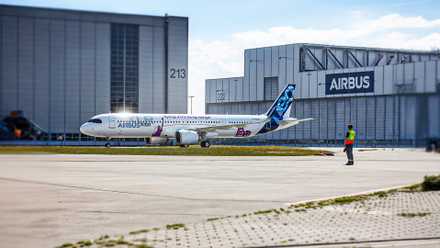
5 Reasons Why Airlines Are Ordering The Airbus A321XLR Over The Boeing 737 MAX 10
Here are five reasons why some airlines are leaning towards the A321XLR over the MAX 10.
How The A321XLR Compares To The A321LR And Standard A321neo

The three A321 variants share the same 146-foot (44.5 meters) fuselage, the same wing, and the same engine options. What separates them is how much fuel they carry and where they store it. The standard A321neo relies on its wing tanks alone and reaches approximately 3,500 nautical miles (6,500 km), making it a short to medium-haul aircraft suited to domestic and intra-European operations. That range covers the vast majority of routes a narrowbody serves.
The A321LR adds a single auxiliary center tank installed in the rear cargo hold, bringing total fuel capacity up enough to reach approximately 4,000 nautical miles (7,400 km). That additional 500 nautical miles opens transatlantic routes like Dublin to New York or Oslo to Boston, which is why the LR has become popular with carriers like Aer Lingus, TAP Air Portugal, and JetBlue on thin long-haul operations. Critically, the LR’s auxiliary tank is a removable cargo hold installation rather than a structural component of the fuselage. It sits inside the existing cargo compartment and is isolated from the airframe, which is why it did not trigger the same regulatory scrutiny as the XLR’s integrated RCT. The trade-off is reduced cargo hold capacity on flights where the tank is installed.
The A321XLR’s structurally integrated RCT pushes its range to 4,700 nautical miles (8,700 km), as mentioned, a further 700 nautical miles (1,296 km) beyond the LR and 1,200 nautical miles (2,222 km) beyond the standard neo. That additional range opens routes the LR cannot reach, including longer transatlantic city pairs and connections between Europe and South Asia. The engineering cost of achieving it was the five-year certification process, the reinforced lower fuselage, the fire-retardant materials, and the inner liner, none of which the LR required. For airlines operating routes within the LR’s range, the simpler cargo hold tank is sufficient.