dailynewsnblog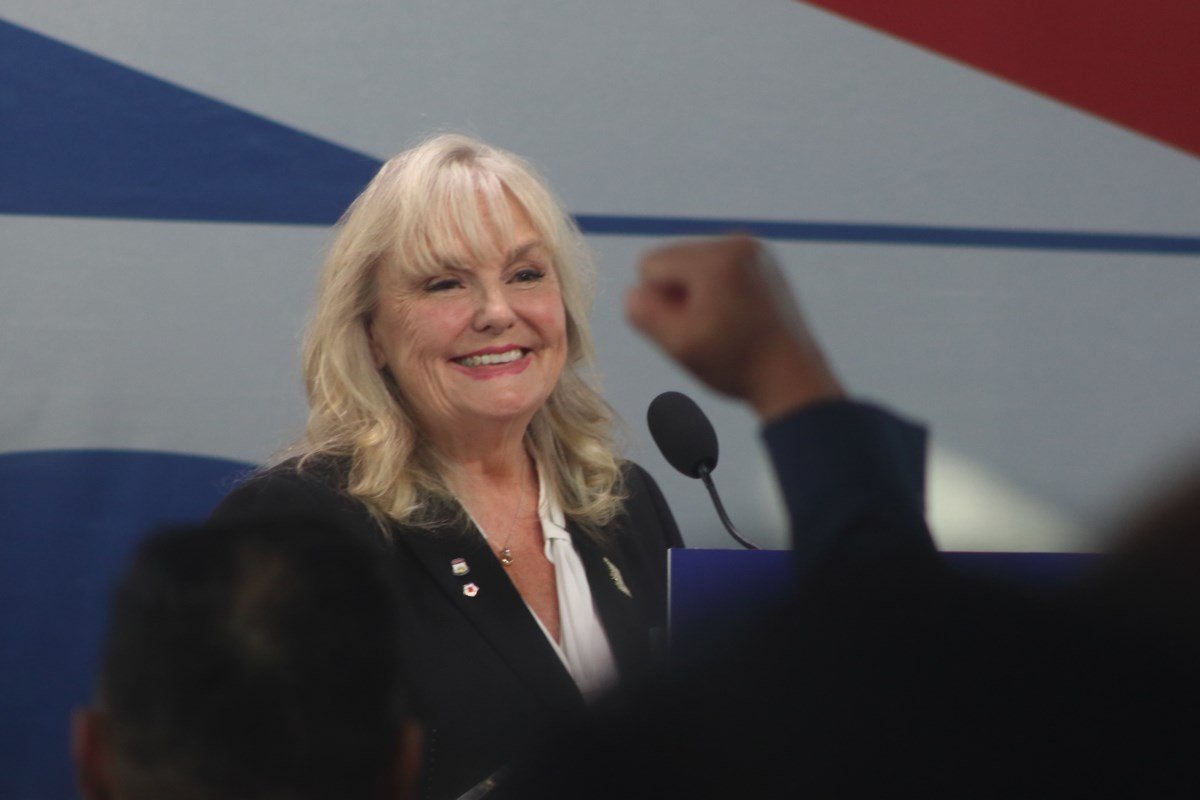

Ranked choice voting, shifting alliances and a rapidly expanding membership base offers a road map to the party’s future
“It doesn’t get any closer than this,” declared Angelo Isidorou, executive director of the BC Conservatives just before announcing the final results of the party’s leadership race.
After four rounds of ranked choice voting (RCV), former federal Minister for National Revenue Kerry-Lynne Findlay clinched the party leadership over academic Caroline Elliott. Under the party’s weighted voting system, which assigned each riding to a maximum of 100 points each—unless there were less than 100 votes cast—Findlay won with just 51 per cent of the points to Elliott’s 49 per cent. The popular vote was even closer, with only 60 votes separating Findlay from Elliott, 50.1 per cent to 49.9 per cent.
How did this race become a total free-for-all? In Round 1, Findlay led with 30 per cent of the points, while Elliott trailed with 26 per cent. Former provincial labour minister, Iain Black, took third with 20 per cent, followed by business leader Yuri Fulmer with 13 per cent and finance critic Peter Milobar with 11 per cent.
Milobar’s performance could have been worse. The former BC Liberal ended the race with nine caucus endorsements, the second most of any candidate. In ridings where he was endorsed, Milobar amassed 23 per cent of the points at stake. Most of his support came from the Interior, particularly his own riding of Kamloops Centre (61 per cent) and Kamloops-North Thompson next door (55 per cent). Milobar fared much worse elsewhere, winning 11 per cent on the Island and failing to break into double digits in the Lower Mainland (eight per cent).
The Kamloops mayor ran a campaign based on the strength of his person-to-person relationships which, while working in provincial towns where politics is “face-to-face,” drowned elsewhere amid a tidal wave of ad spending and grassroots discontent. After his elimination, fellow Black scooped up nearly half of his support (48 per cent), with Elliott taking 27 per cent. More right-wing candidates like Findlay and Fulmer lagged behind, with 16 per cent and 9 per cent respectively.
Fulmer’s fall reshapes the race
Fulmer was eliminated next. After frenzied speculation over his announcement of more than 15,000 new membership signups, the business leader bowed out in Round 2, with 3,344 votes translating into 14 per cent of the points. It was a dizzying fall for the first candidate in the race, especially coming off his peak in March with an attention-grabbing deal with OneBC leader Dallas Brodie to “Unite the Right.” In Brodie’s own riding of Vancouver-Quilchena, Fulmer failed to break double digits in Round 1. In West Vancouver-Sea to Sky, where he ran in 2024, Fulmer won 17 per cent, way behind Elliott’s 42 per cent. His best riding would be Nechako Lakes (31 per cent), where he overcame local MLA John Rustad’s endorsement of Black.
Overall, Fulmer’s campaign performed evenly across the province. He scored 14 per cent in the Interior, 11 per cent on Vancouver Island, and 13 per cent in the Lower Mainland, peaking in Surrey with 18 per cent. He had begun the race portraying himself as an outsider businessman and ended it as arguably the most Libertarian candidate. This reflected in where his support flowed to: almost half (47 per cent) went to Findlay and a third (34 per cent) went to Black, also a fellow business leader. Elliott, who Fulmer had fiercely attacked, got only 19 per cent.
Black, meanwhile, seemed to be closing in. Starting with 20 per cent in Round 1, favourable preferences from both Milobar and Fulmer boosted him to 25 per cent in Round 2 and then to 30 per cent in Round 3. Aided by veteran BC Liberal pollster Dimitri Pantazopoulos, Black almost executed Andrew Wilkinson’s 2018 strategy: let your opponents maul each other and become everyone’s least offensive second choice.
Black had concentrated regional support. While only winning 10 per cent and 13 per cent of the points in the Interior and on the Island, he outright led in the Lower Mainland during Round 1 with 27.3 per cent to Elliott’s 26.9 per cent and Findlay’s 25 per cent. His advantage was built in the suburbs. In his home turf of Burnaby and the Tri-Cities, which he used to represent in Victoria, Black reached 32 per cent south of the Fraser River, he swept Richmond with 45 per cent thanks to Richmond-Bridgeport MLA Teresa Wat’s endorsement. Further east, the endorsement of former mayor Dianne Watts kept him competitive in Surrey, with 23 per cent to Findlay’s 32 per cent.
Black’s long history as a BC Liberal earned him a breadth of endorsements among old party hands, and his time as president of the Greater Vancouver Board of Trade gave him an invaluable network regionwide. The moderate roots of his coalition showed when 30 per cent of his Round 3 voters refused to rank either Elliott or Findlay. Those who did express a preference broke for Elliott (59 per cent, to Findlay’s 41 per cent).
Why Elliott came up short
Elliott’s campaign performed well across the province. The former vice president of BC United fared the best in old BC Liberal heartlands such as North Shore and the Sea-to-Sky (48 per cent) and crossed 50 per cent in her best riding of North Vancouver-Seymour. In the Interior, she took 22 per cent and on the Island, she won 27 per cent. This may reflect how her campaign blanketed the province in digital ads, earning her at least a respectable performance everywhere, alongside where her more cerebral brand of conservatism had appeal.
Boasting big names from Ford Nation like three-time Ontario Progressive Conservative campaign manager Kory Tenycke, pollster Nick Kouvalis, and digital strategist Jeff Ballingall, Elliott entered the race as the perceived front-runner. Ironically, this may have harmed her under the RCV system, where one relies upon other candidates’ second choices to win. For Milobar’s supporters, she was too far right. For Fulmer’s supporters, she was too far left.
Findlay had no such problem. The pugilistic politician built her lead outside the Lower Mainland with 11 caucus endorsements, the most of any candidate. She scored an impressive 38 per cent on the Island and 37 per cent in the Interior, while only winning 25 per cent in the Lower Mainland in Round 1. She was weakest in the City of Vancouver (17 per cent) and West Vancouver-Sea-to-Sky (14 per cent). In the Fraser Valley, Findlay fared better with 37 per cent, powered by strong organizing from religious conservatives. She matched her province-wide performance in battleground Surrey (32 per cent), key to the Conservative breakthrough in October 2024. She also remained competitive in areas friendly to Black such as Richmond (19 per cent) and Burnaby-Tri-Cities (23 per cent).
In rural Bulkley Valley-Stikine, dotted with heavily Christian towns like Telkwa, home to resource development, and where the saga over Indigenous land title began, Findlay won 59 per cent of the points. In Vancouver-Quilchena, nestled in Vancouver’s leafy west side, home to the highest-earning professionals in the province, and where the BC New Democratic Party (NDP) gained the most ground of any riding in 2024, Findlay managed eight per cent. She built her advantage in ridings that matched the modern Conservative coalition: less educated and well-off; more populist and wary.
A new era for the BC Conservatives
Findlay’s campaign was not an overnight moonshot. As a Conservative organizer and MP who has served in both the cabinet and shadow cabinet, Findlay is familiar to the right-wing activists in B.C. Her fierce backing of the freedom convoy earned her crucial grassroots credibility that the other candidates simply could not match. Left for dead early on, Findlay caught fire in the latter half of the race and crested at the perfect time.
Findlay now helms a party fully debt-free and raring to take on the governing BC NDP. Boasting the most members of any party in the province and a higher turnout for this contest than the BC Liberals’ 2022 leadership race, her win marks the consolidation of a new right-wing coalition in B.C. There are ominous signs for the New Democrats in the data, especially on the Island where 1,400 more people voted in this leadership race than in 2022—an increase of more than 130 per cent. Fittingly, the areas with the most growth were in the South Island, just west of the urban core of the Capital Regional District.
Perhaps most symbolically of all, the ridings that saw the greatest membership growth were Langford-Highlands and Juan de Fuca-Malahat. Previously, the two were only just one riding of Langford-Juan de Fuca, where former premier John Horgan reigned supreme. It was also where Aaron Gunn, godfather of the BC Conservatives, spent his childhood in. And it was also where the BC Conservatives, long written off as also-rans, claimed second and pushed BC United into the scrap heap in a historic by-election defeat. Saturday’s victory proves that the BC Conservatives are still the party Gunn built.
Hugh Chan is a University of British Columbia student specializing in international relations and data science.