dailynewsnblog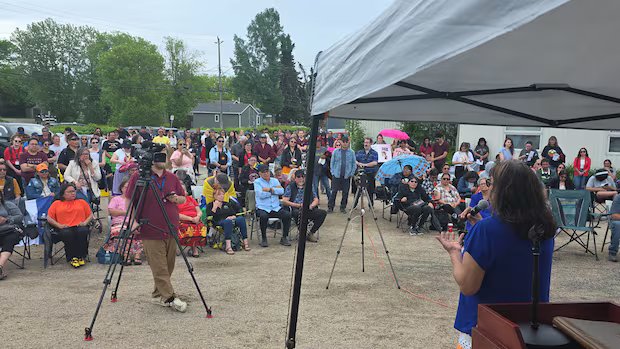
First Nation leaders and health-care providers in northwestern Ontario are demanding the federal government make urgent changes to the federal Non-Insured Health Benefits (NIHB) program.
The program provides coverage for medical transportation, accommodations and meals for those who must leave their communities for health-care services that aren’t available at home. This often means travelling hundreds of kilometres to places like Sioux Lookout, Winnipeg or Thunder Bay.
However, those who use the program say it’s broken, and that people are missing their appointments because travel isn’t being arranged in time or communicated to the recipients at the last minute.
Well over 100 people gathered outside the Indigenous Services Canada (ISC) office in Sioux Lookout, Ont., Monday, calling for a complete system overhaul.
“The system and the issue is not getting any better, despite the fact that there’s been commitments made from the government on improving the service,” said Wayne Moonias, former chief of Neskantaga First Nation, which organized the rally.
“This is not just a Neskantaga issue; it’s right across the northern First Nation communities.”

The event drew participation from several communities, including Bearskin Lake, Cat Lake, Deer Lake, Kasabonika Lake, Mishkeegogamang, Nibinamik, Poplar Hill, Wapekeka and Wunnumin Lake First Nations.
Leaders from Nishnawbe Aski Nation (NAN), Matawa First Nations, and Kiiwetinoong NDP MPP Sol Mamakwa, a member of Kingfisher Lake First Nation, also spoke.
NAN Grand Chief Alvin Fiddler said he recently met with NAN leaders to discuss the urgency of health-care improvements in the north, “and at that meeting, I described NIHB as Canada’s worst insurance company.”
“Their objective is not to keep you well or to keep you alive. Their job and their objective is to operate within the regional envelope that they get every year — that is it,” he told Monday’s crowd.
ISC ‘working diligently to improve service levels’
A spokesperson for ISC provided an emailed statement to CBC News Friday, saying the department is working to address people’s concerns.
“ISC has been working diligently to improve service levels in the Ontario Region medical transportation call centre. To improve service efficiency, we have increased staffing and training, and simplified internal processes as well as travel request documentation,” wrote ISC spokesperson Maryéva Métellus.

The federal government announced $764 million for NIHB in April for the 2026-2027 year.
“These changes aim to improve travel request processing times, reduce delays, and decrease phone wait times.
“Following feedback from clients, First Nations communities and health partners, we are taking action to continually improve. Call centre performance and service levels are continually re-assessed to support improvements to client-focused service,” Métellus wrote.
Delayed diagnoses, worse health outcomes
Dr. Anna Banerji is a pediatrician who provides regular services in Sioux Lookout. She’s also an associate professor at the University of Toronto’s faculty of medicine.
While there have been challenges with the NIHB program for years, Banerji said something has shifted in recent months whereby people are no longer able to confirm the status of their travel arrangements.

“Often you can send three or four faxes and no one responds and you don’t hear anything about your appointment — so sometimes people don’t even know that they have an appointment. The transportation is not arranged,” Banerji said.
“Sometimes what happens, someone will call them and say, ‘OK, you’ve got an appointment this afternoon, get ready and go.’
“Many people have children or elders that they have to take care of or they have a job, and they can’t just drop everything within an hour to get on a flight to go down to their appointment.”
The program needs to be fixed and as soon as possible, because anywhere else, other Canadians would absolutely not tolerate it.– Dr. Anna Banerji, pediatrician and associate professor
Missed appointments can mean delayed diagnoses, resulting in poorer health outcomes among people who don’t have access to specialists in their home communities, she said.
The problem also has a ripple effect on health-care providers.
“I was speaking to the general surgeon when I was last up there [in Sioux Lookout] last week who said that he had four pages of patients booked for scopes and only one showed up,” Banerji said. “That was because they were not being transferred out for their appointments.”
Banerji said the federal government’s recent cuts to Indigenous services have only exacerbated the issue.
“The program needs to be fixed and as soon as possible, because anywhere else, other Canadians would absolutely not tolerate it,” she said.
‘Apartheid of health care’
Dr. Joseph Dooley is chief of staff at the Sioux Lookout Meno Ya Win Health Centre and former chief of obstetrics.
He echoed Banerji’s concerns and added that when people miss their appointments, “Non-Insured Health Benefits will mark them as ‘did not show,’ and that puts kind of a black mark against them for future appointments.”

This is especially worrisome for expectant mothers; while health-care providers try to get them out of the community well in advance of their due date, this is considered an elective visit by NIHB and isn’t always given high priority, he explained.
“These are vital appointments and whether they’re going for surgical procedures, diagnostic procedures or to have their baby, it’s not acceptable that there is no ability to find out whether or not the insurance company, the travel agency that’s supposed to be covering this, is doing their job,” Dooley said. “They are not doing their job at present.”
At the rally, Fiddler said he was born at the Sioux Lookout Indian Hospital. These hospitals were racially-segregated institutions designed to serve First Nation and Inuit patients.
“Even though that old Indian Hospital is no longer there, the remnants of what it represents, the two-tiered system — some people call it apartheid of health care — is still very much alive and well today,” Fiddler said.