dailynewsnblog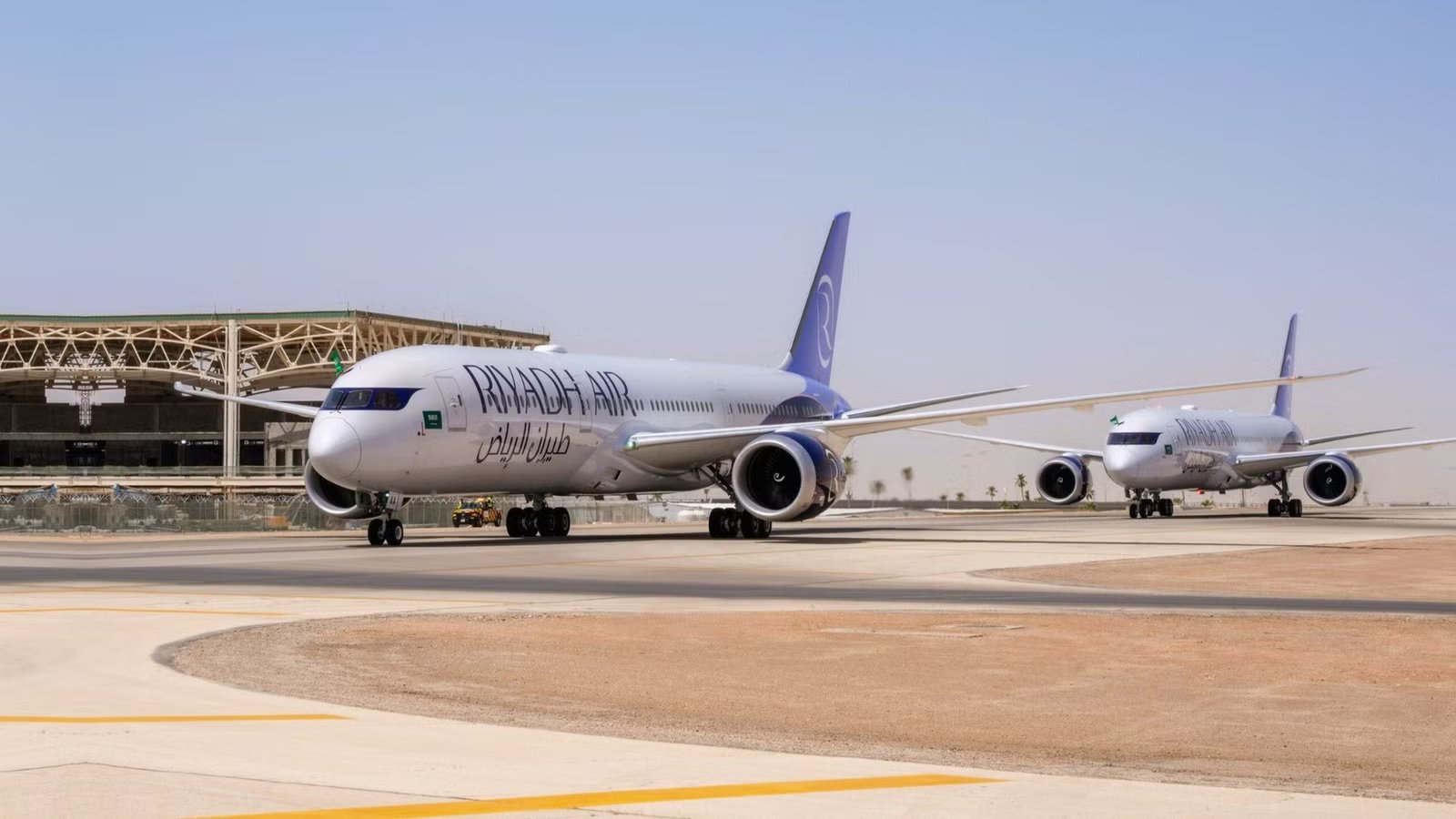
 Riyadh Air is finally moving from promise to public service. After years of aircraft orders, brand reveals, executive roadshows, and carefully managed trial operations, Saudi Arabia’s new global airline is now preparing to launch its first fully publicly scheduled route, and it’s doing so earlier than expected. Tickets are now on sale, its first custom-fitted Boeing 787-9 Dreamliners have arrived, and the airline’s long-planned network is beginning to take shape.
The first official route will be from King Khalid International Airport (RUH) in Riyadh to  London Heathrow Airport (LHR), but this is only the beginning. Five more destinations are already on sale for June and July, while CEO Tony Douglas says the airline plans to connect Riyadh with 22 destinations over the next nine months. For an airline created to help transform the Saudi capital into a global aviation hub, the next few weeks will be the first real test of whether Riyadh Air can turn its premium-brand ambitions into successful day-to-day operations.
Riyadh Air Brings London Launch Forward

Riyadh Air’s first factory-fresh Boeing 787-9s have now arrived in Saudi Arabia, clearing the way for the airline to begin operating its own aircraft on scheduled public flights. The arrival was treated as a major national aviation moment, with the first aircraft welcomed at a formal induction ceremony in Riyadh. It was more than a fleet milestone: it marked the point at which Riyadh Air can finally move beyond a carefully managed launch phase and begin selling seats to the public on its own aircraft.
That first public route will be to London Heathrow, which is now set to launch on June 10, three weeks earlier than the July 1 date previously expected for the airline’s public revenue launch. However, London is not entirely new to Riyadh Air. The carrier has been flying between Riyadh and Heathrow since October 2025, using a leased Boeing 787-9 formerly operated by  Oman Air. Those flights were part of Riyadh Air’s “Pathway to Perfect” launch program and were not made broadly available to the public, instead carrying invited groups, staff, and related travelers while the airline built operational experience.
Flight | Route | Departure | Arrival | Block Time | Frequency |
|---|---|---|---|---|---|
RX401 | Riyadh (RUH) to London Heathrow (LHR) | 02:35 AM | 07:30 AM | 6h 55m | Daily |
RX402 | London Heathrow (LHR) to Riyadh (RUH) | 09:35 AM | 06:05 PM | 6h 30m | Daily |
The London route is therefore both old and new, something that Tony Douglas noted during his speech at the induction ceremony:
“Today marks a truly exciting milestone for Riyadh Air as we introduce our new aircraft and signature premium experience on our established London route. It demonstrates our deep commitment to delivering a truly world-class journey for our guests, one that blends exceptional comfort, cutting-edge technology and our distinctive Saudi ‘Hafawa’ hospitality from the moment they step on board.”
Five More Routes Follow Within Weeks

Riyadh Air is not stopping there. The London launch will be followed within days by routes to Jeddah, Dubai, Cairo, Madrid, and Manchester, giving the new carrier a six-route public network by late July. That gives Riyadh Air a mix of domestic, regional, and European flying from the very beginning, even if the network is still small compared with the global hub the airline ultimately wants to build.
Destination | Launch Date | Initial Frequency | Notes |
|---|---|---|---|
Jeddah | June 14 | 2x daily | First domestic route |
Dubai | June 18 | Daily | Key Gulf business and leisure market |
Cairo | June 25 | Daily | Major regional traffic market |
Madrid | July 17 | 3x weekly | Restores a direct Riyadh–Madrid link |
Manchester | July 23 | 3x weekly | Riyadh Air’s second UK destination |
Jeddah Airport (JED) is arguably the most symbolically important follow-up route. It will be Riyadh Air’s first domestic service and will immediately place the new airline into one of Saudi Arabia’s busiest and most competitive air corridors. OAG ranked Riyadh–Jeddah as the world’s fifth-busiest domestic route in 2025, with 9.8 million seats, up 13% year over year and 22% above 2019 levels. It also called it out for being the fastest-growing route in the global top ten, despite only three Saudi airlines operating the sector: Saudia, Flynas, and Flyadeal.
 Madrid Barajas Airport (MAD) and Manchester Airport (MAN) are different, as neither currently has nonstop flights to Riyadh, so it gives Riyadh Air something more distinctive than another heavily contested regional trunk route. These are also the kinds of routes that can help Riyadh Air build a broader connecting proposition, linking Saudi Arabia with underserved European points while also feeding traffic onward through Riyadh as the network expands.
Boeing Delivers Riyadh Air’s 1st Pair Of 787-9 Dreamliners After Being Completed 4 Months Ago
The airline says the aircraft will become “the foundation for” its “worldwide operations.”
22 Destinations Are Planned In Nine Months

The first six routes are only the opening move. Speaking during the induction ceremony, Douglas said Riyadh Air “intends to connect Riyadh with 22 destinations within the next nine months.” That is an ambitious target for a new airline still taking delivery of its initial Dreamliners, but it also reflects the scale of the project. Riyadh Air was not created to be a small boutique airline; it was created to support Saudi Arabia’s Vision 2030 strategy, grow inbound tourism, and turn Riyadh into a global hub.
Slot filings have already given a strong indication of several additional markets that Riyadh Air is planning to fly to. Excluding the six routes already on sale, the airline’s filed network points to nine more destinations across Europe, the Middle East, South Asia, and Southeast Asia. These should be treated as planned or slot-filed routes rather than fully confirmed launches until they are placed on sale, but they show where Riyadh Air’s early network logic is heading.
Region | Destination | Airport |
|---|---|---|
Europe | Paris Charles de Gaulle | CDG |
Middle East | Amman | AMM |
South Asia | Islamabad | ISB |
South Asia | Lahore | LHE |
South Asia | Mumbai | BOM |
Southeast Asia | Bangkok Suvarnabhumi | BKK |
Southeast Asia | Jakarta | CGK |
Southeast Asia | Kuala Lumpur | KUL |
Southeast Asia | Manila | MNL |
The pattern is telling.  Paris Charles De Gaulle Airport (CDG) would add another major European capital, while Queen Alia International Airport (AMM) in Amman would deepen the regional network. Islamabad, Lahore, Mumbai, Manila, Jakarta, Kuala Lumpur, and Bangkok point to high-volume South Asian and Southeast Asian markets, many of which have large expatriate, labor, religious, and visiting-friends-and-relatives traffic flows to and through Saudi Arabia. These may not all be high-yield premium markets, but they can provide the passenger volume needed to support a developing hub.
Yet even this list does not get the airline to the full 22 destinations mentioned by Douglas, which means more routes are still to come as additional 787-9s arrive from  Boeing. For Riyadh Air, these are exciting times, but the next nine months will also be crucial to proving whether Saudi Arabia’s newest carrier can deliver on its promise of turning Riyadh into a global aviation gateway.