dailynewsnblog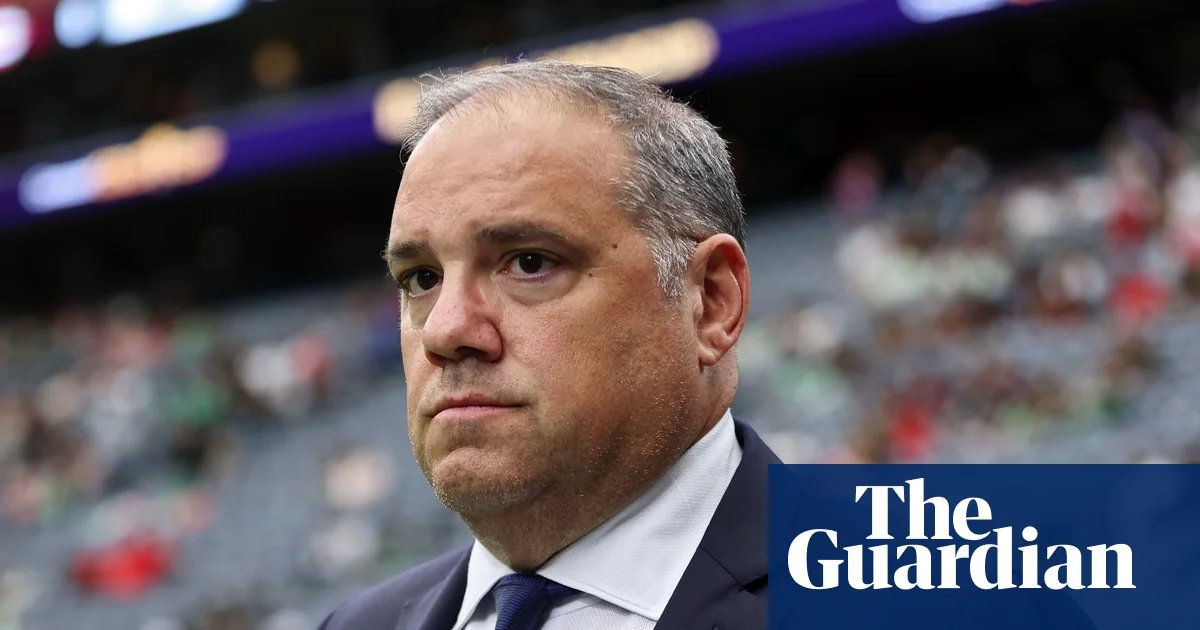
Victor Montagliani believes the World Cup will trigger a “cultural revolution” in North America that could result in Major League Soccer rivaling the Premier League at the top of club football.
In an exclusive interview with the Guardian, the president of Concacaf, who is also Fifa vice president:
-
Defended the tournament’s controversial pricing strategy on the grounds that a World Cup in North America will be the peak of Fifa’s earning power that funds global football.
-
Claimed Donald Trump will have “no part to play” at the tournament and that Fifa is “more than one guy.”
-
Insisted it is too early to begin discussing expanding the World Cup to 64 teams, something which has been requested by South American confederation Conmebol.
-
Expressed support for increasing the Club World Cup to 48 teams to raise standards and drive revenue growth.
-
Left the door open to running for the Fifa presidency in 2031, after Gianni Infantino completes a final term following his expected reelection next year.
In 2012, when he was president of the Canadian Soccer Association, Montagliani was one of the first advocates of Canada bidding to host the World Cup, and has been integral to the development of the tournament since being elected as head of Concacaf in 2016. After attending the first match of this World Cup in Mexico City between the hosts and South Africa on Thursday, the 60-year-old will fly to Toronto for Canada’s opener against Bosnia and Herzegovina the following day, something which promises to be an emotional occasion.
“It’s been a unique experience, one of the best things I’ve done in my career,” Montagliani says. “It’s in my backyard, it’s my confederation, and one of the hosts is my country. It will be special.
“If you take a snapshot of where the game was in North America when we won the bid and now, a lot of things have changed. Canada didn’t even have its own professional league eight years ago – now its clubs are selling players to European Champions League teams and competing in the Concacaf Champions Cup. Lionel Messi is established in Major League Soccer and may buy a franchise.
“Soccer has just grown and grown and then the American economy continues to grow. So those factors have come together to create this huge mega event.”
Montagliani is convinced that this growth is just the start, and that the World Cup can make football a truly North American sport for the first time.
“I think the legacy here will be the cultural revolution of the game in North America, where we no longer think of it as a global sport that we’re not part of, where it’s a European thing,” he says. “Soccer will become our sport, and we will belong in the conversation of a global sport. It will no longer be somebody else’s sport that we just want to consume. It will be ours too. I think that will be the real legacy of this World Cup.
“The potential of MLS in particular is huge, and it can grow to become the second-biggest league in the world. Maybe even the first. It might take a while, but I honestly believe that.
“Just look at the ownership group – how strong it is and how international it is. And then consider the American attitude. I’ve grown up my whole life next to the US, it’s a reality of being Canadian. And I’ve never known anything that our friends from the south do where they want to be number eight in the world, or number 10 in the world. Their attitude is we want to be the best in the world. There’s nothing stopping them trying to be the best league in the world.
“The customer experience of an MLS stadium is outstanding. The training facilities of the clubs are world-class, but ultimately what matters is the product on the pitch. All that’s missing is a few more star players, a higher salary cap, those sort of things. There’s only one Messi, but when you have a proliferation of that level of player across 30 teams the sky is the limit.”
A dominant theme of the World Cup buildup has been the sky-high ticket prices, and many games are yet to sell out, but Montagliani is bullish in defence of the pricing strategy, claiming that Fifa had a once-in-a-generation opportunity to raise revenues which are expected to reach $13bn for the tournament.
“This must be the biggest global event that’s ever taken place in terms of the size and scope,” he says. “From every metric that I’ve heard, it’s the biggest sporting event in the history of the world. And it might be a while until that’s broken. Just the scale of the thing, the hosts, and the economic realities of this side of the world.
“We’ll be back in Europe in four years’ time, which won’t be the same. It’ll be great, but it’s just a different reality of economics. I’m sure the ticket prices will be lower. Fifa is a member organisation run by the members, governed by the members, and the council and the executives have a fiduciary duty to raise revenue, 100% of which goes back into football.
“On behalf of my members, it would be great to keep growing the pot because that means that the membership will have more ability and more opportunities. But I think realistically this could be the peak, from a World Cup perspective.
“But there will be opportunities to grow revenues in other areas. For instance, the Women’s World Cup is the next frontier. Every Women’s World Cup used to lose money. Now it’s right on the edge in terms of profitability. So there’s tremendous growth in that one.
“And you know, the Club World Cup just started last year, which was a big success. There’s a lot of room for that to grow as well. But from the World Cup itself I think it will be difficult to top this one.”
As well as the high prices much of the World Cup’s growth has come from the expansion of the tournament to 48 teams, increasing the number of games from 64 to 104.
Montagliani concedes he was initially sceptical about the expansion and is opposed to a proposal from Conmebol to increase the tournament to 64 in 2030. But he is more open to expanding the Club World Cup to 48 teams.
“I’m a traditionalist who grew up with a 24- or 32-team World Cup so had some concerns, but the teams that have qualified have earned their right to be here,” he says. “So that gives me a higher comfort level that I think with 48 teams we’ll be fine.
“I think the conversation about expanding further can’t be had until we’ve had a couple of cycles of this format. We need to be a little bit more prudent. The World Cup has been 32 teams since 1998 so for us to change after one edition would not be prudent.
“The Club World Cup is different as it started at 32, and it would be interesting to study the impact of a possible expansion. I mean, if you’re a couple of the big clubs in the UK you’re going: ‘Hey, what am I doing at home watching this?’
“I can get that. I think from a club perspective, there’s a lot more quality just because you can buy players, right? So in England you’ve probably got 10 teams that easily could be playing at that level.
“I would say that 48 teams is probably doable at some point. I don’t know if it’s the next one, but I would like to see it studied. I think there’s enough quality in the world to do it for sure. And economically, that’s where the growth could possibly come from. And if you look at other confederations like ours, Asia, Africa, the reality is that our national teams will only get better when our players and our clubs are playing in higher level competition.
“It would change the dynamics as well in terms of the mindset, especially in Europe. The Champions League is probably the trophy every club wants to win, more than their domestic league. In my confederation, it used to be like that. Now our bigger clubs in MLS and the Mexican League, their [main] goal is to qualify for the Concacaf Champions Cup and then qualify for the Club World Cup. It has changed the mentality of the clubs to become way more aspirational. And that’s a good thing. Having the Club World Cup at the top of that pyramid is a great motivator.”
With the tournament days away, Montagliani insists he is unconcerned by potential political problems, despite explosive claims from the US government over the weekend that Iran was attempting to “sneak terrorists” into the country after 15 members of the team’s backroom staff were denied visas.
“President Trump will not have an impact on the tournament,” Montagliani says. “None. I mean, it’s about football, man. He’s obviously going to go to games. He’s going to enjoy himself. He’s the head of state, just like my prime minister, Mark Carney, just like the Mexican president, Claudia Sheinbaum.
“In the end all three governments have done a good job in getting Fifa what they want on most matters. Politicians are politicians, but the work done by administrations, the bureaucracy has been outstanding.
“The collaboration between the three countries, whether it’s on security or logistics, has been fantastic. And so my hat goes off to the Carney administration, the Trump administration, Sheinbaum’s government, in terms of getting the work done that is needed to pull this off.”
Montagliani has long been regarded as a potential successor to Infantino, who is certain to be reelected unopposed at next year’s Fifa Congress in Rabat, Morocco.
While Montagliani’s priority next year will be securing reelection as president of Concacaf, he does not rule out a future Fifa presidential bid, and may be helped that his terms of office mirror those of Infantino who, according to the current Fifa statutes, will have to stand down in 2031.
“That’s a long time away, first and foremost,” Montagliani says. “And my focus has always been and will continue to be on Concacaf. I have my own reelection next year as well. I want to stand for that and obviously finish that off. I’ve still got a lot of work to do here at Concacaf. The future will be the future, whatever that is.
“I think when you govern and run an organisation you’re going to get people that will criticise you, that’s just part of your job. But from a reputational standpoint Fifa has been transformed over the last 10 years. Fifa is not just one guy, or 37 people on the council. Fifa has 211 members and we work for all of them.
“One thing I’ve learned that always saves us in football, is the game itself. When I say us, I mean the football world. I don’t mean Fifa. I mean everybody. Fifa, confederations, leagues, everything. There’s one thing that saves us – football itself. When the ball rolls nothing else matters.”