dailynewsnblog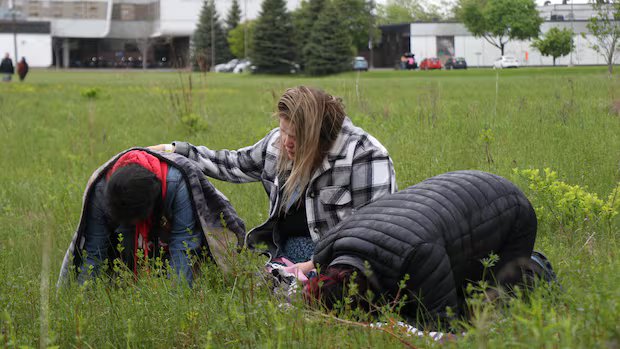

Listen to this article
Estimated 4 minutes
The audio version of this article is generated by AI-based technology. Mispronunciations can occur. We are working with our partners to continually review and improve the results.
WARNING: This story contains distressing details about the death of a child.
Viviane Echaquan-Niquay wept as she arrived at the site of a soccer field in Joliette, Que., when she was greeted by teams beginning the search for her baby sister’s remains.
“I’m happy we’ve made it here,” she said Monday, at the site about 70 kilometres north of Montreal.
Her family has been trying to find answers for over five decades — ever since Laureanna Echaquan never made it home.
On Monday, sage smoke wafted over one of the four search areas as Jean-Paul Echaquan, the uncle of Laureanna, opened a ceremony alongside his family who travelled from the Atikamekw community of Manawan.
In 1973, at just two months old, she was placed, alone, on a plane from Manawan bound for a hospital to treat pneumonia in Joliette, Que., 180 kilometres away.
Although the family was told the infant was doing well and was discharged from the hospital, the next morning, they were informed Laureanna had died.
Armand Echaquan, her father, arrived in Joliette soon after — hoping to bring his baby back to Manawan for a burial.
Instead, he was taken to see a Styrofoam coffin, containing the body of a baby he was told was his daughter.
But he said it wasn’t Laureanna. The child weighed much more than their daughter, and appeared to be over 10 months old, not a few months.

A burial happened quickly thereafter, away from the cemetery.
In the family’s search for answers in the 50 years that followed, administrative discrepancies left them with more questions.
In 2017, Laureanna’s family testified on day one of the National Inquiry into Missing and Murdered Indigenous Women and Girls·
“We’ve lived in sadness for a long time. We want this sadness to end,” said Armand, who has since passed away.
This spring, Justice Chantal Chatelain, from Quebec Superior Court, authorized the exhumation work in four sectors after the request was made by the Atikamekw family.
Areas were chosen for the work based on the accounts of Laureanna’s parents, social workers, and the work of historical human remains detection dogs.

In August 2025, a crew passed a georadar over the area they believed could hold the remains of the baby — reportedly detecting anomalies.
Jean-Paul Echaquan said Monday this search marks a part of his family’s healing.
He was about 10 years old and attending residential school when his niece Laureanna died. He says he never officially met her.
He’s here to support his nieces, the daughters of his late brother Armand Echaquan — who also fought for answers in the years that followed his daughter’s death.
It’s only the fifth exhumation authorized by Quebec’s Superior Court, according to Awacak.
The Indigenous-led organization was among those that pushed for the adoption of Quebec’s Bill 79.
Since it came into effect in 2021, the law allows Indigenous families to access the medical records of their loved ones who went missing or who died in health-care facilities in Quebec before the end of 1992.
According to a recent government report, 129 Indigenous families have started the process of searching for 221 missing children.
In 2025, Quebec Superior Court authorized the first exhumations of two Innu babies. In 2024, the court authorized the work to find the body of a Cree child who attended a Quebec residential school and died in 1966.